
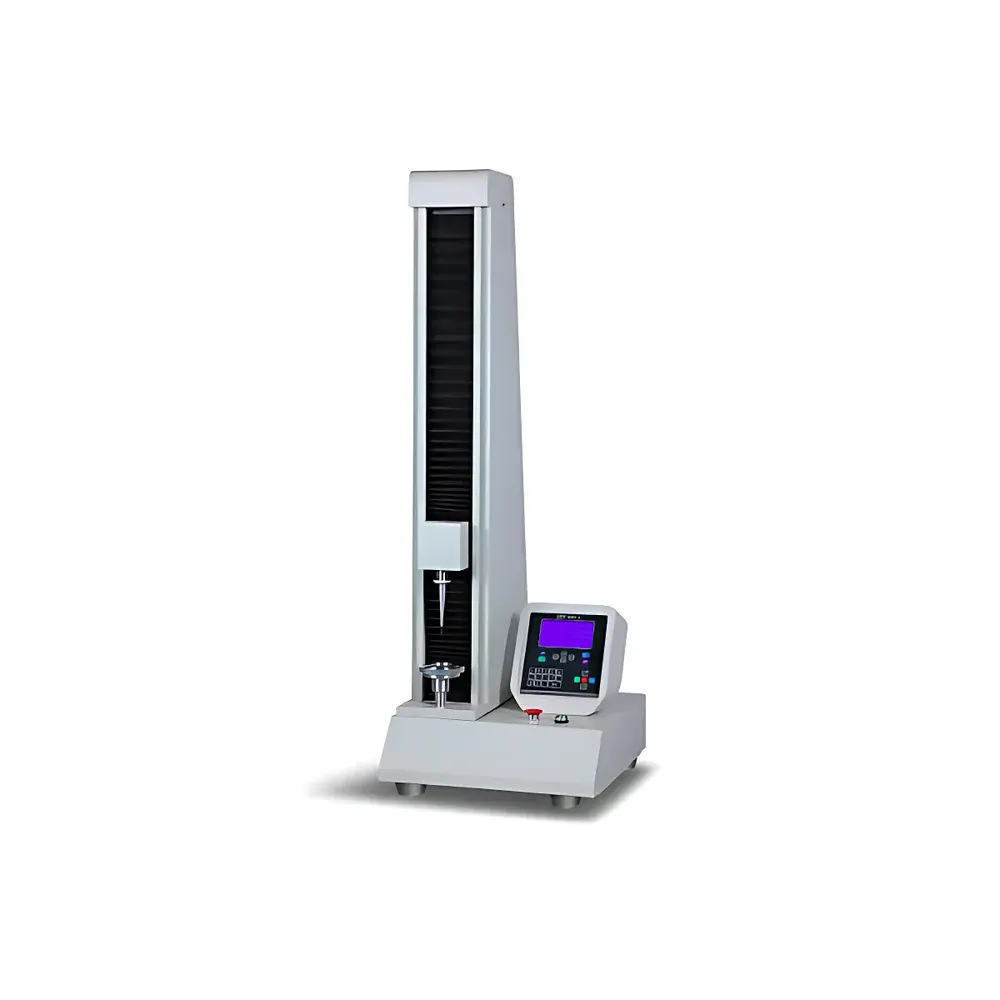
GBPI GBH-1V Single-Column Electronic Tensile Testing Machine for Food Packaging Materials
| Brand | GBPI |
|---|---|
| Origin | Guangdong, China |
| Manufacturer Type | Direct Manufacturer |
| Product Category | Domestic |
| Model | GBH-1V |
| Instrument Type | Electronic Tensile Testing Machine |
| Maximum Test Load | 1.5 kN |
| Force Range | 0–500 N (optional 0–1500 N) |
| Elongation Capacity | up to 1400% |
| Force Accuracy | ±0.5% of reading (Grade 0.5) |
| Travel Distance | 750 mm |
| Displacement Resolution | ±0.5% of reading |
| Effective Sample Width | 30 mm (customizable to 50 mm) |
| Test Speed | 0–500 mm/min, continuously variable |
| Power Supply | AC 220 V, 50 Hz |
| Power Consumption | 1000 W |
| Dimensions (W×D×H) | 600 × 600 × 1300 mm |
| Weight | 70 kg |
Overview
The GBPI GBH-1V is a single-column, microprocessor-controlled electronic tensile testing machine engineered for precision mechanical characterization of flexible packaging materials used in food, pharmaceutical, and consumer goods industries. It operates on the fundamental principle of uniaxial force application under controlled displacement rate, measuring load–deformation response in accordance with standardized quasi-static tensile, peel, tear, puncture, compression, and flexural test protocols. Designed to meet the stringent repeatability and traceability requirements of quality control laboratories and R&D facilities, the GBH-1V delivers Grade 0.5 force accuracy (±0.5% of reading) and displacement fidelity across its full 750 mm travel range—enabling reliable evaluation of modulus, yield strength, ultimate tensile strength, elongation at break, seal integrity, and interfacial adhesion properties. Its rigid dual-post tabletop architecture ensures minimal frame deflection during high-speed or high-load testing, while the imported AC servo motor and precision ground ball screw transmission system guarantee smooth loading, zero drift control, and long-term mechanical stability.
Key Features
- Modular multi-function capability: pre-configured test modes include tensile, 90°/180° peel, heat seal strength (ASTM F88), dart impact (via optional fixture), trouser tear (ASTM D1938), puncture resistance (ASTM F1306), compression, and three-point bending.
- Dual-control architecture: supports both embedded touchscreen operation and PC-based software control; optional external control unit enables standalone operation without host computer dependency.
- High-fidelity data acquisition: 100 Hz sampling rate ensures accurate capture of transient force peaks and deformation events during rapid failure modes.
- Expandable sensor interface: multiple analog input channels accommodate simultaneous use of load cells and extensometers, supporting multi-axis or multi-parameter correlation studies.
- Comprehensive safety system: integrated over-travel limit switches, overload cutoff, emergency stop button, and automatic motor shutdown upon abnormal load deviation.
- Flexible sample handling: standard 30 mm jaw width (expandable to 50 mm); optional pneumatic clamping system available for consistent grip pressure across heterogeneous substrates (e.g., laminated foils, metallized films, nonwovens).
- Energy-efficient design: optimized servo drive reduces thermal drift and extends calibration intervals without compromising dynamic response.
Sample Compatibility & Compliance
The GBH-1V is validated for testing thin-film substrates ranging from 12 µm polymer films to 3 mm rubber sheets and composite laminates. It accommodates common food packaging formats including BOPP, PET, PE, CPP, aluminum foil composites, paperboard laminates, and medical-grade Tyvek®. All hardware and firmware comply with metrological traceability requirements per JJG 139 (Chinese National Verification Regulation for Tensile Testing Machines) and mechanical testing standards including GB/T 1040 (plastics tensile), GB/T 8808 (peel strength of flexible packaging), GB/T 2792 (adhesive tape peel), ASTM D882 (thin plastic sheeting), ASTM F88 (heat seal strength), ISO 37 (vulcanized rubber), and JIS P8113 (paper tensile). The system supports audit-ready documentation per GLP and GMP environments, with optional 21 CFR Part 11-compliant software add-ons for electronic signatures, audit trails, and user access control.
Software & Data Management
The included Windows-based GBPI TestMaster software provides real-time graphical display of stress–strain curves, automatic calculation of ASTM/ISO-defined parameters (e.g., Secant Modulus, Yield Point Offset, Elongation at Break), and statistical reporting (mean, SD, CV%, min/max). Raw data export is native to CSV and Excel-compatible formats; curve overlay functionality allows comparative analysis across batches or material variants. Users may define custom test templates—including variable speed profiles, preload thresholds, and conditional stop criteria—and save them as reusable protocols. The open API architecture permits integration with LIMS platforms via RS232 or TCP/IP. Firmware updates are delivered via USB flash drive; all calibration coefficients are digitally stored and password-protected.
Applications
- Quality assurance of thermoformed trays, pouches, and shrink films in food manufacturing facilities.
- Validation of hot-melt adhesive bonds and cold-seal coatings on dairy and confectionery packaging.
- Comparative assessment of biodegradable film performance versus conventional PE or PP under accelerated aging conditions.
- Research into nanocomposite reinforcement effects on tensile modulus and puncture resistance of multilayer barrier structures.
- Educational labs conducting undergraduate materials science experiments on polymer viscoelasticity and fracture mechanics.
- Third-party certification labs performing accredited testing per YBB pharmaceutical packaging standards (e.g., YBB00112003 for blister foil strength).
FAQ
What is the maximum allowable specimen thickness for the standard mechanical grips?
Standard manual wedge grips accommodate specimens up to 3 mm thick; pneumatic clamps support up to 5 mm with uniform pressure distribution.
Can the GBH-1V perform creep or stress-relaxation tests?
Yes—when equipped with the optional digital extensometer and time-controlled hold modules, it supports ISO 899-1 creep and ISO 3387 stress-relaxation protocols.
Is calibration certification included with shipment?
A factory calibration report traceable to CNAS-accredited standards is provided; optional third-party ISO/IEC 17025 calibration with uncertainty budget is available upon request.
Does the system support automated batch testing with barcode-triggered protocol selection?
Yes—via optional USB barcode scanner integration and custom macro scripting within TestMaster software.
What maintenance intervals are recommended for long-term accuracy retention?
Biannual verification of force transducer linearity and displacement encoder resolution is advised; annual full mechanical inspection—including ball screw lubrication and belt tension check—is recommended for continuous operation environments.



