
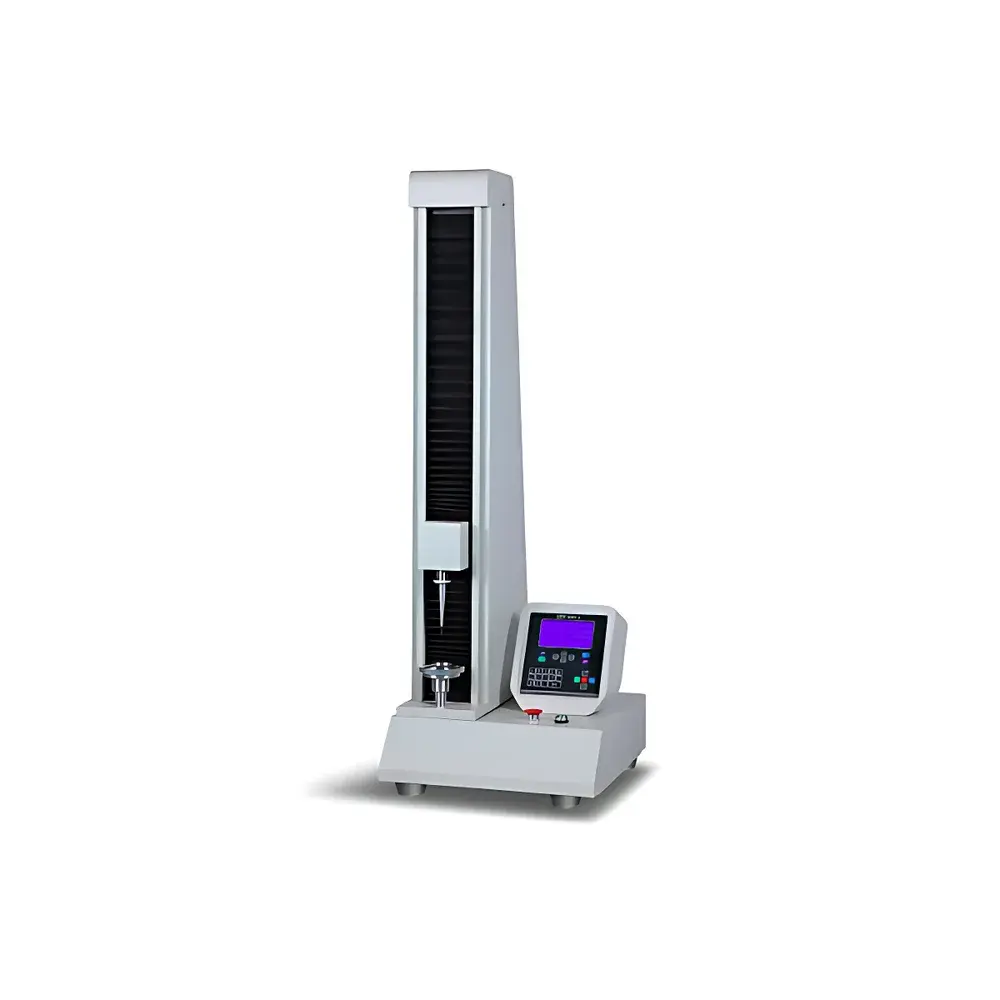
GBPI GBH-1Z1 Single-Column Electronic Tensile Testing Machine
| Brand | GBPI |
|---|---|
| Origin | Guangdong, China |
| Manufacturer Type | Direct Manufacturer |
| Country of Origin | China |
| Model | GBH-1Z1 |
| Instrument Type | Electronic Tensile Testing Machine |
| Maximum Test Load | 1.5 kN |
| Force Range | 0–500 N (optional 0–1500 N) |
| Elongation Capacity | up to 1400% |
| Force Accuracy | ±0.5% of reading (Grade 0.5) |
| Crosshead Travel | 750 mm |
| Displacement Resolution | ±0.5% of reading |
| Effective Specimen Width | 30 mm (customizable to 50 mm) |
| Test Speed Range | 0–500 mm/min, continuously variable |
| Power Supply | AC 220 V, 50 Hz |
| Power Consumption | 1000 W |
| Dimensions (W×D×H) | 600 × 600 × 1300 mm |
| Weight | 70 kg |
Overview
The GBPI GBH-1Z1 is a single-column, microprocessor-controlled electronic tensile testing machine engineered for high-reproducibility mechanical characterization of flexible packaging materials and thin-sheet polymers. It operates on the fundamental principle of uniaxial force application via a precision-driven crosshead, measuring load response and dimensional deformation in real time using calibrated load cells and high-resolution displacement transducers. Designed specifically for quality assurance laboratories in food, pharmaceutical, and packaging industries, the GBH-1Z1 complies with ISO 37, ASTM D882, ASTM F88, ASTM D1938, and over 30 Chinese national and industry standards (e.g., GB/T 1040, GB/T 8808, YBB series), ensuring regulatory alignment for routine QC/QA workflows and method validation under GLP and GMP frameworks.
Key Features
- Modular dual-mode control architecture: supports both embedded touchscreen operation and PC-based software control—enabling standalone use or network-integrated data management.
- High-fidelity force measurement system with ±0.5% full-scale accuracy (Grade 0.5), certified per JJG 139 and traceable to national metrological standards.
- Imported AC servo motor coupled with preloaded ball-screw transmission ensures smooth, backlash-free loading and long-term mechanical stability.
- Real-time sampling at 100 Hz captures transient deformation events during peel, puncture, and tear tests—critical for evaluating seal integrity and material toughness.
- Multi-function test capability: programmable protocols for tensile strength, elongation at break, peel strength (90°/180°), heat seal strength, tear resistance (Elmendorf & trouser), puncture force, compression, and bending modulus.
- Dual configuration options: built-in controller (space-efficient desktop integration) or external control unit (facilitates hardware upgrades and offline instrument operation).
- Comprehensive safety suite including mechanical limit switches, overload cutoff, emergency stop, and software-enforced parameter boundaries.
- Open data structure compliant with ASTM E4 and ISO/IEC 17025 requirements—supports raw channel export (load, displacement, time) in CSV format for third-party statistical analysis.
Sample Compatibility & Compliance
The GBH-1Z1 accommodates specimens up to 50 mm wide and 750 mm travel length, making it suitable for standard film strips (e.g., PET/PE laminates), pouch seals, adhesive tapes, nonwovens, and thin elastomeric sheets. Its 30 mm standard grip width aligns with GB/T 2792 (peel adhesion) and ASTM D3330 (pressure-sensitive tape), while optional pneumatic grips enable rapid, consistent clamping for high-throughput production line verification. All test methods are fully aligned with pharmacopeial requirements (YBB00112003, YBB00102003) and food-contact material regulations (GB 4850, GB/T 10004). Calibration documentation—including optional CNAS-accredited metrology certification—is available upon request to support FDA 21 CFR Part 11 audit readiness.
Software & Data Management
The proprietary GBPI TestMaster™ software provides ISO 17025-compliant data handling: automatic curve annotation, multi-curve overlay comparison, statistical summary (mean, SD, CV%), pass/fail thresholding, and customizable report generation. Raw data files include timestamped metadata (operator ID, environmental conditions, calibration status) and support audit trail functionality per 21 CFR Part 11 Annex 11 guidelines. Export modules allow direct Excel import (XLSX), PDF report templating, and SQL database connectivity for LIMS integration. Software updates are delivered via encrypted USB drive with version-controlled release notes and change logs.
Applications
- Food packaging: seal strength validation of retort pouches, burst pressure assessment of vacuum-sealed trays, and puncture resistance of modified-atmosphere packaging films.
- Pharmaceutical packaging: peel force evaluation of blister lidding foils (per YBB00202004), tensile modulus of child-resistant closures, and tear propagation resistance of HDPE bottles.
- Adhesive & tape manufacturing: 180° peel adhesion (ASTM D3330), loop tack, and shear holding time quantification.
- Academic research: stress-strain behavior modeling of biodegradable polymers (PLA, PHA), interfacial adhesion studies in multilayer coextrusions, and creep/recovery analysis under controlled humidity.
- Regulatory submission support: generation of validated test reports meeting ICH Q5E comparability requirements for packaging component changes.
FAQ
What standards does the GBH-1Z1 natively support?
It includes preconfigured test methods for all referenced GB, YBB, ASTM, ISO, and JIS standards listed in the technical documentation—with editable parameters to accommodate lab-specific SOP deviations.
Is the system compliant with 21 CFR Part 11 for electronic records?
Yes—when deployed with TestMaster™ v3.2+ and configured with user authentication, electronic signatures, and audit trail logging enabled, it meets ALCOA+ data integrity principles.
Can the instrument be integrated into an existing LIMS environment?
Absolutely—the RS232 interface supports ASCII command protocol; optional Ethernet module enables TCP/IP communication for HL7 or ASTM E1384 message exchange.
What maintenance intervals are recommended?
Load cell recalibration every 12 months; ball-screw lubrication every 6 months; annual mechanical inspection per GB/T 17590 maintenance schedule.
Is training provided for method development and instrument qualification?
GBPI offers on-site IQ/OQ documentation packages, UAT support, and operator certification workshops aligned with ISO/IEC 17025 clause 6.2.5 competency requirements.



