
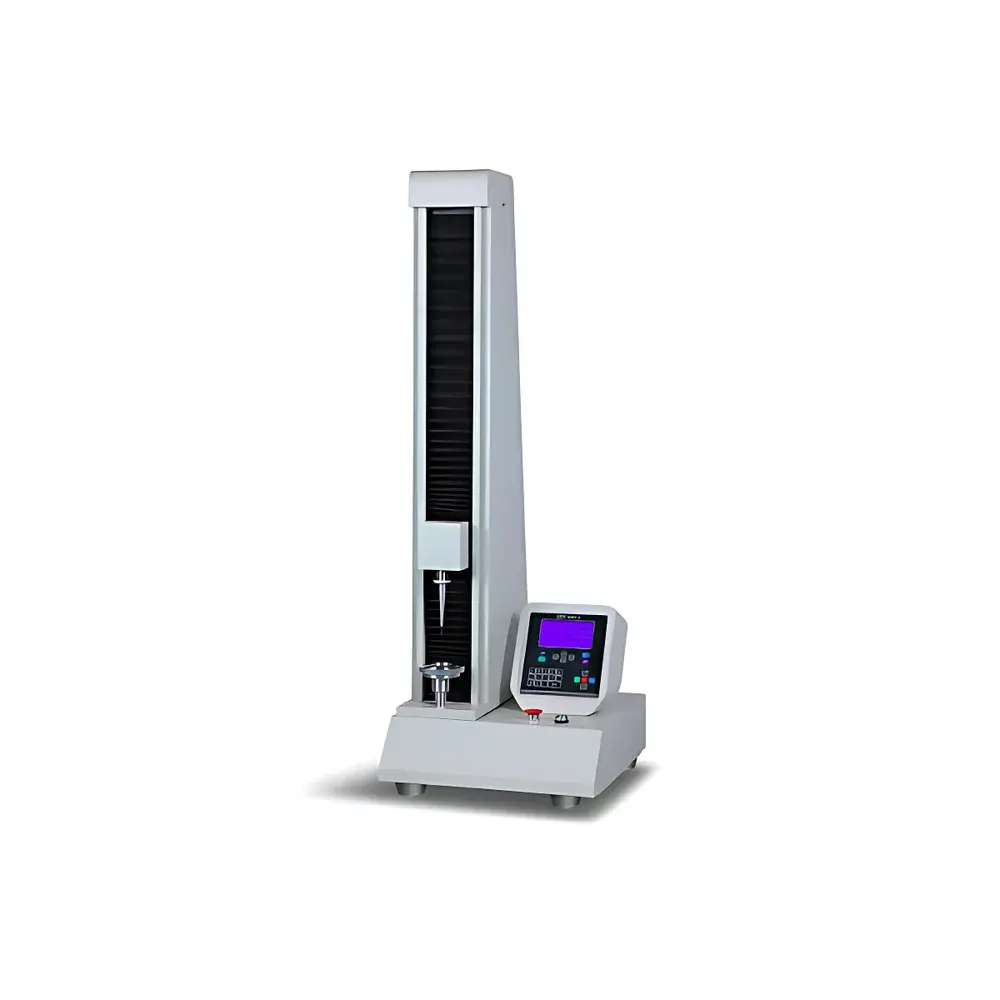
GBPI GBH-3R Single-Column Electronic Tensile Testing Machine for Disposable Mask Break Strength Testing
| Brand | GBPI |
|---|---|
| Origin | Guangdong, China |
| Manufacturer Type | Direct Manufacturer |
| Country of Origin | China |
| Model | GBH-3R |
| Instrument Type | Electronic Tensile Testing Machine |
| Maximum Test Load | 1.5 kN |
| Force Range | 0–500 N (optional 0–1500 N) |
| Elongation Capacity | up to 1400% |
| Force Accuracy | ±0.5% of reading (Class 0.5) |
| Crosshead Travel | 750 mm |
| Displacement Resolution | ±0.5% of reading |
| Effective Specimen Width | 30 mm (customizable to 50 mm) |
| Test Speed | 0–500 mm/min, continuously variable |
| Power Supply | AC 220 V, 50 Hz |
| Power Consumption | 1000 W |
| Dimensions (W×D×H) | 600 × 600 × 1300 mm |
| Weight | 70 kg |
Overview
The GBPI GBH-3R is a single-column, microprocessor-controlled electronic tensile testing machine engineered specifically for high-reproducibility mechanical characterization of disposable medical masks and other thin, flexible packaging materials. It operates on the fundamental principle of uniaxial tensile loading—applying controlled, calibrated force to a standardized specimen while precisely measuring load, displacement, and strain in real time. Designed to meet stringent regulatory expectations for quality assurance in medical device manufacturing, the GBH-3R delivers traceable, ISO/IEC 17025-compatible mechanical data essential for compliance with GB/T 32610 (Technical Specification for Disposable Protective Masks), YY/T 0969 (Single-use Medical Face Masks), and international equivalents including ASTM F2100 (Standard Specification for Performance of Materials Used in Medical Face Masks) and EN 14683 (Medical face masks — Requirements and test methods). Its dual-range load cell architecture supports both low-force mask strap integrity tests and higher-force structural rupture assessments, enabling full evaluation of mask earloop attachment strength, filter layer tensile resistance, and overall seam durability under simulated use conditions.
Key Features
- Class 0.5 force accuracy per JJG 139 and ISO 7500-1, verified across the full 0–500 N operating range (extendable to 0–1500 N with optional load cell)
- High-resolution displacement measurement with ±0.5% repeatability, enabled by precision-ground ball screws and imported AC servo motor control
- Continuous speed adjustment from 0.01 to 500 mm/min, supporting quasi-static mask elongation tests and rapid failure-mode analysis
- Dual configuration options: integrated control unit (space-efficient, desktop-ready) or external controller (facilitating standalone operation and future hardware upgrades)
- Real-time data acquisition at 100 Hz sampling rate, ensuring capture of transient peak loads during brittle fracture or viscoelastic yielding
- Modular fixture interface compatible with standard 30 mm tensile grips, puncture probes, peel blocks, and optional pneumatic clamping systems for operator-independent specimen alignment
- Comprehensive safety architecture including mechanical limit switches, software-defined overload cutoff (adjustable threshold), and emergency stop circuit compliant with IEC 61800-5-2
- Open data structure supporting direct export to CSV, Excel, or third-party statistical platforms; all raw waveform data—including load vs. displacement, stress vs. strain, and time-stamped event markers—remain fully accessible
Sample Compatibility & Compliance
The GBH-3R accommodates specimens conforming to standardized geometries defined in YY/T 0969 Annex B (mask strap tensile test), GB/T 32610 Clause 6.3 (tensile strength of mask body), and ASTM D882 (tensile properties of thin plastic sheeting). It supports flat, anisotropic, and layered structures—including nonwovens (SMS, Meltblown), elastic earloops (TPE, spandex), aluminum-laminated barriers, and hydrophobic treatment-coated fabrics. All test protocols are programmable to align with mandatory regulatory sequences: pre-load conditioning, ramp-to-failure, plateau-hold, and post-fracture elongation recovery assessment. The system meets metrological traceability requirements per CNAS-CL01 and supports audit-ready documentation for GLP/GMP environments, including electronic signature capability, 21 CFR Part 11-compliant audit trails, and calibration certificate linkage within test reports.
Software & Data Management
Control and analysis are executed via GBPI’s proprietary TensileMaster v4.2 software—validated for laboratory use under ISO 13485 and FDA QSR guidelines. The interface provides intuitive method templates for mask-specific standards (e.g., “YY/T 0969 Earloop Tensile” or “GB/T 32610 Filter Layer Rupture”), each embedding correct specimen dimensions, gauge length, preload settings, and pass/fail logic. Real-time curve overlays allow comparative analysis across batches or material lots; statistical summaries auto-generate Cp/Cpk indices for process capability reporting. Raw data files retain metadata including operator ID, environmental temperature/humidity logs (when interfaced with external sensors), instrument calibration status, and firmware revision—all embedded in XML-based report exports. Software updates are delivered via secure HTTPS channel with SHA-256 hash verification.
Applications
- Tensile strength and elongation at break of mask body material (outer/inner layers and middle filtration layer)
- Breaking force and deformation behavior of elastic earloops under static and dynamic loading
- Peel strength of ultrasonically welded seams and adhesive-bonded interfaces
- Puncture resistance of mask surface against sharp object penetration (using ASTM F1306-compliant probe)
- Creep and stress relaxation behavior of thermoplastic nonwovens at elevated humidity (when paired with environmental chamber)
- Quality conformance testing for ISO 13485-certified medical device manufacturers and contract testing laboratories
- Material qualification and supplier evaluation per ASTM D882 and ISO 527-3
FAQ
Does the GBH-3R comply with YY/T 0969 and GB/T 32610 test requirements?
Yes—the system includes pre-configured test methods aligned with the dimensional, speed, and reporting specifications of both standards, including mandatory specimen preparation protocols and acceptance criteria for earloop tensile strength (≥10 N) and mask body elongation (≥10%).
Can the system be validated for GMP-regulated environments?
Yes—full IQ/OQ/PQ documentation packages are available; the software supports 21 CFR Part 11 user access controls, electronic signatures, and immutable audit trails for all test executions and parameter modifications.
Is calibration traceable to national standards?
All load cells are factory-calibrated against NIM (National Institute of Metrology, China)-certified deadweight standards, with certificates issued per ISO/IEC 17025 and accompanied by uncertainty budgets.
What maintenance intervals are recommended?
Ball screw lubrication every 6 months; annual verification of force transducer linearity and displacement encoder resolution; biannual inspection of grip jaw serration integrity and pneumatic system seals (if equipped).



