
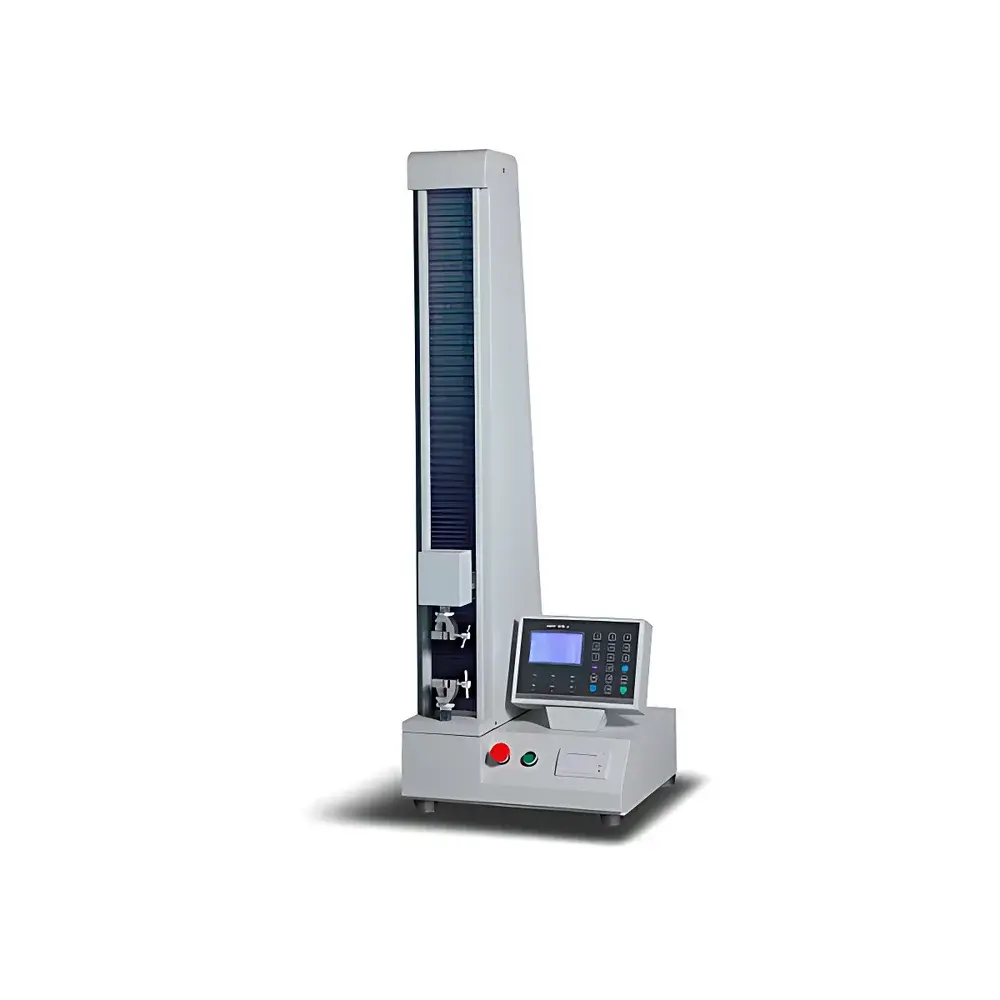
GBPI GBL-H3 Single-Column Electronic Tensile & Puncture Tester
| Brand | GBPI |
|---|---|
| Origin | Guangdong, China |
| Manufacturer Type | Direct Manufacturer |
| Product Category | Domestic |
| Model | GBL-H3 |
| Price Range | USD 2,800–7,000 (FOB) |
| Instrument Type | Electromechanical Tensile Testing Machine |
| Maximum Test Load | 0.5 kN |
| Force Range | 0–300 N (optional 0–500 N), Elongation Capacity: up to 1400% |
| Force Accuracy | ±1% of reading (Class 1 per ISO 7500-1 / ASTM E4) |
| Travel Distance | 700 mm |
| Displacement Resolution | ±1% of reading |
| Test Speed | 0–500 mm/min, infinitely variable |
| Effective Specimen Width | 30 mm (customizable to 50 mm) |
| Sampling Rate | 50 Hz |
| Safety Protection | Triple-stage mechanical/electrical/emergency-stop safeguard |
| Dimensions (W×D×H) | 600 × 500 × 1300 mm |
| Weight | 65 kg |
| Power Supply | AC 220 V, 50 Hz |
| Rated Power | 300 W |
Overview
The GBPI GBL-H3 Single-Column Electronic Tensile & Puncture Tester is a precision-engineered electromechanical testing system designed for routine and regulatory-compliant mechanical property evaluation of flexible packaging materials and thin-sheet polymers. Operating on the principle of controlled uniaxial force application with high-fidelity load cell feedback and closed-loop displacement control, the instrument delivers repeatable tensile, peel, seal strength, tear, and puncture measurements in accordance with internationally harmonized test methodologies. Its modular architecture supports standardized specimen geometry and fixture configurations required by pharmacopeial, food-contact, and industrial packaging regulations—making it suitable for laboratories operating under GLP, ISO/IEC 17025, or FDA-aligned quality systems.
Key Features
- Multi-function capability: Simultaneously configured for tensile strength, elongation at break, 90°/180° peel, heat seal strength (ASTM F88), dart impact (via optional drop-weight module), and needle puncture resistance (ASTM F1306/F2825).
- High-resolution force transduction: Dual-range load cell (0–300 N standard; 0–500 N optional) calibrated to ISO 7500-1 Class 1 accuracy (±1% of reading), traceable to national metrological standards.
- Precision motion control: Stepper-motor-driven crosshead with 0–500 mm/min infinitely variable speed and real-time position feedback; travel resolution maintained within ±1% of full scale over 700 mm stroke.
- Human-centered interface: Backlit LCD display showing real-time load-displacement curves, peak values, and statistical summaries; integrated thermal printer for immediate report generation with timestamp, operator ID, and test parameters.
- Robust mechanical design: Rigid single-column frame with reinforced aluminum alloy uprights and precision-ground guide rails; emergency stop button compliant with IEC 60204-1 safety directives.
- Data integrity assurance: 50 Hz sampling rate ensures accurate capture of transient mechanical events—including yield points, necking onset, and seal failure modes—critical for root-cause analysis in packaging defect investigations.
Sample Compatibility & Compliance
The GBL-H3 accommodates specimens up to 50 mm wide and 1400% elongation capacity—enabling reliable characterization of highly extensible films (e.g., LDPE, TPU, elastomeric laminates) and low-modulus substrates (e.g., tissue-grade nonwovens, hydrocolloid dressings). Fixture interchangeability supports standardized grips per ASTM D882 (thin plastics), ASTM D1938 (tear propagation), ASTM F904 (adhesive peel), and YBB pharmaceutical packaging monographs. The system conforms to over 30 referenced standards including GB/T 1040.3, ISO 527-3, ASTM E4 (load verification), JJG 139 (national verification regulation), and USP Annex 3 (container closure integrity testing support protocols). All test methods are preloaded into firmware with editable parameter templates to ensure method reproducibility across shifts and sites.
Software & Data Management
While the GBL-H3 operates as a standalone instrument with embedded firmware, optional PC-based software (GBPI TestMaster v3.x) enables advanced data management: automated pass/fail evaluation against user-defined limits, multi-curve overlay comparison, export to CSV/PDF/XLSX formats, and audit-trail logging compliant with FDA 21 CFR Part 11 requirements (electronic signatures, change history, access controls). Raw force-displacement datasets retain full temporal resolution for post-test reanalysis—including derivative calculations (modulus, toughness, energy-to-break) and Weibull distribution modeling for seal reliability assessment.
Applications
- Quality control of pharmaceutical blister lidding foils, pouch seals, and sterile barrier systems (per ISO 11607-2 and YBB compendial requirements).
- Validation of adhesive bond integrity in medical device packaging assemblies (e.g., Tyvek®/PET-laminated trays).
- Mechanical benchmarking of compostable films (PLA, PHA) against conventional PE or PP references under accelerated aging conditions.
- Regulatory submission support for FDA 510(k) dossiers requiring mechanical performance data on drug delivery patches and transdermal films.
- R&D screening of nano-reinforced polymer blends where dispersion homogeneity affects tensile anisotropy and tear initiation thresholds.
FAQ
Does the GBL-H3 meet ISO/IEC 17025 calibration requirements for accredited labs?
Yes—the base system includes factory calibration certificates traceable to CNAS-accredited reference standards; users may perform intermediate verifications using certified reference load cells and displacement gauges per ISO/IEC 17025 Clause 6.6.
Can test data be exported directly to LIMS platforms?
Via optional TestMaster software with configurable ODBC drivers and HL7-compatible metadata tagging for seamless integration with laboratory information management systems.
Is thermal sealing functionality built-in or requires external equipment?
The GBL-H3 does not include integrated heating elements; however, it accepts third-party pneumatic or servo-controlled heat seal testers (e.g., GBPI HST series) via digital I/O handshake for synchronized seal-and-test workflows.
What maintenance intervals are recommended for long-term accuracy retention?
Biannual load cell verification and annual mechanical inspection (guide rail lubrication, belt tension check, encoder alignment) are advised; GBPI provides certified service technicians and spare parts kits with documented maintenance logs.
Are custom fixtures available for non-standard specimen geometries?
Yes—GBPI offers engineering consultation and CNC-machined fixtures for specialized applications such as ring tensile (ISO 1421), trouser tear (ISO 9073-4), or micro-puncture of hydrogel membranes.



