
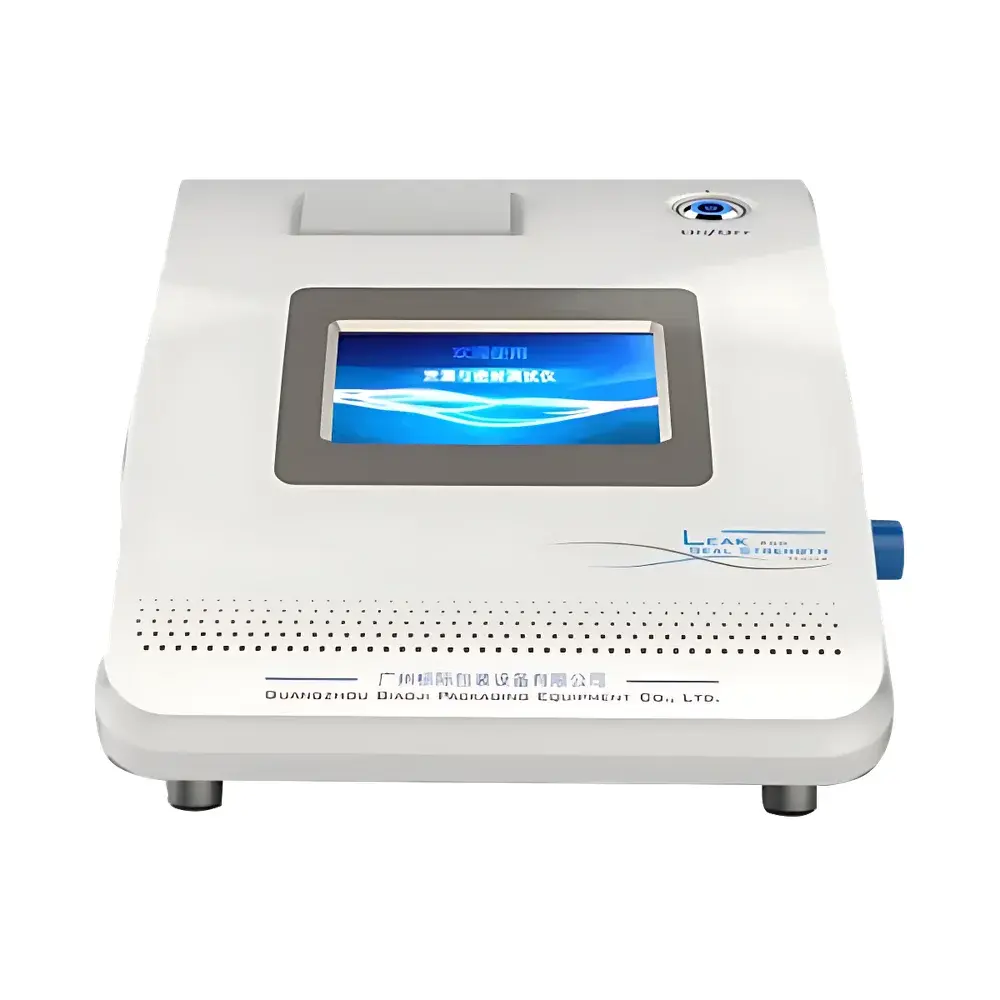
GBPI GBM-D1A Intelligent Seal Integrity and Burst Strength Tester
| Brand | GBPI (Guangzhou Biaoji) |
|---|---|
| Origin | Guangdong, China |
| Manufacturer Type | Direct Manufacturer |
| Model | GBM-D1A |
| Compliance | ASTM F1140, F2054, F2095, F2096 |
| Test Volume Range | 0–90,000 mL |
| Pressure Range | 1–1000 kPa |
| Pressure Resolution | 0.1 kPa |
| Pressure Accuracy | ±0.5% FS |
| Test Duration | 1–1000 s |
| Dimensions (L×W×H) | 400 × 415 × 272 mm |
| Weight | ≤5 kg |
| Operating Temperature | +2°C to +25°C |
| Storage Temperature | −20°C to +60°C |
| Relative Humidity (non-condensing) | 10–90% RH (2–25°C), 10–70% RH (25–30°C), 10–50% RH (30–35°C) |
| Ambient Pressure | 90.0–105.0 kPa |
| Power Supply | 100–240 VAC, 47–63 Hz |
| Max Power Consumption | 140 W |
| Input Gas Pressure | 50–1000 kPa |
| Gas Flow Control | Main line (auto, 0–10 L/min), Bypass (manual, 0–100 L/min) |
| Interface | 1 × USB 2.0 Type-A |
Overview
The GBPI GBM-D1A Intelligent Seal Integrity and Burst Strength Tester is a precision-engineered, multi-mode pressure-based testing platform designed for quantitative evaluation of seal integrity, burst resistance, and leak performance in flexible and semi-rigid packaging systems. It operates on the principle of controlled pneumatic pressurization—applying calibrated internal pressure to sealed packages until failure occurs or predefined test conditions are met. Unlike destructive tensile or peel-based methods, this instrument delivers objective, repeatable metrics rooted in physical pressure–time–response relationships, making it especially suitable for regulatory-grade validation in sterile barrier systems and shelf-life critical applications.
Key Features
- Multi-standard compliance with fully configurable test protocols: burst (ASTM F1140/F2054/YY/T 0681.3/.9), pressure decay leakage (ASTM F2095/ISO 11607-1), creep-to-failure (ASTM F1140/YY/T 0681.3), and submerged bubble emission (ASTM F2096/YY/T 0681.5).
- Wide volumetric capacity up to 90,000 mL—enabling assessment of large-format pouches, medical device trays, and industrial bulk packaging without sample subdivision.
- High-resolution pressure control (0.1 kPa resolution, ±0.5% FS accuracy) with programmable ramp rates, dwell times, and real-time pressure hold stability monitoring.
- Dual gas flow architecture: automated main-line regulation (0–10 L/min) for precise pressurization and manual bypass (0–100 L/min) for rapid purge or water-submersion pre-conditioning.
- Modular test head options—including needle-penetration and handheld probe configurations—to accommodate diverse closure geometries (e.g., foil seals, heat-sealed edges, crimped caps, luer-lock interfaces).
- Integrated USB 2.0 interface supporting direct data export, firmware updates, and optional barcode scanner or thermal label printer integration for GLP-aligned sample traceability.
Sample Compatibility & Compliance
The GBM-D1A accommodates a broad spectrum of packaging substrates including laminated aluminum foils, co-extruded polymeric films, Tyvek®-based sterile wraps, thermoformed trays, and rigid-plastic containers with flexible seals. Its mechanical design and pressure calibration protocol align with internationally recognized standards governing medical device packaging validation (ISO 11607-1:2019, YY/T 0681 series), pharmaceutical container integrity (USP principles), and food packaging safety (GB/T 17876). While not inherently 21 CFR Part 11 compliant out-of-the-box, its data logging architecture supports audit-ready configuration when deployed with validated third-party software and procedural controls per GMP/GLP requirements.
Software & Data Management
The instrument’s embedded firmware enables full test parameter definition—including target pressure, ramp slope, hold duration, pass/fail thresholds, and failure mode classification (burst vs. leak vs. creep rupture). All test records include timestamped pressure–time curves, annotated failure locations (where visually detectable), and metadata such as operator ID, sample ID, environmental conditions, and calibration status. Raw data exports in CSV format facilitate post-processing in statistical analysis tools (e.g., Minitab, JMP) or integration into LIMS environments. Optional reporting templates support generation of summary certificates aligned with internal SOPs or external audit requests.
Applications
- Sterile Medical Device Packaging: Validation of seal strength and gross leak detection in ISO 11607-compliant pouches, peel-open trays, and barrier envelopes.
- Pharmaceutical Unit-Dose Blister Packs: Assessment of cavity seal integrity under simulated distribution stresses and accelerated aging conditions.
- Food & Beverage Flexible Packaging: Evaluation of retort pouch integrity, modified atmosphere packaging (MAP) seal robustness, and shelf-life prediction via creep endurance profiling.
- Consumer Health Products: Testing of moisture-barrier sachets (e.g., masks, supplements), child-resistant closures, and tamper-evident seals.
- Quality Assurance Labs: Routine incoming inspection of packaging materials, process capability studies (Cpk/Ppk), and root cause analysis of field failures.
FAQ
Does the GBM-D1A meet FDA or EU MDR requirements for medical device packaging validation?
Yes—when operated within its validated range and supported by documented IQ/OQ/PQ protocols, it fulfills the functional requirements of ISO 11607-1:2019 and YY/T 0681 series, which are referenced in both FDA guidance documents and EU MDR Annex I essential requirements.
Can the system perform non-destructive leak testing?
No—the GBM-D1A is a destructive pressure-based tester. For non-destructive alternatives (e.g., helium mass spectrometry or vacuum decay), complementary instrumentation is recommended.
Is calibration traceable to national standards?
Yes—pressure transducers are factory-calibrated against NIST-traceable references; users receive a calibration certificate with each unit and may schedule periodic recalibration through GBPI-authorized service centers.
What maintenance is required for long-term reliability?
Routine verification of gas path integrity, O-ring replacement every 12 months (or after 500 cycles), and annual sensor recalibration are recommended. No consumables beyond standard compressed air or nitrogen supply are required.
Can test methods be locked to prevent unauthorized modification?
User-level access control supports password-protected method editing; administrator privileges are required to alter core calibration parameters or firmware settings—supporting basic change control governance.






