
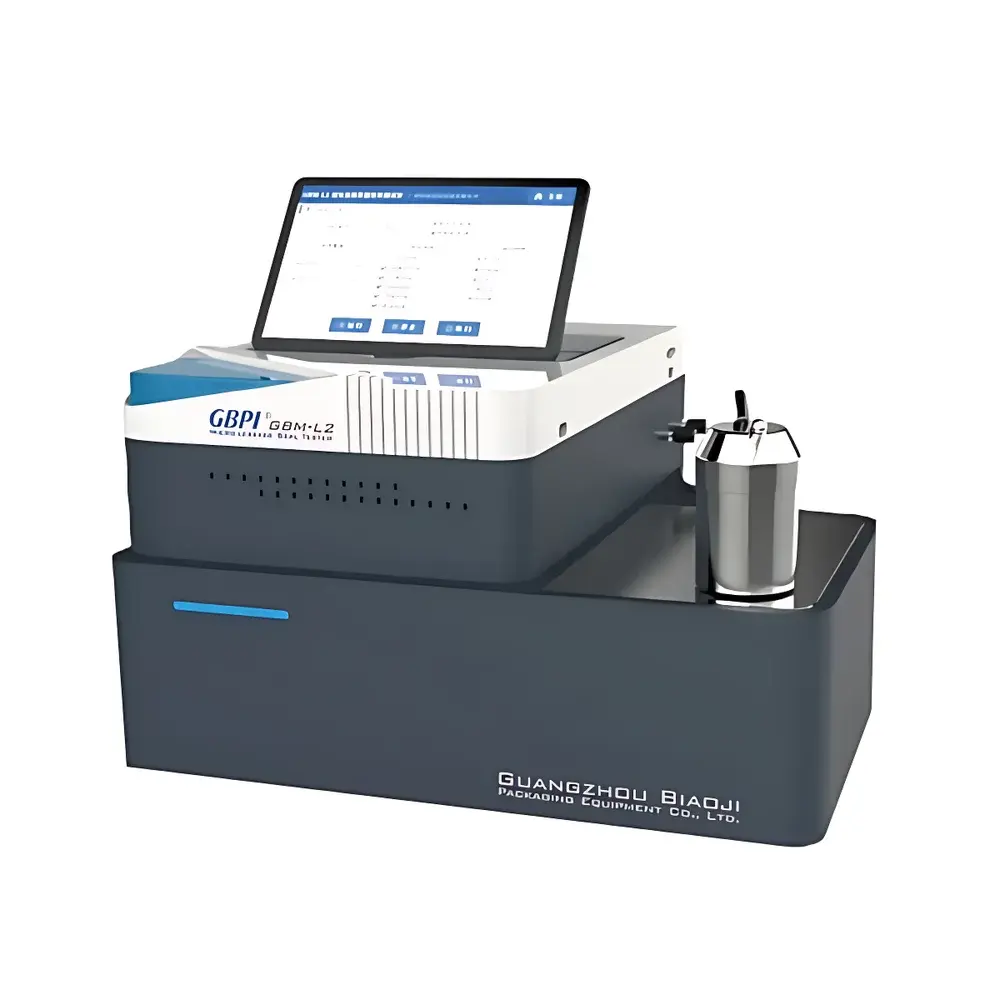
GBPI GBM-L2C Vacuum Decay & Pressure Decay Micro-Leak Tester for Infusion Bottles
| Brand | GBPI (Guangzhou Biaoji) |
|---|---|
| Origin | Guangdong, China |
| Manufacturer Type | OEM/ODM Manufacturer |
| Region Classification | Domestic (China) |
| Model | GBM-L2C |
| Price | USD 42,000 (approx.) |
| Absolute Pressure Range | 0–300 kPa |
| Differential Pressure Range | −2 to +2 kPa |
| Detection Sensitivity | 1–3 µm |
| Equilibration/Test Time | 1–3600 s |
| Vacuum Purge Time | 1–3600 s |
| Set Flow Rate | 0–3 mL/min |
| Sensor Configuration | Dual-sensor (absolute + differential pressure), dual-loop system |
| Accuracy | ±0.1% FS |
| Vacuum Pump | Imported, 3 L/s pumping speed, ≤50 dB(A), high ultimate vacuum |
| Mass Flow Controller | UK-sourced, resolution 0.001 mL/min |
| Control Interface | 11″ color capacitive touchscreen |
| Compliance | ASTM F2338-09(2013), YY/T 0681.18–2020, USP <1207.2>, ASTM F2095 |
| GMP Alignment | Audit trail, multi-level user permissions, 21 CFR Part 11–ready data integrity architecture |
Overview
The GBPI GBM-L2C Vacuum Decay & Pressure Decay Micro-Leak Tester is an engineered solution for deterministic, non-destructive container closure integrity testing (CCIT) of rigid and semi-rigid pharmaceutical primary packaging. It operates on two complementary physical principles—vacuum decay and pressure decay—enabling robust detection of micro-leaks ranging from 1 to 3 µm equivalent hole diameter. Unlike single-mode systems, the GBM-L2C employs a dual-sensor architecture (high-stability absolute and differential pressure transducers) within a dual-loop pneumatic circuit, allowing it to distinguish true leakage events from transient thermal or volumetric artifacts—particularly critical when evaluating lyophilized vials under residual vacuum. The instrument conforms to internationally recognized CCIT standards including ASTM F2338-09(2013), USP , YY/T 0681.18–2020, and ASTM F2095, supporting method validation, regulatory submission, and routine QC release testing in GMP environments.
Key Features
- Dual-mode operation: Simultaneous or sequential vacuum decay and pressure decay testing—eliminating false-negative results common in vacuum-only assessment of evacuated lyo vials.
- High-fidelity sensing: Dual-pressure measurement system with ±0.1% full-scale accuracy enables quantitative leak rate calculation and empirical correlation to equivalent leak orifice size.
- Validated sensitivity: Capable of detecting leaks as small as 1 µm in rigid containers (e.g., glass vials, HDPE bottles, infusion bags) with repeatability ≤0.8% RSD across repeated measurements.
- Imported critical components: High-efficiency vacuum pump (3 L/s, ≤50 dB(A), oil-level indicator for maintenance); precision mass flow controller (UK-sourced, 0.001 mL/min resolution) for synthetic leak generation during method qualification.
- GMP-compliant human-machine interface: 11-inch industrial-grade capacitive touchscreen with role-based access control, electronic signatures, and full audit trail per FDA 21 CFR Part 11 and EU Annex 11 requirements.
- Modular test chamber design: Fully customizable cavity geometry—including nested fixtures—to accommodate heterogeneous sample sets (e.g., multiple vial sizes, pre-filled syringes, ampoules, and IV bags) without hardware reconfiguration.
Sample Compatibility & Compliance
The GBM-L2C supports CCIT for a broad spectrum of sterile dosage forms and packaging formats: lyophilized and liquid-filled vials (including West-style closures), glass and polymer ampoules, pre-filled syringes, ophthalmic dropper bottles, HDPE containers, and flexible infusion bags. Its dual-mode architecture ensures reliable performance across varying headspace conditions—whether under vacuum, ambient pressure, or positive overpressure. All test methods are aligned with current regulatory expectations for deterministic CCIT, including ICH Q5C stability linkage, USP risk-based approach, and EMA reflection paper on alternative CCIT. System qualification documentation (IQ/OQ/PQ protocols) and standard operating procedures (SOPs) are provided to support GLP/GMP audits and regulatory inspections.
Software & Data Management
The embedded software platform complies with GAMP5 classification for Category 4 systems. It provides real-time graphical visualization of pressure decay curves, automatic pass/fail decision logic based on user-defined thresholds, and exportable CSV/Excel reports with full metadata (operator ID, timestamp, chamber ID, environmental logs). Audit trail records all critical actions—including parameter edits, result overrides, and user logins—with immutable timestamps and digital signature verification. Data storage adheres to ALCOA+ principles (Attributable, Legible, Contemporaneous, Original, Accurate, Complete, Consistent, Enduring, Available), ensuring traceability throughout product lifecycle and facilitating FDA or EMA inspection readiness.
Applications
- Final container release testing of injectables per USP and Ph. Eur. 5.1.10.
- Stability study monitoring for container-closure system integrity at accelerated and long-term conditions.
- Process validation support for stopper seating, crimping, and sealing operations.
- Root cause analysis of sterility failures via comparative leak mapping across production batches.
- Method suitability studies for novel packaging formats (e.g., polymer-based IV containers, silicone-coated syringes).
- Supplier qualification of closures, elastomers, and blow-fill-seal assemblies.
FAQ
What is the difference between vacuum decay and pressure decay modes?
Vacuum decay applies sub-atmospheric pressure to the test chamber, drawing internal headspace gas through a leak; pressure decay pressurizes the chamber to force external gas into the container. The GBM-L2C uses both to resolve ambiguity in evacuated systems.
Can the GBM-L2C be used for flexible packaging like IV bags?
Yes—custom chamber designs with compliant sealing gaskets and volume compensation algorithms ensure stable baseline pressure acquisition for non-rigid formats.
Does the system support 21 CFR Part 11 compliance?
Yes—full electronic signature capability, audit trail, and role-based permission management are natively implemented and validated.
How is method sensitivity verified?
Using the integrated UK-sourced mass flow controller to generate calibrated synthetic leaks (0.001–3 mL/min), enabling correlation between measured pressure decay rate and equivalent orifice size per ASTM F2338 Annex A3.
Is IQ/OQ/PQ documentation included?
Yes—comprehensive qualification packages, including test scripts, acceptance criteria, and deviation handling procedures, are supplied with each unit.





