
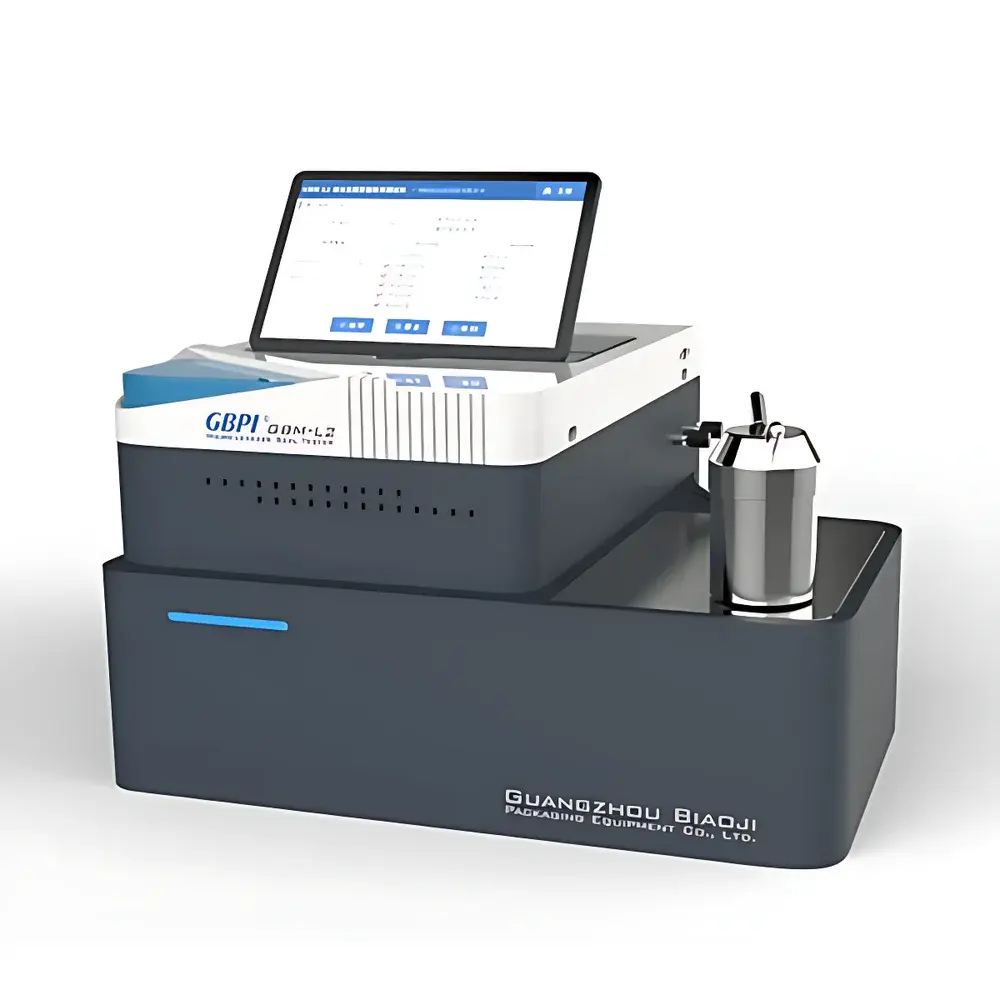
GBPI GBM-L2T Vacuum Decay / Pressure Decay Leak Tester
| Brand | GBPI |
|---|---|
| Origin | Guangdong, China |
| Manufacturer Type | Manufacturer |
| Model | GBM-L2T |
| Key Specifications | Absolute Pressure Range: 0–300 kPa |
| Differential Pressure Range | −2 to +2 kPa |
| Detection Sensitivity | 1–3 µm |
| Equilibration/Test Time | 1–3600 s |
| Vacuum Purge Time | 1–3600 s |
| Set Flow Rate | 0–3 mL/min |
| Sensor Configuration | Dual-sensor (absolute + differential pressure) |
| Test Chamber | Custom-engineered per sample geometry |
| Compliance Standards | ASTM F2338-2009(2013), YY/T 0681.18-2020, USP <1207.2>, ASTM F2095 |
Overview
The GBPI GBM-L2T Vacuum Decay / Pressure Decay Leak Tester is an engineered solution for deterministic, non-destructive micro-leak detection in sterile and hermetically sealed primary packaging. It operates on two complementary physical principles—vacuum decay testing (VDT) and pressure decay testing (PDT)—to address the limitations inherent in single-mode methods, particularly for packages containing internal vacuum (e.g., lyophilized vials) or headspace-sensitive formulations. In VDT mode, the test chamber is evacuated to establish a controlled pressure differential across the package wall; any ingress of gas or vapor through a leak path causes measurable pressure rise in the chamber, monitored via high-stability absolute and differential pressure transducers. In PDT mode, the chamber is pressurized to a defined setpoint, and leakage is inferred from pressure decay resulting from gas egress into the package interior. This dual-method architecture enables robust discrimination between true leaks and false negatives arising from outgassing, moisture condensation, or thermal drift—critical for regulatory-grade quality control in GMP environments.
Key Features
- Dual-sensor architecture integrating high-accuracy absolute pressure sensors (0–300 kPa, ±0.1% FS) and differential pressure sensors (±2 kPa, ±0.1% FS) for simultaneous cavity pressure monitoring and dynamic baseline compensation.
- Configurable dual-cycle methodology: independent optimization of vacuum purge time (1–3600 s), equilibration duration (1–3600 s), and test phase timing ensures method robustness across diverse container closure systems.
- Calibrated gas flow simulation using a UK-sourced mass flow controller (range: 0–3 mL/min, resolution: 0.001 mL/min), enabling traceable sensitivity verification against NIST-traceable leak standards.
- Low-noise, high-efficiency vacuum system featuring a European-imported dry scroll pump (pumping speed: 3 L/s, ultimate vacuum: ≤5 Pa, acoustic noise: ≤50 dB(A)), with integrated oil-level monitoring and maintenance alerts.
- 11-inch industrial-grade capacitive touchscreen HMI with intuitive workflow navigation, real-time pressure curve visualization, and on-screen pass/fail decision logic based on user-defined thresholds.
Sample Compatibility & Compliance
The GBM-L2T supports validation-compliant testing of rigid and semi-rigid pharmaceutical primary containers, including but not limited to: glass and polymer-based vials (lyophilized and liquid-filled), ampoules, pre-filled syringes, ophthalmic dropper bottles, HDPE bottles, IV bags, and flexible pouches. All test chambers are custom-fabricated using FDA-compliant 316L stainless steel or electropolished aluminum, with O-ring-sealed lid mechanisms and rapid-change modular inserts to accommodate varying geometries. The system conforms to critical industry standards: ASTM F2338-2009(2013) for vacuum decay testing of intact packages; YY/T 0681.18-2020 (Chinese national standard for sterile package integrity); USP “Package Integrity Evaluation – Sterile Products”; and ASTM F2095 for pressure decay testing of flexible packaging. Its design aligns with Annex 11 (Computerised Systems) and EU GMP Annex 11 requirements, supporting 21 CFR Part 11-compliant audit trails.
Software & Data Management
The embedded software platform complies with ICH GCP and FDA 21 CFR Part 11 requirements, providing role-based access control (administrator, operator, reviewer), electronic signatures, immutable audit logs tracking all parameter changes, test executions, and result modifications—including timestamps, user IDs, and reason-for-change fields. Raw pressure-time datasets are stored in CSV and PDF formats with embedded metadata (test ID, lot number, operator, environmental conditions). Export functionality supports integration with LIMS and MES platforms via secure FTP or OPC UA protocols. Method templates can be saved, version-controlled, and locked to prevent unauthorized edits—ensuring consistent execution across shifts and sites.
Applications
This instrument delivers quantitative, repeatable leak detection in regulated manufacturing settings where container closure integrity (CCI) directly impacts sterility assurance and product shelf life. Typical use cases include: release testing of lyophilized drug products where residual vacuum complicates conventional VDT interpretation; stability study support for CCI trending over time; qualification of stopper-crimp combinations under varying humidity and temperature stress; verification of laser-drilled venting holes in breathable packaging; and root cause analysis during process deviations involving filling line performance or stoppering parameters. Its sensitivity range (1–3 µm equivalent leak orifice) covers the critical defect size threshold identified in USP as posing significant microbial ingress risk.
FAQ
What regulatory standards does the GBM-L2T validate against?
ASTM F2338-2009(2013), YY/T 0681.18-2020, USP , and ASTM F2095—fully documented in the system validation package.
Can the system verify detection sensitivity down to 1 µm?
Yes, using calibrated reference leaks and the integrated mass flow controller, users perform periodic method suitability checks per USP Section 4.2.
Is the test chamber customizable for irregularly shaped containers?
All chambers are engineered per customer specifications, including multi-cavity fixtures, nested adapters for mixed-size vial batches, and low-volume cavities for small-format devices.
Does the software support electronic signatures and audit trail export?
Yes—full 21 CFR Part 11 compliance is enabled by default, with configurable retention policies and encrypted database backups.
What environmental conditions are required for stable operation?
Ambient temperature: 20–30 °C; relative humidity: ≤80% RH, non-condensing; power supply: AC 220 V ±10%, 50 Hz.






