
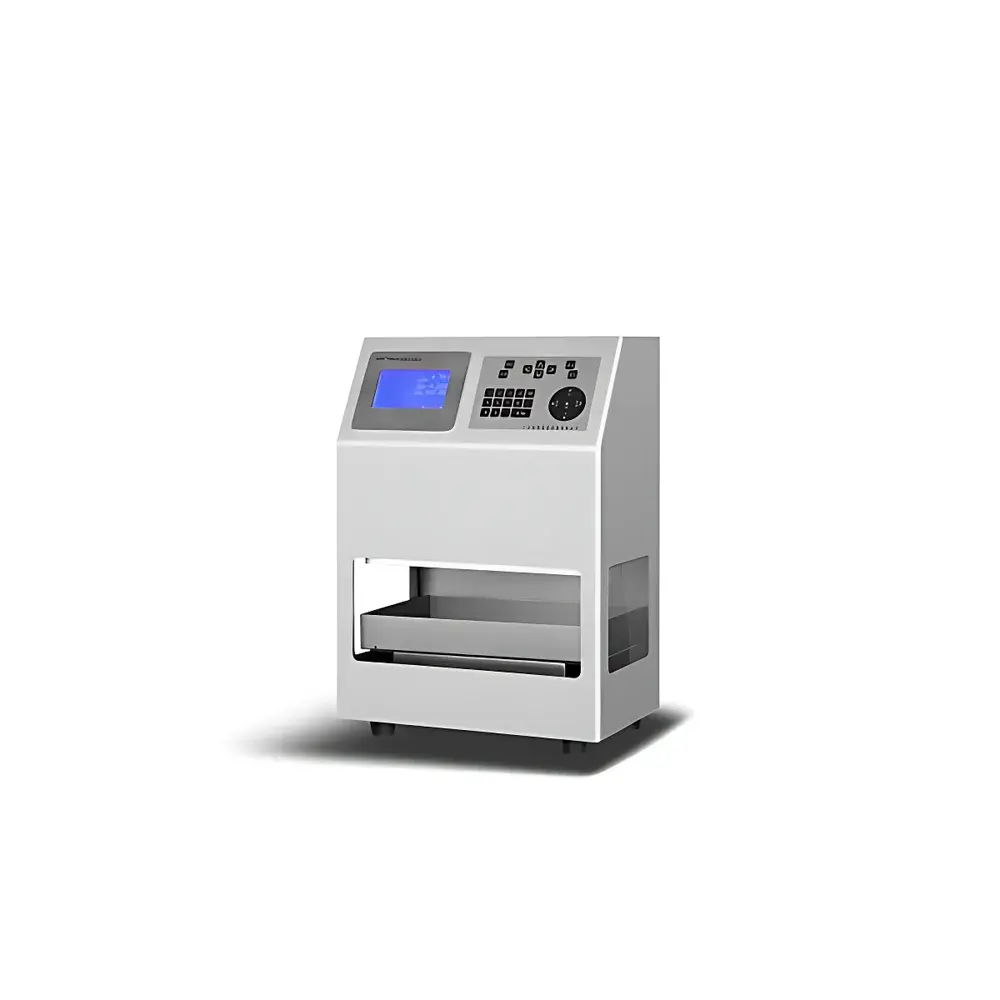
GBPI GBN-200A Packaging Bag Compression & Burst Strength Tester
| Brand | GBPI |
|---|---|
| Model | GBN-200A |
| Origin | Guangdong, China |
| Manufacturer Type | Direct Manufacturer |
| Country of Origin | China |
| Quotation | Upon Request |
| Test Range | 0–3000 N (optional) |
| Stroke | 0–135 mm |
| Effective Test Area | 500 mm × 400 mm |
| Test Speed | 0–500 mm/min (infinitely variable) |
| Dimensions (W×D×H) | 400 mm × 260 mm × 550 mm |
| Power Rating | 1000 W |
| Supply | AC 220 V, 50 Hz |
Overview
The GBPI GBN-200A Packaging Bag Compression & Burst Strength Tester is an electromechanical universal testing system engineered for quantitative mechanical evaluation of flexible packaging integrity under controlled compressive loading. It operates on the principle of quasi-static axial compression, applying precisely regulated force to sealed or unsealed pouches, stand-up bags, vacuum-sealed trays, and laminated film structures until deformation, yield, or catastrophic failure (burst) occurs. Designed in strict alignment with international packaging performance standards—including ISO 2872 (packaging—determination of resistance to internal pressure), ISO 12048 (packaging—compression tests on transport packages), ASTM D642 (standard test method for determining compressive resistance of shipping containers), and GB/T 16491 (general requirements for electronic universal testing machines)—the GBN-200A delivers traceable, repeatable mechanical data essential for quality assurance, regulatory compliance, and package design validation in pharmaceutical, food, personal care, and medical device supply chains.
Key Features
- High-resolution load cell with factory-calibrated range up to 3000 N (optional configurations available), ensuring linearity and repeatability per ISO 7500-1 Class 1 accuracy requirements.
- Programmable stroke control (0–135 mm) with real-time displacement feedback via high-resolution encoder; supports both displacement-limited and force-limited test modes.
- Infinitely variable crosshead speed (0–500 mm/min), enabling precise simulation of static stacking loads, dynamic drop-induced compression, or accelerated aging protocols.
- Integrated embedded computing module (ARM-based industrial controller) allows full test execution—including parameter configuration, real-time curve acquisition, pass/fail logic, and result storage—without external PC dependency.
- Backlit LCD interface (4.3″ TFT) displays live force (N), displacement (mm), time (s), peak load, and test status; supports multilingual UI (English default).
- Dual control architecture: users may select either built-in controller mode (compact footprint, plug-and-play operation) or external PC-linked mode (for advanced scripting, database integration, or GLP-compliant audit trails).
- Real-time multi-curve overlay capability—up to four concurrent test traces—with scalable X/Y axes, cursor-based measurement, and export-ready vector graphics output.
- Comprehensive software suite (Windows-compatible, USB/RS-232 interface) includes configurable test templates, customizable report generation (PDF, Excel, CSV), and built-in calibration wizard compliant with ISO/IEC 17025 documentation requirements.
Sample Compatibility & Compliance
The GBN-200A accommodates a broad spectrum of flexible and semi-rigid packaging formats: heat-sealed PE/PP pouches, aluminum-laminated sachets, retortable stand-up pouches, blister card assemblies, and corrugated tray overwraps. Its 500 mm × 400 mm active platen area ensures uniform load distribution across large-format retail packaging without edge-effect artifacts. All test methods implemented conform to regulatory expectations for packaging validation under FDA 21 CFR Part 11 (electronic records/signatures), EU Annex 11 (computerized systems), and ICH Q5C (stability testing of biotechnological products). Calibration certificates (traceable to NIM, China) and optional third-party metrological verification are available upon request to support GLP/GMP audits.
Software & Data Management
The proprietary GBPI TestSuite v3.2 software provides role-based access control, electronic signature workflows, and immutable audit trails—including operator ID, timestamp, parameter version, raw data hash, and calibration history—for full 21 CFR Part 11 compliance. Raw force-displacement datasets are stored in HDF5 format with metadata embedding (test standard, sample ID, environmental conditions). Reports feature configurable headers, statistical summaries (mean, SD, CV%), pass/fail thresholds, and graphical overlays for comparative analysis across batches or material lots. Export options include PDF/A-1b (archival), XLSX (statistical post-processing), and XML (LIMS integration).
Applications
- Quantitative validation of seal strength retention after accelerated aging (ASTM F1980).
- Burst pressure assessment of sterile barrier systems per ISO 11607-1.
- Stacking load simulation for e-commerce fulfillment packaging (ASTM D4169 DC13/DC17 profiles).
- Comparative evaluation of film laminate performance under humidified or elevated temperature conditions.
- Root cause analysis of field failures linked to compression-induced delamination or seal creep.
- Supporting Design of Experiments (DoE) for optimizing seal parameters (temperature, dwell time, pressure) in thermoforming lines.
FAQ
Does the GBN-200A meet FDA or EU regulatory requirements for packaging validation?
Yes—when operated with validated software, calibrated sensors, and documented procedures, it satisfies data integrity and traceability expectations outlined in 21 CFR Part 11 and EU Annex 11.
Can the instrument perform both constant-rate and constant-load compression tests?
Yes—it supports displacement-controlled (constant speed), force-controlled (load-hold), and hybrid ramp-and-hold protocols via programmable test sequences.
Is external PC hardware mandatory for operation?
No—the embedded controller enables autonomous testing; a PC is only required for advanced reporting, LIMS integration, or firmware updates.
What maintenance intervals are recommended for long-term accuracy?
Annual sensor recalibration and biannual mechanical inspection (platen parallelism, guide rail lubrication) are advised per ISO 17025 guidelines.
Are test method templates preloaded for common standards like ASTM D642 or ISO 2872?
Yes—default templates for 12 major packaging standards are included, with editable parameters to match lab-specific SOPs.





