
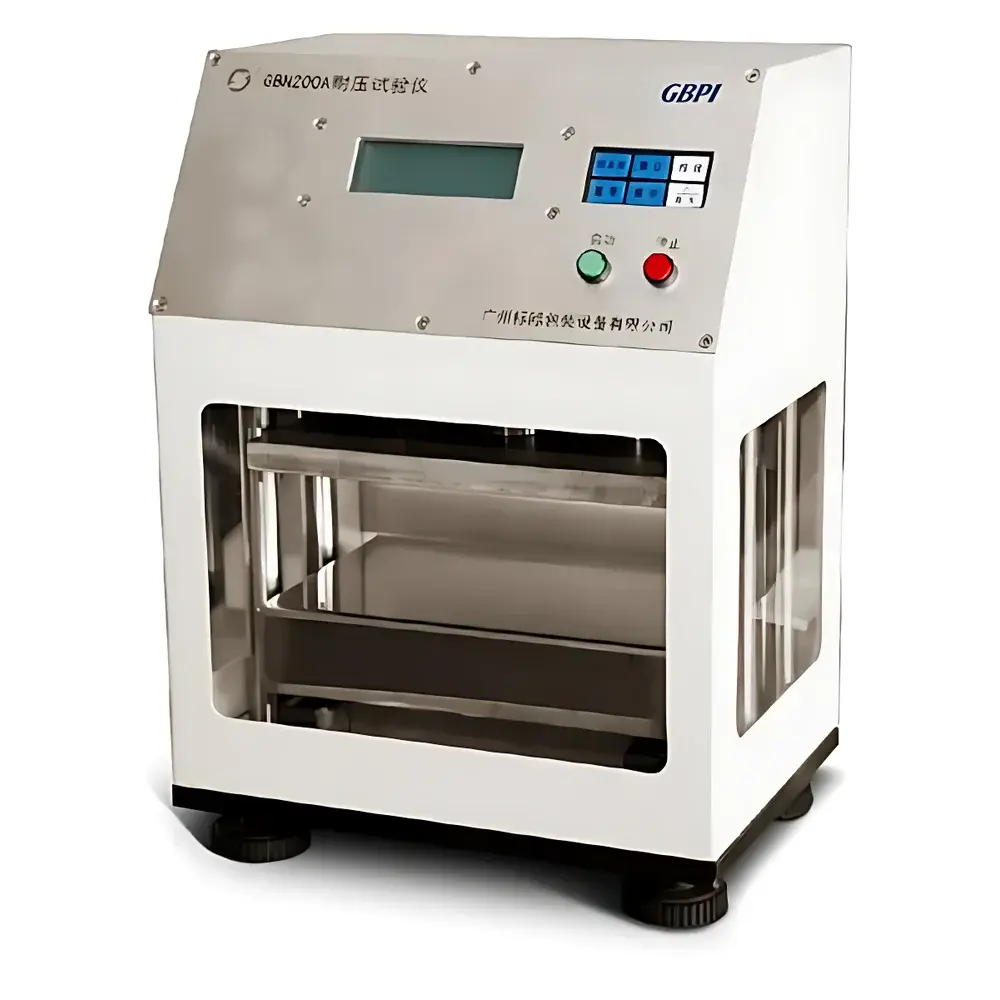
GBPI GBN200A Compression Tester for Packaging Integrity and Burst Strength Evaluation
| Brand | GBPI |
|---|---|
| Model | GBN200A |
| Origin | Guangdong, China |
| Manufacturer Type | Direct Manufacturer |
| Regional Classification | Domestic (China) |
| Pricing | Upon Request |
| Force Range | 0–500 N |
| Stroke | 0–100 mm |
| Effective Test Area | 200 mm × 340 mm |
| Speed Range | 0–300 mm/min (infinitely variable) |
| Power Supply | AC 220 V, 50 Hz |
Overview
The GBPI GBN200A Compression Tester is an electromechanical force-testing instrument engineered for quantitative evaluation of compressive resistance in flexible and semi-rigid packaging structures—including pouches, stand-up bags, blister packs, and corrugated trays. It operates on the principle of controlled uniaxial compression under programmable load, displacement, and velocity profiles, enabling precise simulation of real-world stacking, handling, and transit-induced mechanical stress. Unlike generic universal testers, the GBN200A integrates purpose-built hardware and firmware optimized specifically for packaging integrity assessment per ASTM D642 (Standard Test Method for Determining Compressive Resistance of Shipping Containers), ISO 12048 (Packaging—Complete, filled transport packages—Compression and stacking tests), and relevant sections of GB/T 4857 series (Chinese national standards for package performance testing). Its dual-mode control architecture supports both closed-loop force regulation and open-loop displacement tracking, ensuring high reproducibility across repeated test cycles in QC laboratories and R&D environments.
Key Features
- Programmable multi-parameter control: Independent adjustment of compression speed (0–300 mm/min), target load (0–500 N), stroke limit (0–100 mm), and dwell time (0–9999 s) via intuitive software interface.
- Dual control modes: Select between constant-rate compression, constant-force holding (with user-defined hold duration), or position-controlled ramp-and-hold sequences.
- Modular controller design: Optional internal controller (integrated into main frame for space efficiency) or external controller unit (enabling standalone operation, field upgrades, and simplified maintenance without PC dependency).
- Real-time data acquisition: High-resolution analog-to-digital conversion captures force and displacement at ≥1 kHz sampling rate, supporting accurate peak load detection and deformation curve reconstruction.
- Comprehensive post-test analysis: On-screen overlay of multiple compression curves, automatic calculation of yield point, plateau force, collapse load, and energy absorption (area under curve); exportable to CSV, PDF, or Excel formats.
- Regulatory-ready reporting: Built-in template generator for audit-compliant test reports including operator ID, sample ID, environmental conditions (optional sensor integration), calibration traceability, and timestamped digital signatures.
Sample Compatibility & Compliance
The GBN200A accommodates flat, planar specimens up to 200 mm × 340 mm in footprint—sufficient for standard retail pouches, medical device pouches, food-grade laminates, and pharmaceutical secondary packaging. Its rigid platen assembly ensures uniform pressure distribution with minimal edge effects. The system complies with mechanical safety requirements outlined in IEC 61000-6-2 (EMC immunity) and IEC 61000-6-4 (EMC emissions). For regulated industries, the optional software module supports 21 CFR Part 11-compliant electronic records, including audit trails, role-based access control, and electronic signatures—facilitating GLP/GMP-aligned validation protocols in pharmaceutical and medical packaging QA/QC labs.
Software & Data Management
The included Windows-based GBPI TestSuite v3.x provides full instrument control, real-time visualization, and statistical post-processing. Calibration coefficients are stored in encrypted non-volatile memory with NIST-traceable certificate import capability. All raw data files include embedded metadata (test parameters, calibration date, firmware version) and support SHA-256 hash verification for data integrity assurance. Network-enabled models allow remote monitoring via Ethernet; local USB storage enables offline data backup independent of host PC uptime. Data export conforms to ISO/IEC 17025 documentation requirements, with configurable report headers and footers suitable for internal SOPs or third-party accreditation submissions.
Applications
- Stacking strength validation of filled pouches and cartons prior to warehouse storage
- Seal integrity benchmarking under compressive stress (e.g., detecting weak seal zones prone to burst during palletization)
- Comparative evaluation of laminate structure performance across material suppliers
- Accelerated aging studies correlating compression resistance loss with shelf-life indicators
- Pre-shipment qualification testing for e-commerce fulfillment centers requiring ISTA 3A/3E compliance
- Root cause analysis of field failures involving package deformation or product damage
FAQ
What is the maximum recommended specimen thickness for reliable compression testing?
The GBN200A is optimized for specimens ≤50 mm thick when using standard platens. Thicker samples may require custom platens or spacer kits to maintain axial alignment and avoid eccentric loading.
Does the system support automatic calibration verification?
Yes—via integrated reference load cell diagnostics and optional external calibration weights traceable to national metrology institutes (e.g., CNAS-accredited providers in China or A2LA-accredited labs in North America).
Can test methods be saved and recalled as reusable templates?
Absolutely. Users can store unlimited method configurations—including speed ramps, dwell steps, pass/fail criteria, and report formatting—with password-protected access levels.
Is firmware upgrade supported over the network?
Firmware updates are delivered via secure HTTPS download and installed through the TestSuite application; no physical service visit required for routine enhancements.
How is mechanical overload protection implemented?
Hardware-limited torque cutoff in the servo motor driver, combined with software-enforced upper bounds on force and displacement, prevents actuator stall or structural damage during abnormal test conditions.




