
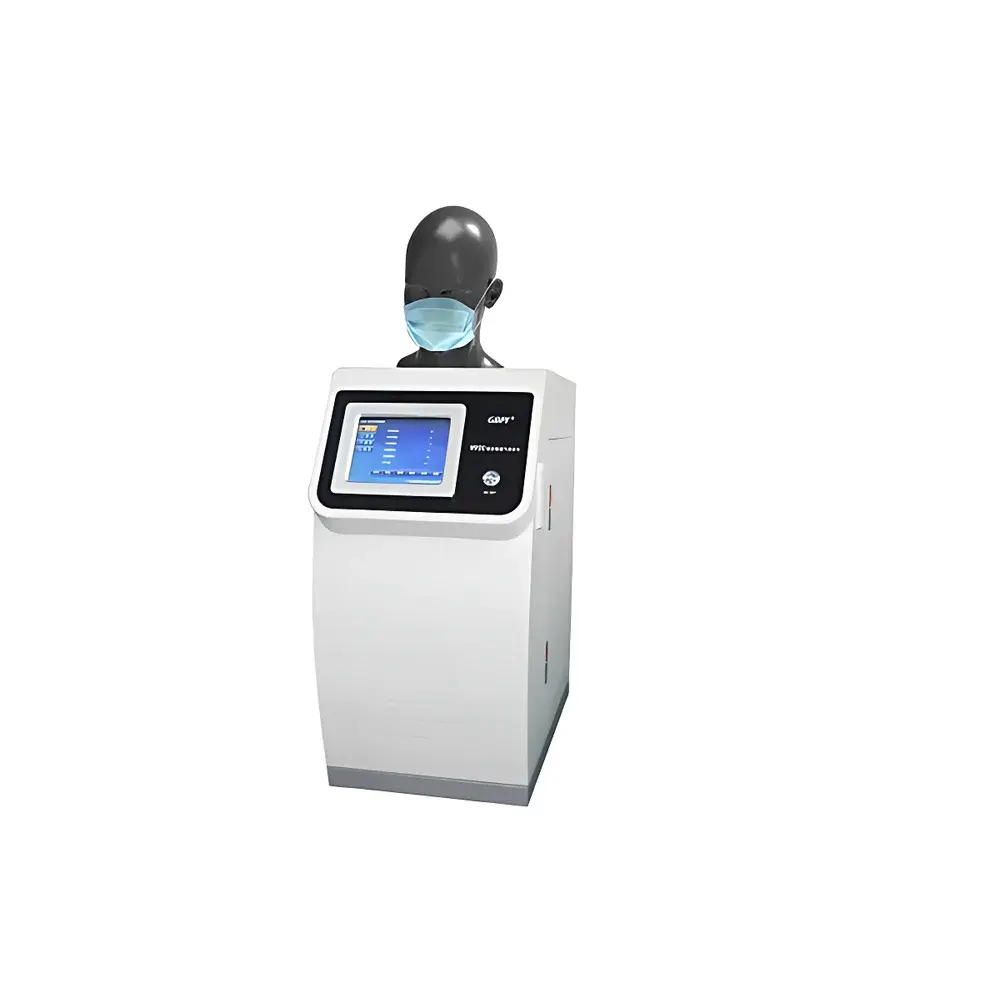
GBPI GBN702-a Respiratory Resistance Tester for Face Masks and Respirators
| Brand | GBPI |
|---|---|
| Origin | Guangdong, China |
| Manufacturer Type | Direct Manufacturer |
| Country of Origin | China |
| Model | GBN702-a |
| Price Range | USD 14,000 – 43,000 |
| Airflow Range | 0–100 L/min |
| Airflow Accuracy | ±2% FS |
| Differential Pressure Range | −1000 to +1000 Pa |
| Pressure Resolution | 1 Pa |
| Test Flow Rate | (85 ± 1) L/min (constant) |
| Pump Capacity | ≥100 L/min |
| Dimensions (W×D×H) | 380 × 620 × 825 mm |
| Headform Sizes | 30 mm, 25 mm, 20 mm |
| Power Supply | AC 220 V, 50 Hz |
Overview
The GBPI GBN702-a Respiratory Resistance Tester is a precision-engineered instrument designed to quantify the inhalation and exhalation resistance of personal protective equipment (PPE), specifically filtering facepiece respirators (FFRs), surgical masks, and daily-use particulate-filtering masks. It operates on the principle of controlled airflow generation through standardized headforms under defined volumetric flow conditions, measuring the resulting differential pressure across the test specimen in accordance with internationally harmonized respiratory protection testing protocols. The system complies with key regulatory frameworks governing occupational safety and public health—including China’s mandatory standards GB 2626–2006 (for respirators) and GB/T 32610–2016 (for daily protective masks)—and serves as a critical verification tool for quality control laboratories, national inspection agencies, and PPE manufacturers engaged in GLP-compliant validation workflows.
Key Features
- Integrated dual-path pneumatic architecture enabling seamless switching between inhalation and exhalation measurement modes via a specialized flow-directional valve—eliminating manual reconfiguration and reducing operator-induced variability.
- High-sensitivity thermal mass airflow sensor with no requirement for temperature or pressure compensation; delivers full-scale accuracy of ±2% and minimal start-up flow threshold for reliable low-flow characterization.
- Multi-sensor chip design within a single airflow transducer, extending effective turndown ratio and supporting stable measurement across the entire 0–100 L/min range.
- Dual-channel differential pressure sensing using two-wire, explosion-proof micro-pressure transducers with external zero/span adjustment, programmable damping, and long-term zero stability—ensuring traceable, repeatable results over extended operational cycles.
- Embedded data logger featuring a 128×64 graphical LCD interface with full Chinese-language navigation and 4 MB onboard memory for time-stamped pressure and flow records.
- Calibrated constant-flow delivery at (85 ± 1) L/min—aligned precisely with GB 2626–2006 Clause 6.3 and GB/T 32610–2016 Annex B requirements for breath resistance evaluation.
- Modular headform system accommodating three interchangeable sizes (20 mm, 25 mm, 30 mm) to simulate varying facial geometries and ensure representative seal assessment during resistance testing.
Sample Compatibility & Compliance
The GBN702-a supports flat-panel mask specimens, cup-shaped respirators, and folded-style face coverings mounted on standardized headforms per ISO 16900-1:2016 (Respiratory protective devices — Methods of test — Part 1: Determination of breathing resistance). Its mechanical and metrological configuration satisfies the physical test conditions specified in GB 2626–2006 (Annex A), GB/T 32610–2016 (Clause 6.3), and ASTM F2299/F2299M–17 (Standard Test Method for Determining the Initial Efficiency of Materials Used in Medical Face Masks to Penetration by Particulates Using Latex Spheres). While not certified to EN 149:2001+A1:2009 or ISO 14644-3 directly, its pressure and flow performance envelopes are compatible with the underlying test logic of those standards when adapted with appropriate calibration and procedural documentation. All pressure and flow measurements are traceable to national metrological standards through factory calibration certificates issued per ISO/IEC 17025–compliant internal procedures.
Software & Data Management
The instrument operates independently without PC dependency, yet supports optional USB data export for post-test analysis in CSV format. Internal logging captures timestamped differential pressure (Pa), instantaneous airflow (L/min), and mode status (inhalation/exhalation) at user-configurable intervals. For laboratories operating under FDA 21 CFR Part 11 or ISO/IEC 17025 environments, GBPI provides supplementary documentation packages—including instrument qualification protocols (IQ/OQ), calibration records, uncertainty budgets, and audit trail templates—to facilitate integration into validated quality management systems. Firmware updates are delivered via secure encrypted USB media, with version history and change logs maintained in accordance with ICH Q9 principles.
Applications
- Verification of compliance for N95-equivalent respirators and KN95-certified masks against national filtration efficiency and breathability thresholds.
- Batch release testing in manufacturing QA/QC labs prior to packaging and distribution.
- Comparative resistance profiling of novel filter media (e.g., electret nonwovens, nanofiber laminates, graphene-enhanced composites) under standardized breathing simulation.
- Supporting R&D studies on mask fit–resistance trade-offs, especially in pediatric and geriatric demographic modeling using scaled headforms.
- Third-party certification body testing for CNAS-accredited laboratories conducting conformity assessments per China Compulsory Certification (CCC) schemes.
FAQ
Does the GBN702-a meet ISO 16900-1 requirements for breathing resistance testing?
Yes—the instrument’s airflow control accuracy (±2%), pressure resolution (1 Pa), and constant-flow stability (85 ± 1 L/min) align with the metrological criteria outlined in ISO 16900-1:2016 Section 7.2 for Class 2 test systems.
Can the device be used for both inhalation and exhalation resistance measurement on the same sample without reinstallation?
Yes—its integrated bidirectional flow path and automated valve actuation allow sequential inhalation and exhalation tests on a single mounted specimen without disassembly or realignment.
Is external software required to generate compliant test reports?
No—on-device display shows real-time pressure and flow values, and all raw data are stored internally. Optional PC-based reporting software is available for automated PDF report generation with configurable headers, logos, and pass/fail flags per standard clauses.
What calibration standards are applied to the pressure and flow sensors?
Flow sensors are calibrated against a NIST-traceable primary rotameter; differential pressure sensors are calibrated using a deadweight tester referenced to China National Institute of Metrology (CNIM) standards. Calibration certificates include expanded uncertainty statements at k=2.
How frequently should routine verification be performed?
Daily zero-check and span verification using certified reference pressure modules and calibrated flow restrictors are recommended before first use each shift, per GB/T 27025–2019 guidance for in-house verification of test equipment.





