
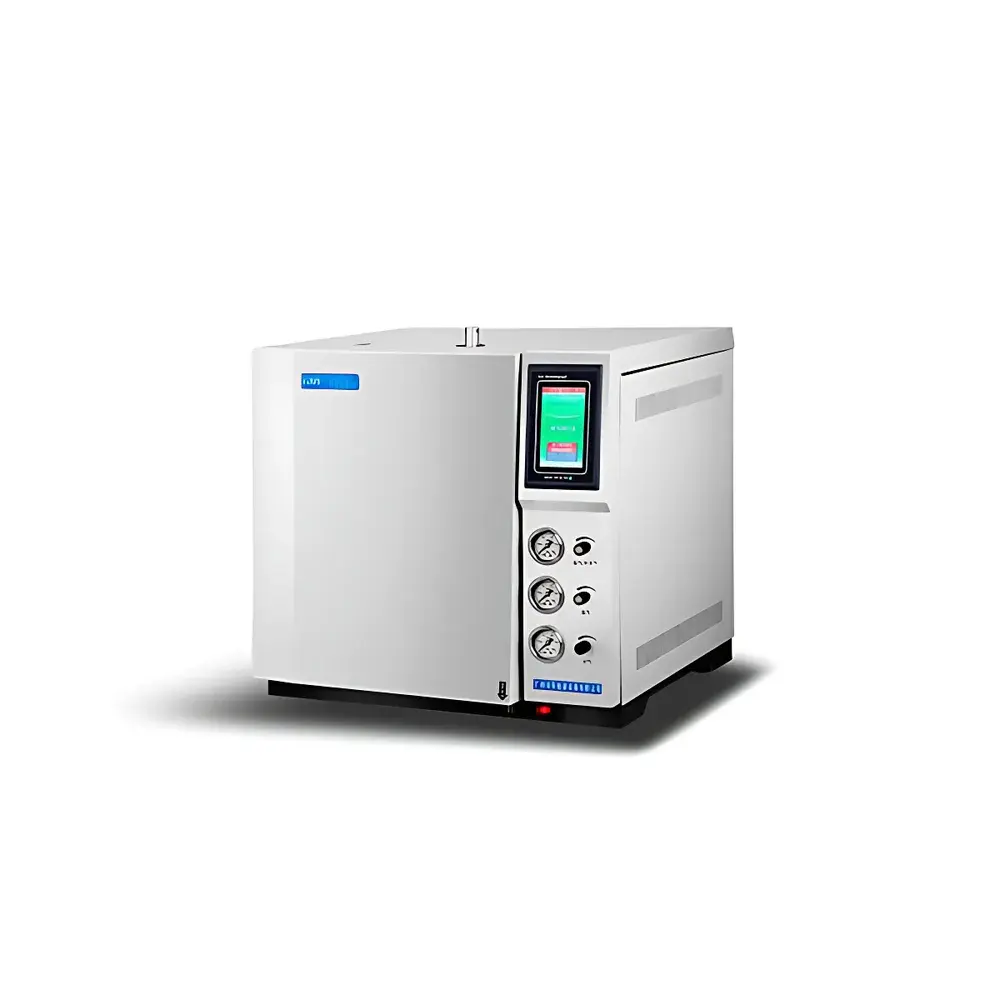
GBPI GC9802-K1 Laboratory Gas Chromatograph for Ethylene Oxide Residue Testing in Disposable Masks
| Brand | GBPI |
|---|---|
| Origin | Guangdong, China |
| Manufacturer Type | Direct Manufacturer |
| Regional Classification | Domestic (China) |
| Model | GC9802-K1 |
| Instrument Type | Benchtop Laboratory Gas Chromatograph |
| Application Scope | General-Purpose Quantitative Analysis of Volatile Organic Compounds |
| Detector | Flame Ionization Detector (FID), Optional Alternative Detectors Available |
| Detection Limit | ≤3×10⁻¹² g/s (n-Hexadecane) |
| Baseline Noise | ≤2×10⁻¹⁴ A |
| Baseline Drift | ≤1×10⁻¹³ A/30 min |
| Column | EO-Specific Capillary Column (30 m × 0.32 mm × 0.5 µm), Optional Alternate Columns Supported |
| Autosampler | 20-Position Headspace Sampler |
| Oven Dimensions | 240 × 210 × 240 mm |
| Temperature Range | 4 °C above ambient to 450 °C (1 °C increments) |
| Temperature Control Accuracy | ±0.1 °C |
| Temperature Gradient Uniformity | ±1% |
| Independent Temperature Zones | 6 |
| Programmable Temperature Ramps | Up to 16 steps |
| Ramp Rate | 0.1–60 °C/min |
| Maximum Runtime Setting | 6000 min |
| Optional Accessories | Oil-Free Air Generator (3 L/min, with oil/water removal), Hydrogen Generator (300 mL/min, 99.999% purity), High-Purity Nitrogen Cylinder (99.999%, regulator included, locally sourced) |
| Calibration Standard | Certified Ethylene Oxide Reference Material |
| Data System | Dual-Channel Chinese-Language GC Workstation with Instrument Control, Real-Time Chromatogram Display, Zoom/Pan Functionality, PDF Report Export, and Manual Start Button Integration |
| Injection System | Split/Splitless Capillary Injector with Septum Purge Function |
| Safety Features | Dual-Layer Over-Temperature Protection (Software + Hardware), Advanced Acoustic Damping |
Overview
The GBPI GC9802-K1 is a dedicated benchtop gas chromatograph engineered for the precise quantification of residual ethylene oxide (EO) in single-use medical face masks and other sterilized medical devices. It operates on the principle of capillary gas chromatography coupled with flame ionization detection (GC-FID), a method widely accepted under ISO 10993-7, USP , and YY/T 0681.13–2014 for EO residue analysis. The system integrates a temperature-programmable oven, a high-resolution EO-specific fused-silica column, and a low-noise FID detector—ensuring robust separation and sensitive detection of trace EO (down to sub-ppm levels in extracted sample solutions). Designed for compliance-driven laboratories, the GC9802-K1 supports full method validation workflows including linearity, LOD/LOQ determination, repeatability, and intermediate precision per ICH Q2(R2) guidelines.
Key Features
- Six independently controlled temperature zones—including oven, injector, detector, and transfer lines—for optimal thermal management and retention time stability.
- Programmable 16-step temperature ramping with adjustable rates (0.1–60 °C/min) and extended runtime capability (up to 100 hours), enabling complex multi-analyte separations beyond EO.
- FID detector with documented sensitivity (≤3×10⁻¹² g/s n-hexadecane), ultra-low baseline noise (≤2×10⁻¹⁴ A), and minimal drift (≤1×10⁻¹³ A/30 min), ensuring high signal-to-noise ratios for low-concentration EO peaks.
- Integrated 20-position headspace autosampler compatible with standard 20 mL vials, supporting automated, reproducible headspace equilibration and injection per ISO 11357-3 and ASTM D3327.
- Real-time dual-channel workstation with live chromatogram rendering, interactive zoom/pan tools, and customizable report templates compliant with GLP documentation requirements.
- Dual-layer over-temperature protection (hardware interlock + software limit), acoustic damping enclosure, and septum purge-enabled split/splitless injector for reduced ghost peaks and enhanced column lifetime.
Sample Compatibility & Compliance
The GC9802-K1 is validated for use with aqueous and solvent-based EO extraction protocols specified in GB 19083–2010, YY 0469–2011, and ISO 10993-7 Annex C. It accommodates samples from polypropylene, nonwoven fabric, and elastomeric mask components following standardized extraction (e.g., 60 °C, 60 min in sealed vials). The system meets essential regulatory expectations for medical device testing laboratories, including alignment with FDA 21 CFR Part 11 data integrity principles (via audit trail-enabled workstation logging), traceable calibration using NIST-traceable EO standards, and compatibility with GMP/GLP-compliant SOPs. All hardware and software configurations support IQ/OQ documentation packages upon request.
Software & Data Management
The bundled dual-channel Chinese-language GC workstation provides full instrument control, real-time acquisition, peak integration (tangent skim, valley-to-valley), and quantitative analysis using external standard or internal standard methods. Raw data files (.dat) are stored with embedded metadata (operator ID, method name, injection time, column history). Audit trails record all parameter changes, manual integrations, and report exports—supporting retrospective review during regulatory inspections. Reports can be exported in PDF, Excel, or CSV formats, with configurable headers, footers, and pass/fail criteria based on EO limits defined in YY/T 0681.13–2014 (≤10 µg/g for masks) or ISO 10993-7 (≤4 µg/g for implantables). Remote monitoring via LAN is supported; optional English-language firmware upgrade available.
Applications
Beyond EO residue testing in surgical masks and respirators (N95, KN95), the GC9802-K1 serves as a general-purpose analytical platform for volatile organic compound (VOC) analysis across multiple regulated domains. Applications include residual solvent testing in pharmaceutical packaging (per USP ), monomer quantification in polymer films (GB/T 10004–2008), pesticide screening in agricultural commodities, and purity assessment of industrial solvents. Its modular architecture allows rapid reconfiguration for alternative detectors (ECD, TCD) or columns—enabling laboratories to expand scope without capital reinvestment.
FAQ
What regulatory standards does the GC9802-K1 support for EO testing?
It is configured and validated for GB 19083–2010, YY/T 0681.13–2014, ISO 10993-7, and USP , with method parameters aligned to these documents.
Is the system compatible with electronic signatures and audit trails for 21 CFR Part 11 compliance?
Yes—the workstation supports user-level access control, electronic signature capture, and immutable audit logs for all critical data events.
Can the instrument analyze other residual solvents besides EO?
Yes. With appropriate column selection and method development, it quantifies chloroform, methanol, acetone, hexane, and other Class 2/3 solvents per ICH Q3C.
What maintenance is required for long-term FID performance?
Routine cleaning of the jet and collector electrode every 200 injections; annual replacement of the FID ceramic igniter and verification of H₂/air flow ratios.
Does GBPI provide installation qualification (IQ) and operational qualification (OQ) documentation?
Yes—customizable IQ/OQ protocols and executed reports are available upon order confirmation, including temperature uniformity mapping and detector response linearity verification.
Related Products




