
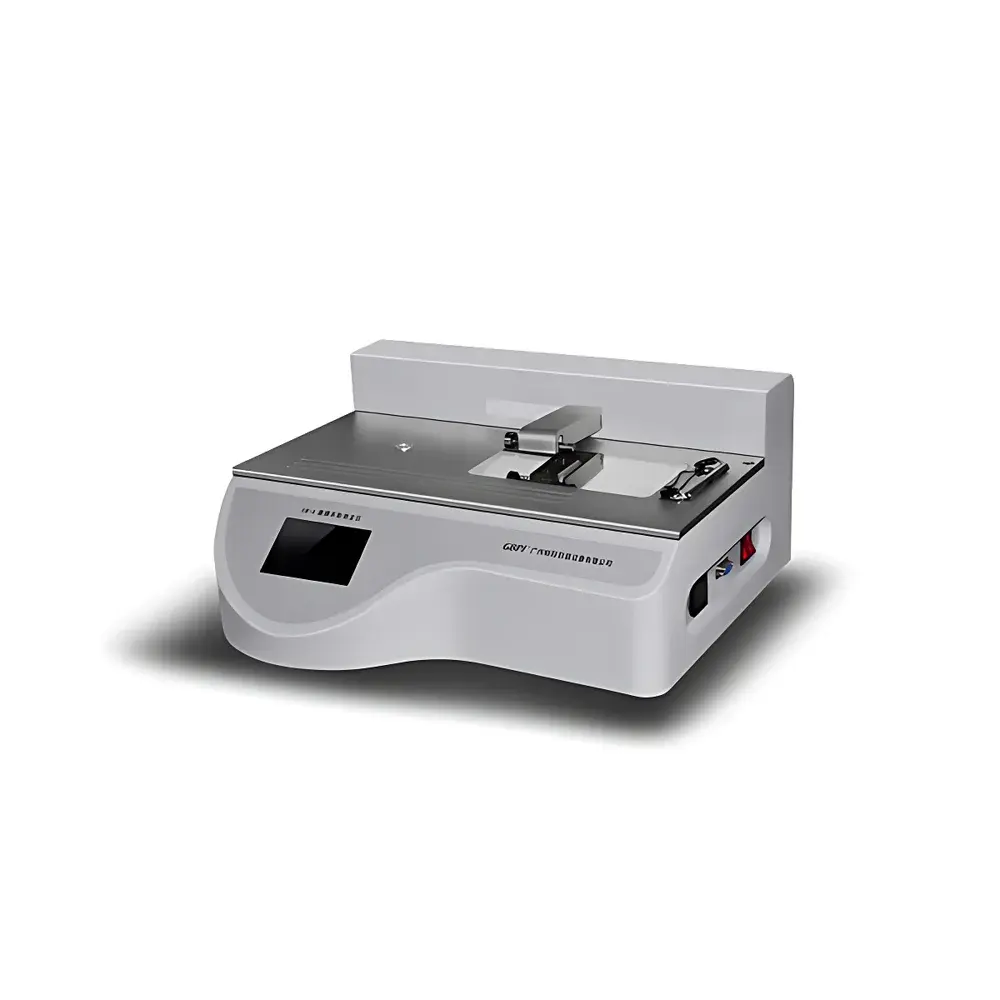
GBPI GM-5A Coefficient of Friction and Peel Tester
| Brand | GBPI |
|---|---|
| Model | GM-5A |
| Origin | Guangdong, China |
| Manufacturer Type | Direct Manufacturer |
| Country of Origin | China |
| Price Range | USD 1,400 – 7,000 (FOB) |
| Standards Compliance | GB/T 10006–1988, ASTM D1894–2014, ISO 8295–2004, TAPPI T816 |
| COF Range | 0.01–0.999 |
| Measurement Accuracy | ±2% |
| Load Cell Range | 0–10 N |
| Slider Mass | 200 ± 2 g |
| Slider Dimensions | 63 × 63 mm |
| Test Speed | Adjustable from 100 mm/min (stepless) |
| Temperature Control Option | Ambient to 75 °C |
| Specimen Thickness Limit | ≤2 mm |
| Test Platform Size | 200 × 470 mm |
| Overall Dimensions | 470 × 330 × 210 mm |
| Weight | 37 kg |
| Power | AC 220 V ±10%, 50 Hz, 100 W |
Overview
The GBPI GM-5A Coefficient of Friction and Peel Tester is a dual-function precision instrument engineered for quantitative evaluation of static and kinetic coefficients of friction (COF), as well as peel strength, in flexible packaging materials and thin-sheet substrates. It operates on the fundamental principle of horizontal tensile force measurement: a standardized slider (200 g, 63 × 63 mm) is pulled across a fixed specimen surface at controlled velocity (typically 100 mm/min, continuously adjustable), while a high-stability load cell captures the peak (static) and plateau (kinetic) frictional forces. The system calculates COF values as the ratio of measured frictional force to normal force (i.e., slider weight). For peel testing, the instrument accommodates 90° or 180° configurations per ASTM D903 and ISO 8510–2, enabling consistent separation force quantification of laminated or coated structures. Designed specifically for packaging R&D, quality control laboratories, and regulatory compliance units, the GM-5A delivers repeatable, traceable data aligned with international test standards—making it suitable for GLP-compliant documentation and routine QC release testing.
Key Features
- Integrated dual-mode operation: simultaneous COF and peel testing capability without hardware reconfiguration
- High-fidelity 10 N load cell with ±2% full-scale accuracy, factory-calibrated using NIST-traceable reference weights
- Real-time LCD interface displaying static COF, kinetic COF, peel force (N), and test speed—no PC required for basic operation
- Stepless speed control (100 mm/min nominal, adjustable range supports low-speed creep analysis and high-speed dynamic assessment)
- Modular mechanical architecture with protected overload circuitry: automatic sensor shutdown above 110% rated capacity prevents calibration drift or permanent transducer damage
- Quick-swap slider assembly with precision-machined stainless steel base and interchangeable mass options (standard 200 g, optional 500 g/1000 g kits available)
- Optional Peltier-based temperature-controlled stage (ambient to +75 °C) for evaluating thermal dependence of interfacial adhesion
Sample Compatibility & Compliance
The GM-5A accommodates films, foils, laminates, coated papers, and nonwovens up to 2 mm thickness, including polyolefin-based structures (LDPE, PP), PET, BOPP, aluminum foil composites, and pharmaceutical blister lidding materials. Its test geometry conforms strictly to the contact-area and normal-force requirements specified in GB/T 10006–1988 (Chinese national standard), ASTM D1894–2014 (Standard Test Method for Static and Kinetic Coefficients of Friction of Plastic Film and Sheeting), ISO 8295–2004 (Plastics — Film and Sheeting — Determination of the Coefficients of Friction), and TAPPI T816 (Coefficient of Friction of Paper and Paperboard). All firmware and reporting outputs support audit-ready metadata tagging—including operator ID, timestamp, environmental conditions (if logged externally), and calibration certificate traceability—enabling alignment with FDA 21 CFR Part 11 electronic record requirements when used with validated software modules.
Software & Data Management
The optional GBPI TestMaster v3.2 software provides full instrument control via RS-232 or USB-to-serial interface. It captures real-time force–displacement curves with configurable sampling rates (up to 100 Hz), supports zoomable waveform review, automatic peak detection for static COF, and linear regression analysis for kinetic COF determination. Reports export to PDF and CSV formats with embedded digital signatures, revision-controlled templates, and customizable headers (lab name, SOP number, instrument ID). Audit trail functionality logs all user actions—including method edits, result deletions, and calibration events—with immutable timestamps. Data files comply with ISO/IEC 17025 clause 7.5.2 for raw data retention and are compatible with LIMS integration via HL7 or ASTM E1384 interfaces.
Applications
- Quality assurance of printed and metallized packaging webs prior to converting or filling
- Development of anti-block and slip-additive formulations in polymer extrusion
- Validation of heat-seal integrity and delamination resistance in pouch laminates
- Regulatory submission support for USP and packaging compatibility studies
- Root-cause analysis of high-speed packaging line jams attributed to excessive film-to-film friction
- Comparative evaluation of surface treatments (corona, plasma, SiOx coating) on COF modulation
FAQ
Does the GM-5A meet FDA or EU MDR requirements for medical packaging validation?
Yes—the instrument’s mechanical design, measurement traceability, and optional software features (electronic signatures, audit trails, calibration management) support compliance with FDA 21 CFR Part 11 and EU Annex 11 when deployed within a validated laboratory environment.
Can the system perform both static and kinetic COF measurements in a single run?
Yes—each test automatically records the initial breakaway force (static COF) and sustained sliding force (kinetic COF) without manual intervention.
Is third-party calibration certification included with purchase?
A factory-issued calibration certificate (traceable to CNAS-accredited standards) is provided; ISO/IEC 17025-certified recalibration services are available annually through GBPI’s global service network.
What maintenance is required to ensure long-term measurement stability?
Biannual verification using supplied standard masses and slider reference blocks is recommended; no lubrication or consumable parts are required under normal operating conditions.
Can the GM-5A be integrated into an automated production line for inline monitoring?
While designed primarily for lab-based QC, its analog output (0–10 V) and Modbus RTU protocol support enable integration with PLC-based MES systems for pass/fail feedback loops.





