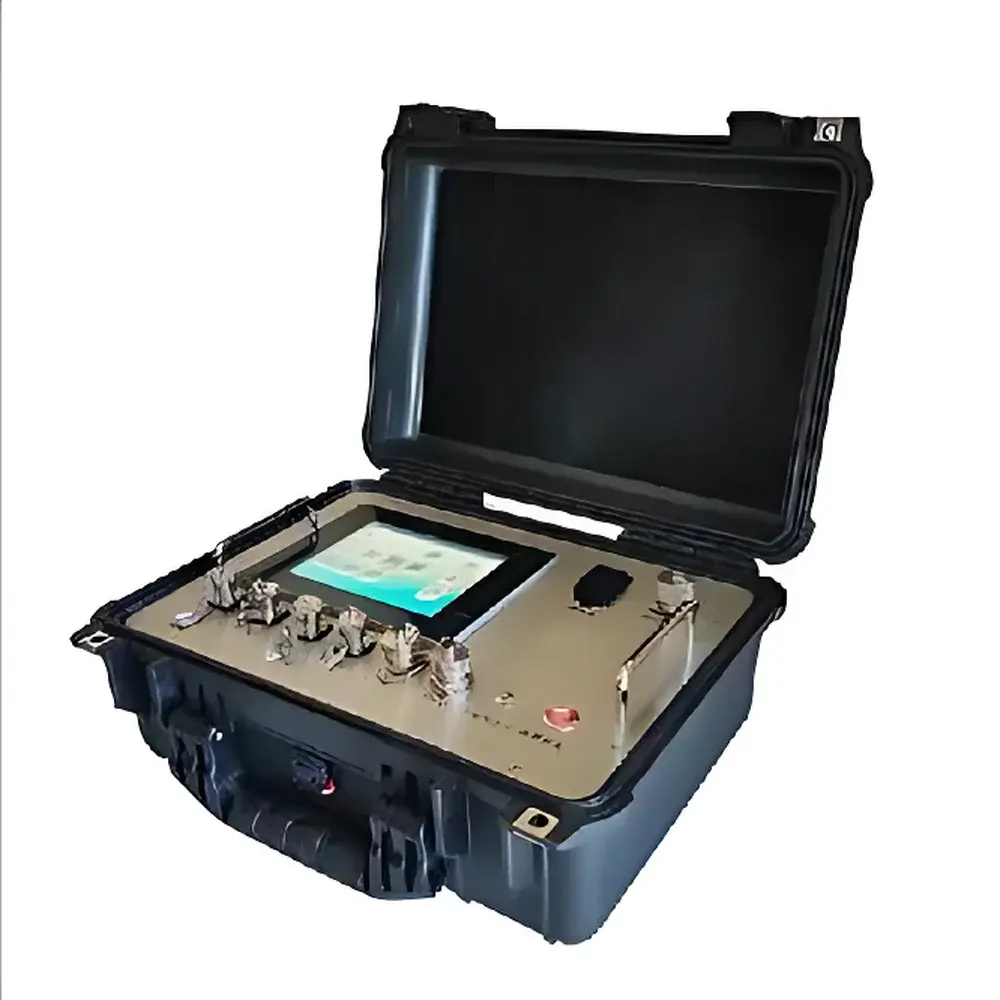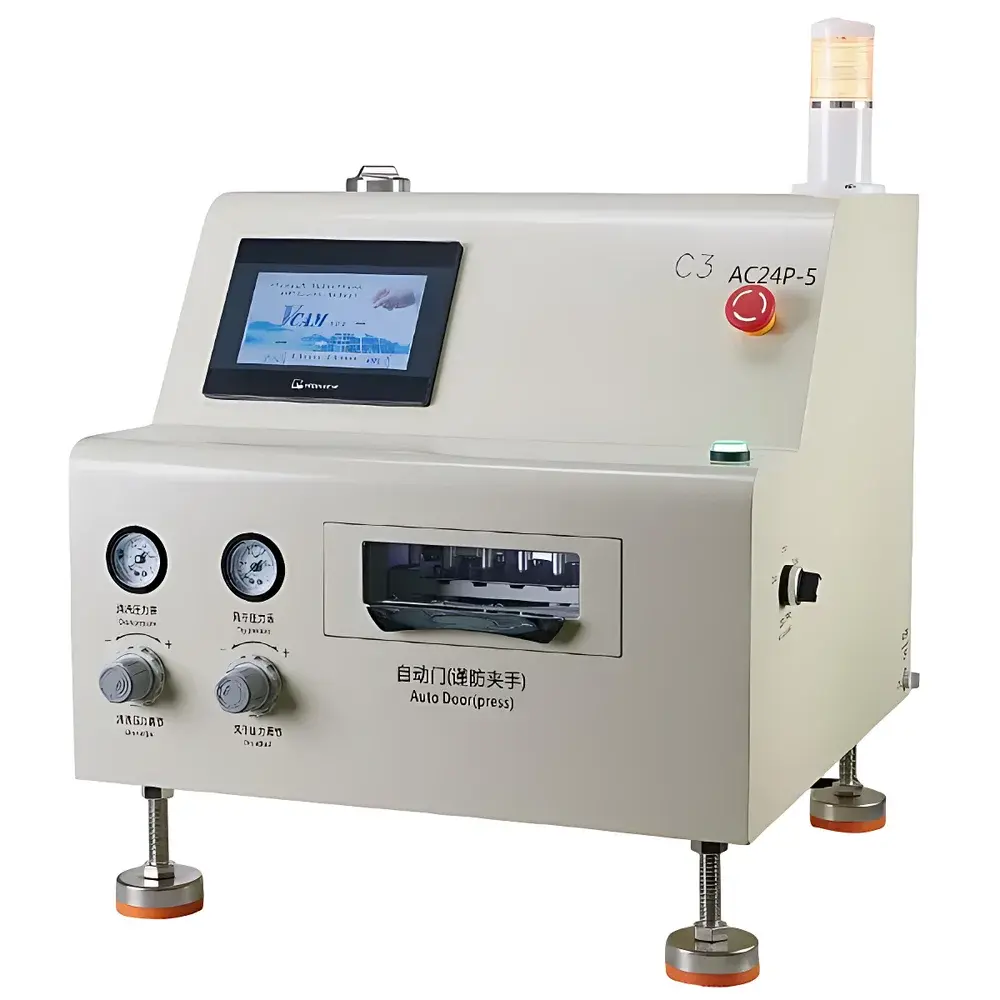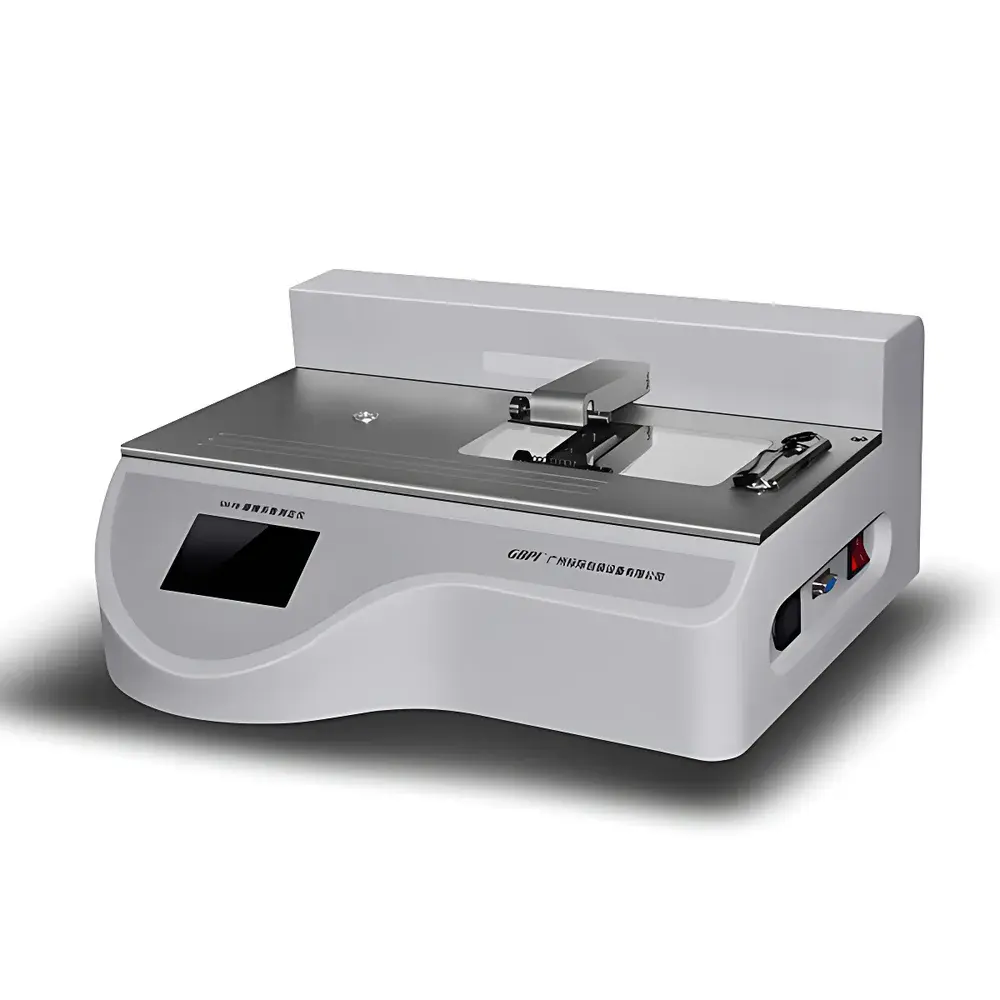
GBPI GM-FB Coefficient of Friction and Peel Strength Tester
| Brand | GBPI |
|---|---|
| Origin | Guangdong, China |
| Manufacturer Type | Original Equipment Manufacturer (OEM) |
| Country of Origin | China |
| Model | GM-FB |
| Pricing | Available Upon Request |
| Test Standards | GB 10006, ISO 8295, ASTM D1894, TAPPI T816 |
| Friction Coefficient Range | 0.001–0.999 |
| Resolution | 0.1% |
| Force Measurement Range | 0–9.8 N |
| Slider Velocity | 0–500 mm/min (infinitely variable |
| standard test speeds | 100 ± 10 mm/min and 150 ± 10 mm/min) |
| Stroke Length | 100 ± 5 mm |
| Max Sample Thickness | ≤ 2 mm |
| Slider Dimensions | 63 mm × 63 mm |
| Slider Mass | 200 g ± 2 g |
| Test Platform Size | 200 mm × 470 mm |
| Display | LCD with real-time COF and peel force curves |
| Power Supply | AC 220 V ± 10 V, 50 Hz |
| Rated Power | 100 W |
| Net Weight | 13.6 kg |
| Dimensions (W×D×H) | 470 mm × 340 mm × 220 mm |
| Interface | Standard USB for PC connectivity (optional software package) |
| Compliance | Designed per GMP Annex 11 (Computerized Systems), supports audit trail, user access control, electronic signatures, and data integrity per ALCOA+ principles |
Overview
The GBPI GM-FB Coefficient of Friction and Peel Strength Tester is a dual-function precision instrument engineered for quantitative evaluation of interfacial tribological behavior and adhesive separation performance in flexible packaging and sheet materials. It operates on the fundamental principle of horizontal sliding friction measurement—based on the classical Coulomb model—where static and kinetic coefficients of friction (COF) are determined by measuring the peak and sustained force required to initiate and maintain relative motion between two contacting surfaces under controlled normal load. Simultaneously, the system supports peel strength assessment via standardized 90° or 180° configurations, enabling direct quantification of interfacial adhesion between laminated or coated layers. The instrument implements a motor-driven belt mechanism that moves the test platform while a calibrated slider—loaded with a precisely defined mass (200 g ± 2 g)—remains stationary via suspension from a high-stability load cell. This architecture ensures minimal inertial interference and high reproducibility across repeated measurements. Designed for routine QC/QA laboratories in packaging R&D, film extrusion, and converting facilities, the GM-FB delivers traceable, standards-aligned results essential for material specification compliance and process optimization.
Key Features
- Dual-mode operation: simultaneous or independent measurement of static/dynamic coefficient of friction (μs/μk) and peel strength (N/15 mm or N/mm)
- Infinitely variable slider velocity (0–500 mm/min), pre-configured for ISO 8295 (100 mm/min) and ASTM D1894 (150 mm/min) protocols
- High-fidelity load cell with 0.001–0.999 COF range and 0.1% resolution, calibrated using NIST-traceable reference weights
- Integrated LCD interface displaying real-time force-time curves, μs, μk, and peel peak/average values with auto-scaling capability
- Modular hardware architecture with quick-access service panels and tool-free sensor replacement for minimal downtime
- GMP-compliant software suite supporting 21 CFR Part 11 requirements: role-based user permissions, electronic signatures, immutable audit trails, and full data lifecycle logging
- USB 2.0 interface enabling bidirectional communication with Windows-based analysis software for curve overlay, statistical deviation reporting (SD, CV%), and batch comparison
- Overload protection circuitry prevents sensor damage during accidental over-force events; automatic zero-reset function ensures baseline stability
Sample Compatibility & Compliance
The GM-FB accommodates a broad spectrum of planar substrates up to 2 mm thick—including polymer films (LDPE, PET, BOPP), metallized foils, paperboard, nonwovens, woven sacks, printed labels, and medical transdermal patches. Its standardized slider geometry (63 mm × 63 mm) and consistent normal force (1.96 N nominal, derived from 200 g mass) ensure cross-laboratory comparability. The system fully complies with GB 10006 (China), ISO 8295 (International), ASTM D1894 (USA), and TAPPI T816 (North America) for friction testing, and meets ISO 8510-2 and ASTM D903 for peel evaluation. All firmware and software modules are validated per ICH Q9/Q10 principles and documented in accordance with GLP Annexes and ISO/IEC 17025:2017 clause 7.7 (Ensuring validity of results).
Software & Data Management
The optional GBPI LabLink™ software provides a secure, validated environment for test method definition, execution, and report generation. Users define test parameters—including speed profile, dwell time, number of replicates, and pass/fail thresholds—via intuitive drag-and-drop workflows. Raw force-time datasets are stored in encrypted .gbp binary format with embedded metadata (operator ID, timestamp, instrument serial, calibration status). Statistical outputs include mean COF, standard deviation, confidence intervals (95%), and outlier detection per Grubbs’ test. Reports export to PDF/A-1b (archival), CSV (LIMS integration), and XML (eLDR submission). Audit logs record every action—from parameter modification to result approval—with hash-verified timestamps. Optional LIMS middleware enables automated data ingestion into enterprise systems via HL7 or RESTful API.
Applications
- Quality control of slip additives (e.g., erucamide, oleamide) in blown and cast films
- Evaluation of anti-blocking performance in heat-sealable laminates
- Validation of surface treatment efficacy (corona, plasma, flame) on polyolefins
- Assessment of ink adhesion and rub resistance on flexible packaging substrates
- Peel strength verification of pressure-sensitive adhesives in medical device pouches
- Friction profiling of release liners used in label manufacturing
- Comparative analysis of biodegradable film formulations under accelerated aging conditions
FAQ
What standards does the GM-FB natively support?
It is factory-configured for GB 10006, ISO 8295, ASTM D1894, and TAPPI T816. Custom test methods can be programmed via LabLink™.
Can the instrument perform both friction and peel tests without hardware reconfiguration?
Yes—slider fixtures and clamping assemblies are tool-free interchangeable; no recalibration is required between modes.
Is remote diagnostics and software update capability available?
When connected to the GBPI SmartLab IoT platform, users may initiate firmware updates, view real-time sensor health metrics, and request technician-assisted troubleshooting.
How is data integrity ensured during electronic record retention?
All data files are digitally signed at creation; audit trails are write-once/read-many (WORM) compliant and cannot be edited or deleted without system administrator override.
Does the GM-FB support multi-user environments with differentiated access rights?
Yes—software enforces three-tier permission levels: Operator (test execution only), Supervisor (method editing + result review), and Administrator (system configuration + audit log management).