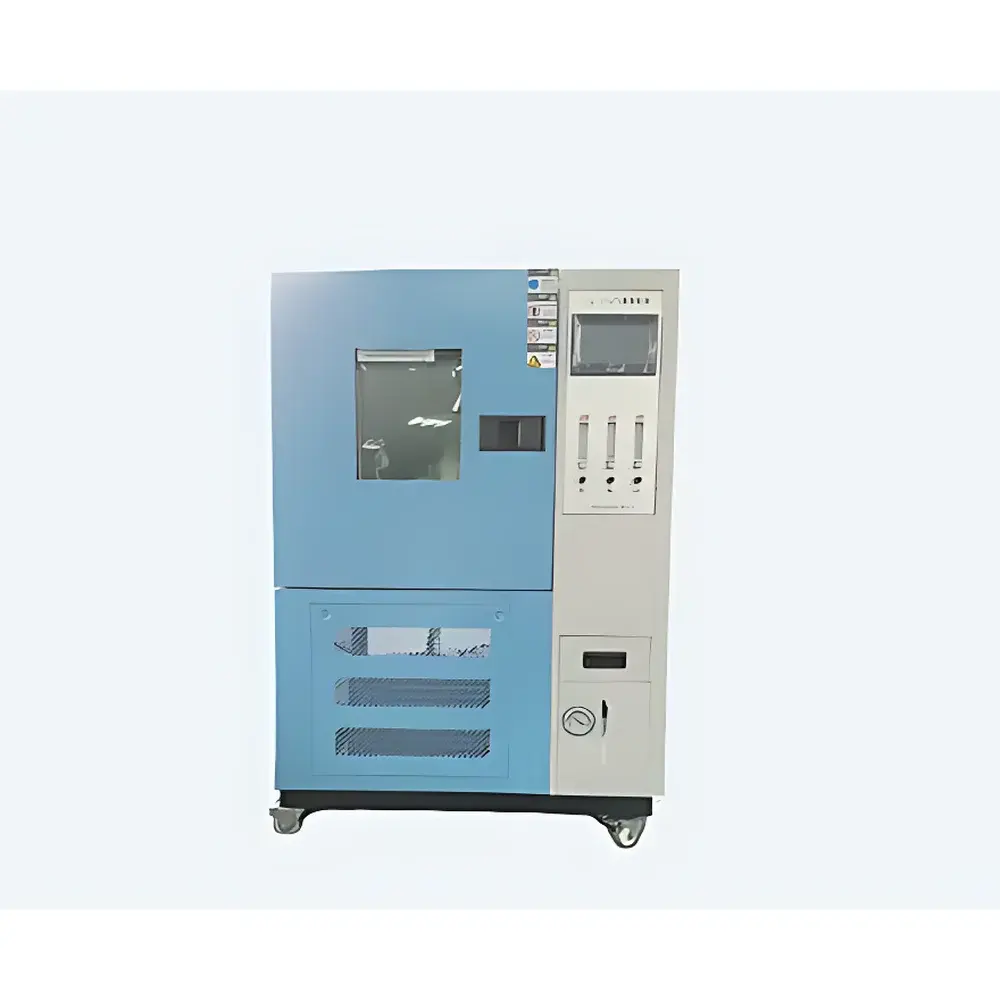
GBPI GQ-300 Controlled Atmosphere Storage Chamber for Fresh Produce Research
| Brand | GBPI |
|---|---|
| Origin | Guangdong, China |
| Manufacturer Type | Direct Manufacturer |
| Country of Origin | China |
| Model | GQ-300 |
| Price Range | USD 4,200 – 7,000 |
| Temperature Control Range | 0–60 °C (3–50 °C with humidification) |
| Temperature Accuracy | ±1 °C |
| Temperature Stability | ±0.1 °C |
| Humidity Range | Ambient – 95 % RH |
| Humidity Fluctuation | ±5 % RH |
| Gas Measurement | O₂ (0–100 %), CO₂ (0–5 %), C₂H₄ (0–100 ppm, optional) |
| Gas Measurement Resolution | O₂/CO₂ ±0.01 %, C₂H₄ ±1 ppm |
| Mass Flow Control Range | 0–100 mL/min per gas (O₂, CO₂, N₂) |
| Mass Flow Resolution | 0.01 mL/min |
| Refrigeration Capacity | 1 HP (3 HP optional) |
| Total Power Consumption | 2000 W |
| Internal Dimensions | 480 × 380 × 730 mm |
| External Dimensions | 610 × 625 × 1600 mm |
| Construction | Prefinished Color-Coated Steel Panels |
| Gas Purity Requirement | ≥99.9 % |
| Power Supply | AC 220 V, 50 Hz |
Overview
The GBPI GQ-300 Controlled Atmosphere Storage Chamber is an engineered research platform designed for precise postharvest physiology studies and shelf-life optimization of fresh horticultural commodities. It operates on the principle of dynamic controlled atmosphere (CA) regulation—leveraging real-time feedback control of gaseous composition (O₂, CO₂, N₂, and optionally ethylene), temperature, and relative humidity within a thermally insulated chamber. Unlike static storage systems, the GQ-300 integrates closed-loop gas sensing, proportional mass flow actuation, PID-driven thermal management, and active ethylene mitigation to replicate and interrogate physiologically relevant storage environments. Its architecture supports hypothesis-driven experimentation in respiration kinetics, anaerobic metabolism thresholds, enzymatic browning inhibition, and microbial load dynamics under defined atmospheric stressors—making it suitable for academic laboratories, food science departments, and R&D centers engaged in produce quality assurance and sustainable cold chain development.
Key Features
- High-fidelity gas sensing using imported electrochemical (O₂, CO₂) and photoionization (C₂H₄, optional) sensors, calibrated to NIST-traceable standards with resolution of ±0.01 % for O₂/CO₂ and ±1 ppm for ethylene.
- Dual-stage refrigeration system based on hermetic scroll compressors (1 HP standard, 3 HP optional), delivering stable thermal control across 0–60 °C with ±0.1 °C setpoint stability and minimal acoustic emission (<52 dBA).
- PID-regulated resistive heating combined with solid-state relay (SSR) switching—eliminating mechanical contact wear and enabling uniform chamber-wide thermal distribution.
- High-resolution mass flow controllers (MFCs) with 0.01 mL/min minimum increment, supporting reproducible gas blending for O₂, CO₂, and N₂ injection at sub-percent precision.
- Ultrasonic high-frequency humidification (15 W) operating without thermal drift, maintaining RH from ambient up to 95 % with ±5 % fluctuation tolerance over continuous 72-hour operation.
- Integrated ethylene catalytic oxidation unit (optional) and UV-C germicidal irradiation module (200 W), validated against ISO 11137 for surface bioburden reduction and ethylene abatement in sealed environments.
Sample Compatibility & Compliance
The GQ-300 accommodates whole fruits (e.g., apples, pears, kiwifruit), cut leafy greens, berries, and root vegetables within its 13.2 L internal volume (480 × 380 × 730 mm). Chamber geometry and airflow design ensure laminar, non-turbulent circulation to prevent localized microclimates and support uniform gas exchange across heterogeneous sample loads. All materials in direct contact with samples—including interior panels, gaskets, and tubing—are FDA-compliant and extractables-tested per USP . The system meets structural requirements for ISO 17025-accredited laboratories when operated within specified ambient conditions (0–40 °C, non-condensing). Data logging complies with ALCOA+ principles: audit trails, user authentication, electronic signatures, and timestamped parameter records are exportable in CSV/Excel format for GLP/GMP-aligned documentation.
Software & Data Management
The embedded 7-inch capacitive touchscreen interface provides real-time visualization of all measured parameters (O₂ %, CO₂ %, C₂H₄ ppm, T/°C, RH/%), setpoints, and actuator status (compressor duty cycle, MFC valve positions, humidifier ON/OFF). Local data is stored on industrial-grade SD card (≥16 GB) with automatic rollover and CRC-32 error checking. Optional IC smart-card access control enables multi-user permission tiers (operator, technician, administrator) and session-based log isolation. PC-side software (Windows-compatible, USB or Ethernet connectivity) supports advanced trend analysis, comparative CA profile overlay, and automated report generation compliant with ISO/IEC 17025 clause 7.8.2. Raw sensor output files retain native 10-Hz sampling resolution for third-party kinetic modeling (e.g., Michaelis-Menten respiration fitting).
Applications
- Quantitative determination of critical O₂ partial pressure thresholds for hypoxic injury in climacteric vs. non-climacteric fruit.
- Evaluation of CO₂-induced physiological disorders (e.g., flesh browning in ‘Honeycrisp’ apple, internal breakdown in ‘Bartlett’ pear).
- Validation of ethylene scrubber efficiency under varying loading densities and ventilation rates.
- Accelerated shelf-life testing of modified atmosphere packaging (MAP) prototypes using chamber-simulated headspace equilibration.
- Microbial ecology studies assessing fungal spore germination and bacterial biofilm formation under low-O₂/high-CO₂ conditions.
- Curriculum-integrated teaching modules on postharvest physiology, gas exchange modeling, and environmental control theory.
FAQ
What gas purity specifications are required for reliable long-term operation?
GBPI specifies ≥99.9 % purity for O₂, CO₂, and N₂ supply gases. Impurities such as moisture, hydrocarbons, or particulates may degrade sensor response time and MFC calibration integrity; inline filtration (0.01 µm) and desiccant traps are recommended.
Is the GQ-300 compatible with regulatory submissions to FDA or EFSA?
While the instrument itself is not FDA-cleared, its data acquisition architecture—supporting full audit trail, user-level permissions, and electronic record integrity—meets foundational requirements for inclusion in 21 CFR Part 11-compliant study protocols when deployed in qualified laboratory environments.
Can the chamber operate unattended for extended periods (e.g., 14-day trials)?
Yes. With uninterrupted power, stable ambient temperature (≤35 °C), and pre-conditioned gas supplies, the GQ-300 maintains target conditions continuously for >336 hours. Battery-backed real-time clock and non-volatile memory preserve settings during brief outages.
How is calibration traceability maintained for gas sensors?
Factory calibration certificates reference NIST-traceable gas standards. Users may perform field verification using certified span gases (e.g., 5.00 % CO₂ in N₂); GBPI provides calibration procedure documentation aligned with ISO 6142.
What maintenance intervals are recommended for optimal performance?
Compressor oil inspection every 12 months; humidifier tank cleaning weekly; MFC inlet filter replacement quarterly; UV-C lamp replacement annually (8,000-hour rated life); full sensor recalibration every 18 months or after exposure to condensation or solvent vapors.