
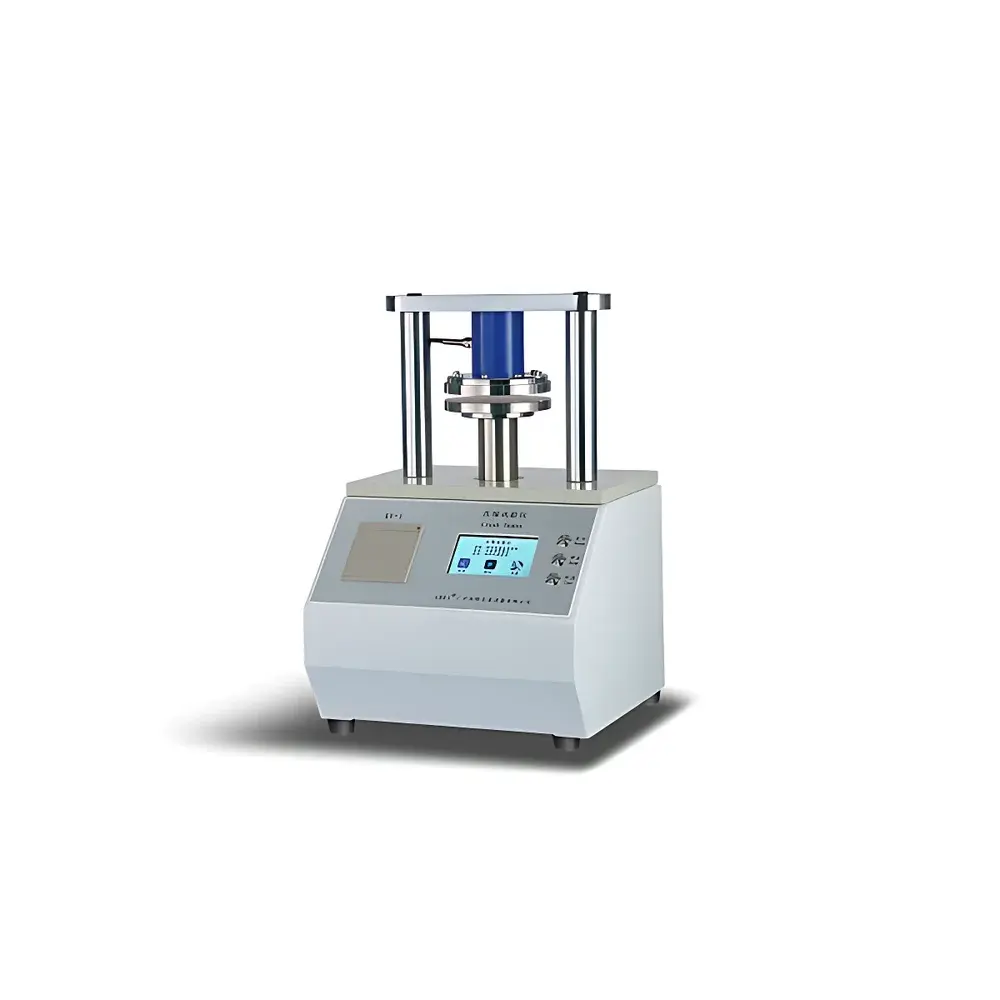
GBPI GY-1B Computer-Controlled Compression Testing Machine for Corrugated Board and Paper Materials
| Brand | GBPI |
|---|---|
| Model | GY-1B |
| Origin | Guangdong, China |
| Manufacturer | Guangzhou GBPI Packaging Instrument Co., Ltd. |
| Measurement Range | 30–3000 N |
| Resolution | 1 N |
| Accuracy | ±1% of reading |
| Repeatability | ≤1% |
| Test Speed | (12.5 ± 2.5) mm/min |
| Parallelism of Compression Plates | <0.05 mm |
| Maximum Plate Separation | ≥70 mm |
| Weight | ~34 kg |
| Dimensions (W×D×H) | ~330 × 350 × 510 mm |
| Standards Compliance | TAPPI T472, JIS P 8126, GB/T 2679.8, GB/T 6546, GB/T 6548, GB/T 2679.6, GB/T 451.3, GB/T 6547 |
Overview
The GBPI GY-1B Computer-Controlled Compression Testing Machine is a precision-engineered instrument designed specifically for mechanical strength evaluation of corrugated fiberboard, linerboard, medium, kraft paper, and related packaging substrates. It operates on the fundamental principle of uniaxial compressive force application between two parallel platens, measuring resistance to deformation under controlled displacement rate. The system adheres to standardized test geometries and loading protocols defined in international and national packaging material standards—including TAPPI T472 (Ring Crush Test), JIS P 8126 (Edge Crush Test), and multiple Chinese national standards (GB/T series) governing vertical crush, flat crush, edge crush, adhesion peel, and flute compression behavior. Its rigid frame, high-precision load cell, and regulated crosshead speed ensure consistent force transmission and minimal parasitic bending moments—critical for reproducible results in quality control laboratories, R&D centers, and third-party certification facilities serving the global packaging supply chain.
Key Features
- Microprocessor-controlled closed-loop drive system with adjustable crosshead speed (12.5 ± 2.5 mm/min), compliant with standard-specified testing velocities.
- High-stability dual-platen architecture with parallelism maintained within <0.05 mm—minimizing non-uniform stress distribution across specimen surfaces.
- Integrated 30–3000 N load measurement range with 1 N resolution and ±1% full-scale accuracy, traceable to national metrological standards.
- Modular accessory interface supporting rapid tooling changes for multi-mode testing without recalibration: ring crush (RCT), edge crush (ECT), flat crush (FCT), peel adhesion (PAT), flute compression (CCT/CMT), and thickness measurement.
- Robust cast-iron base and reinforced steel column structure ensuring long-term dimensional stability and vibration damping during dynamic loading cycles.
- Onboard digital display with real-time load and displacement readouts; optional RS232/USB interface for external data logging and report generation.
Sample Compatibility & Compliance
The GY-1B accommodates standardized specimens per ISO 12192, TAPPI T818, and GB/T 451.3—ranging from 15 × 15 mm square coupons for thickness testing to 15 × 100 mm strips for ECT and 15.2 × 15.2 mm squares for FCT. Specimen preparation tools—including ring crush centering disks, ECT guide blocks, PAT peel fixtures, and CCT fluting jigs—are supplied as part of the certified accessory suite. All test modes align with regulatory frameworks applicable to packaging performance validation: ASTM D6342 (for RCT), ISO 3037 (ECT), ISO 3035 (FCT), and FDA-relevant Good Manufacturing Practice (GMP) documentation requirements for material qualification in pharmaceutical and food-grade packaging applications. The instrument supports GLP-compliant audit trails when paired with validated PC-based software.
Software & Data Management
While the base GY-1B operates via embedded firmware with local display, it is fully compatible with GBPI’s optional PC-based TestMaster™ software (v3.2+). This platform enables automated test sequence programming, real-time curve plotting (load vs. displacement), statistical analysis (mean, SD, CV%), export to CSV/PDF/Excel formats, and user-access-level permissions. Data integrity features include electronic signatures, timestamped event logs, and 21 CFR Part 11–compliant audit trail functionality—meeting documentation rigor expected by ISO/IEC 17025-accredited labs and regulatory auditors. Calibration records, maintenance history, and test method templates are centrally managed within the software database.
Applications
- Quality assurance of corrugated board raw materials (linerboard, medium) and finished boxes in manufacturing environments.
- Validation of adhesive bond strength in multi-ply structures through controlled peel separation (PAT).
- Determination of flute resilience and structural efficiency via laboratory-scale corrugated formation (CCT/CMT).
- Comparative benchmarking of recycled versus virgin fiber grades under identical compressive loading conditions.
- Supporting sustainability initiatives by quantifying mechanical degradation after humidity cycling or accelerated aging protocols.
- Supplier qualification and incoming inspection per contractual technical specifications aligned with ISTA, ASTM, or customer-specific packaging standards.
FAQ
Is the GY-1B suitable for testing non-corrugated paper products such as printing paper or tissue?
Yes—the instrument can evaluate compressive stiffness and failure thresholds of single-ply and multi-ply papers using appropriate fixtures and specimen dimensions per GB/T 451.3 or ISO 536.
Does the system require annual recalibration by an accredited body?
While routine user verification using certified reference loads is recommended quarterly, formal recalibration traceable to CNAS or ILAC-MRA signatory labs is advised annually to maintain compliance with ISO/IEC 17025 requirements.
Can test data be exported directly into LIMS or ERP systems?
Yes—via ASCII-formatted CSV output or OPC UA protocol integration when using TestMaster™ Enterprise Edition, enabling seamless ingestion into enterprise data infrastructure.
What safety certifications does the GY-1B carry?
It conforms to IEC 61010-1:2010 for electrical safety and includes mechanical interlocks, emergency stop circuitry, and CE-marked power supply components.
Is training provided for operators and maintenance personnel?
GBPI offers on-site or virtual operator certification programs covering test method selection, fixture installation, result interpretation, and preventive maintenance schedules.





