
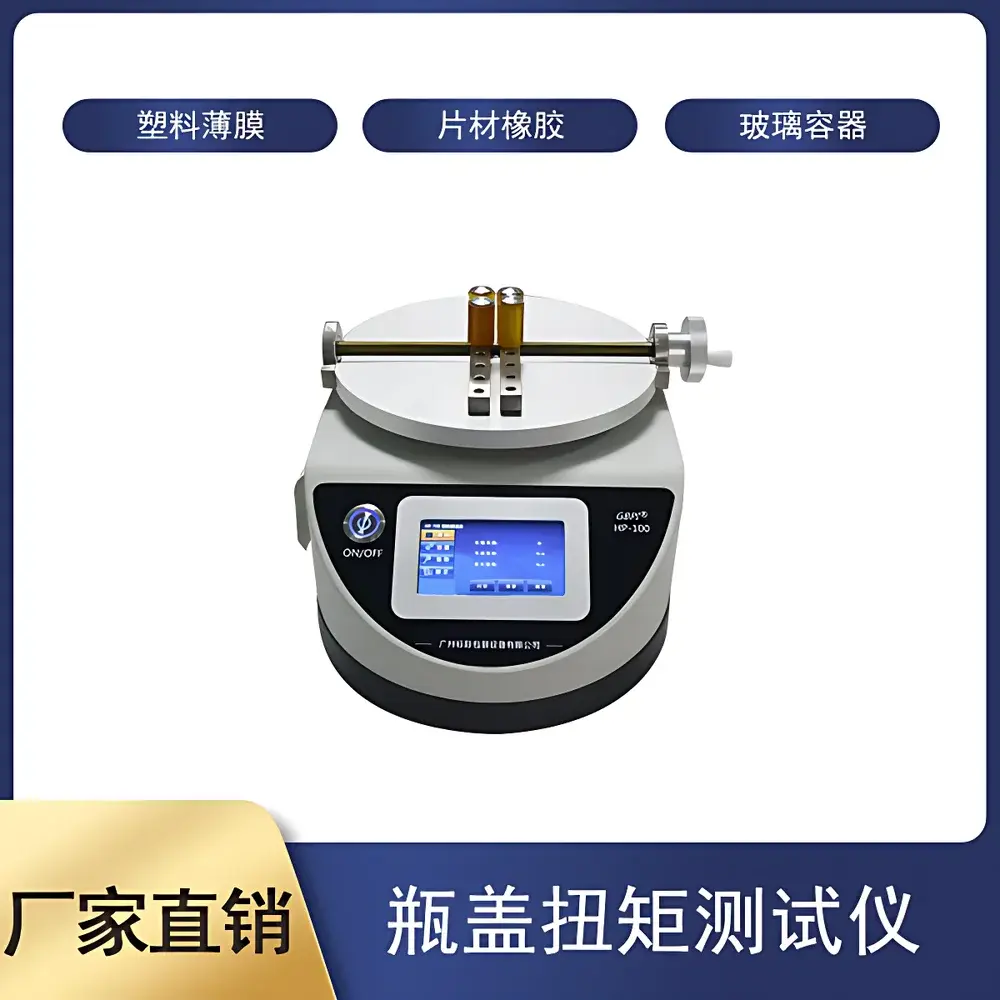
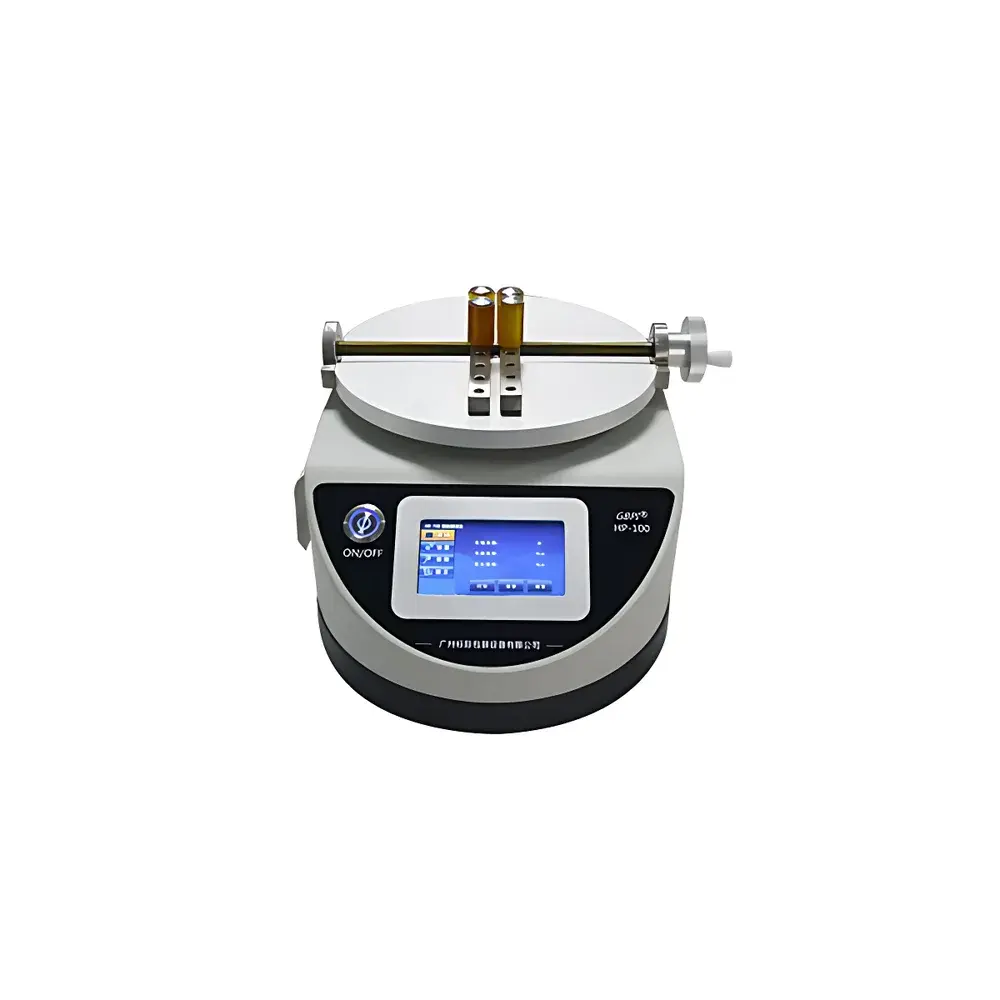
GBPI HP-100 Digital Cap Torque Tester
| Brand | GBPI |
|---|---|
| Model | HP-100 |
| Type | Digital Cap Torque Tester |
| Torque Measurement Range | 0.01–10 N·m (0.001–20 N·m optional) |
| Torque Resolution | 0.001 N·m |
| Accuracy | ±1% of full scale |
| Twist Angle Compatibility | Φ10–150 mm |
| Motor Power | 1 W |
| Dimensions | 410 × 320 × 200 mm |
| Weight | 9.5 kg |
| Display | 4.3-inch high-resolution capacitive touchscreen |
| Data Storage | Local storage for up to 10 test records with statistical analysis (max/min/mean/SD) |
| Output | Built-in thermal printer (3-part moisture-, dust-, and scratch-resistant paper) |
| Units | N·m, lbf·in, kgf·cm |
| Bidirectional Testing | Clockwise & counterclockwise torque measurement |
| Peak Hold & Auto-Alarm | Configurable overload threshold with audible/visual alert |
| Calibration & Settings | Non-volatile memory retention across power cycles |
| Compliance | Designed for ISO 8503-2, ASTM D3474, USP <661>, and packaging integrity validation per FDA 21 CFR Part 11–compliant data handling protocols |
Overview
The GBPI HP-100 Digital Cap Torque Tester is an engineered precision instrument designed for quantitative evaluation of closure torque in pharmaceutical, cosmetic, food, and consumer product packaging systems. It operates on the principle of controlled rotational force application and real-time digital transduction of torsional load, enabling repeatable, traceable measurement of both sealing (tightening) and opening (loosening) torque values. Unlike analog or mechanical torque wrenches, the HP-100 employs a calibrated strain-gauge-based torque sensor coupled with closed-loop DC motor control, ensuring consistent angular velocity and minimal inertia-induced overshoot during dynamic testing. Its primary purpose is to support quality control (QC) and process validation activities—specifically verifying cap-torque consistency across production batches, validating child-resistant (CR) and senior-friendly (SF) closure functionality, and assessing package integrity under mechanical stress conditions.
Key Features
- High-resolution 4.3-inch capacitive touchscreen interface with intuitive icon-driven navigation and multilingual UI support (English, Spanish, French, Chinese).
- Bidirectional torque measurement capability—supports both clockwise (sealing) and counterclockwise (opening) rotation with independent zeroing and peak-hold functions.
- Three selectable torque units (N·m, lbf·in, kgf·cm) with automatic scaling and real-time unit conversion during live measurement.
- Configurable overload alarm: user-defined torque threshold triggers visual indicator and audible beep to prevent sensor saturation or mechanical damage.
- Onboard statistical processing engine computes maximum, minimum, mean, and standard deviation from up to 10 stored test records—no external software required.
- Non-volatile memory retains calibration coefficients, alarm thresholds, unit preferences, and date/time settings across power cycles without battery backup dependency.
- Integrated thermal printer outputs compliant test reports including timestamp, operator ID (optional), sample ID, torque value, direction, and pass/fail status per preset limits.
- Modular chuck system accommodates cylindrical closures from Φ10 mm to Φ150 mm diameter with adjustable centering and axial preload compensation.
- Low-power 1 W brushless DC motor ensures stable low-speed rotation (<1 rpm to 30 rpm) suitable for quasi-static torque profiling and creep testing protocols.
Sample Compatibility & Compliance
The HP-100 is validated for use with screw-capped bottles (glass, HDPE, PET), aluminum-sealed vials, laminated tube caps, and blister-lid peel seals. Its clamping geometry supports flat-top, ribbed, and contoured caps without slippage, thanks to dual-axis alignment and pneumatic-assisted grip pressure (optional add-on). The instrument conforms to key international standards governing packaging performance testing: ASTM D3474 (Standard Practice for Calibration of Torque Measuring Devices Used for Packaging Applications), ISO 8503-2 (Surface Roughness – Method for the Assessment of Surface Roughness), and USP (Plastic Packaging Systems for Pharmaceutical Use). For regulated environments, audit trails—including operator login, parameter changes, calibration events, and raw torque vs. time curves—are exportable via USB and structured to align with FDA 21 CFR Part 11 requirements when paired with GBPI’s optional TraceLink™ software suite.
Software & Data Management
While fully functional as a standalone unit, the HP-100 integrates seamlessly with GBPI’s TraceLink™ PC software (Windows 10/11, x64) for advanced data governance. TraceLink enables automated report generation in PDF/XLSX formats, SPC charting (X-bar/R, Cpk/Ppk), electronic signature capture, and database synchronization with LIMS platforms via ODBC. All test records include embedded metadata: timestamp (with NTP-synced RTC), environmental temperature/humidity (via optional external sensor input), operator ID, and instrument serial number. Raw torque-time datasets are saved in CSV format with millisecond-level temporal resolution, supporting post-test waveform analysis for failure mode identification (e.g., sudden torque drop indicating seal rupture or thread stripping).
Applications
- Pharmaceutical packaging QC: verification of torque consistency for parenteral vials, oral solid dose bottles, and inhaler actuators.
- Child-resistant/senior-friendly (CR/SF) closure validation per 16 CFR §1700.20 and ISO 8317.
- Stability study support: monitoring torque degradation over accelerated aging (40°C/75% RH) or freeze-thaw cycles.
- Supplier qualification: comparative torque profiling of caps sourced from multiple vendors under identical test conditions.
- Process development: correlation of capping machine torque settings with measured bottle seal integrity (e.g., helium leak rate, vacuum decay).
- Regulatory submission documentation: generating auditable, ALCOA+ compliant data packages for ANDA, NDA, or MAA filings.
FAQ
What is the recommended calibration interval for the HP-100?
Calibration should be performed at least annually or after 5,000 test cycles—whichever occurs first—using NIST-traceable torque standards. GBPI provides certified calibration services with ISO/IEC 17025-accredited certificates.
Can the HP-100 measure torque on non-cylindrical closures such as flip-top caps or pumps?
Yes, with optional custom fixtures (e.g., universal jaw adapter or vacuum suction base), the HP-100 accommodates asymmetric closures provided rotational axis alignment is maintained within ±2° tolerance.
Is firmware upgrade supported in the field?
Yes—firmware updates are delivered via USB flash drive and installed through the device’s maintenance menu. Each release includes version-locked checksum verification and rollback capability.
Does the built-in printer meet GMP documentation requirements?
The thermal printer produces permanent, smudge-resistant output compliant with Annex 11 and EU GMP Chapter 4; however, for full electronic record compliance, pairing with TraceLink™ and a qualified e-signature workflow is recommended.
How is traceability ensured during multi-operator usage?
Each test record logs the currently active operator profile (assigned via alphanumeric ID), and all configuration changes are time-stamped and attributed—supporting role-based access control when used with TraceLink™.



