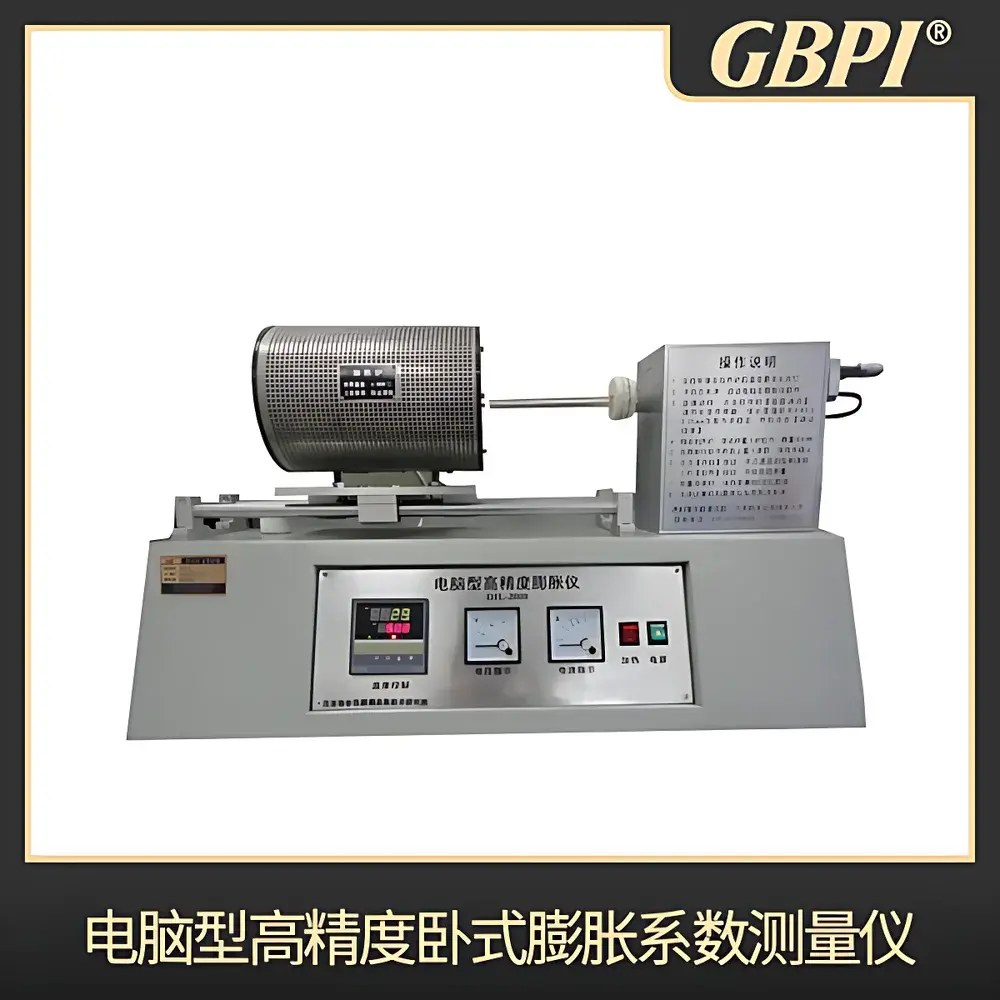
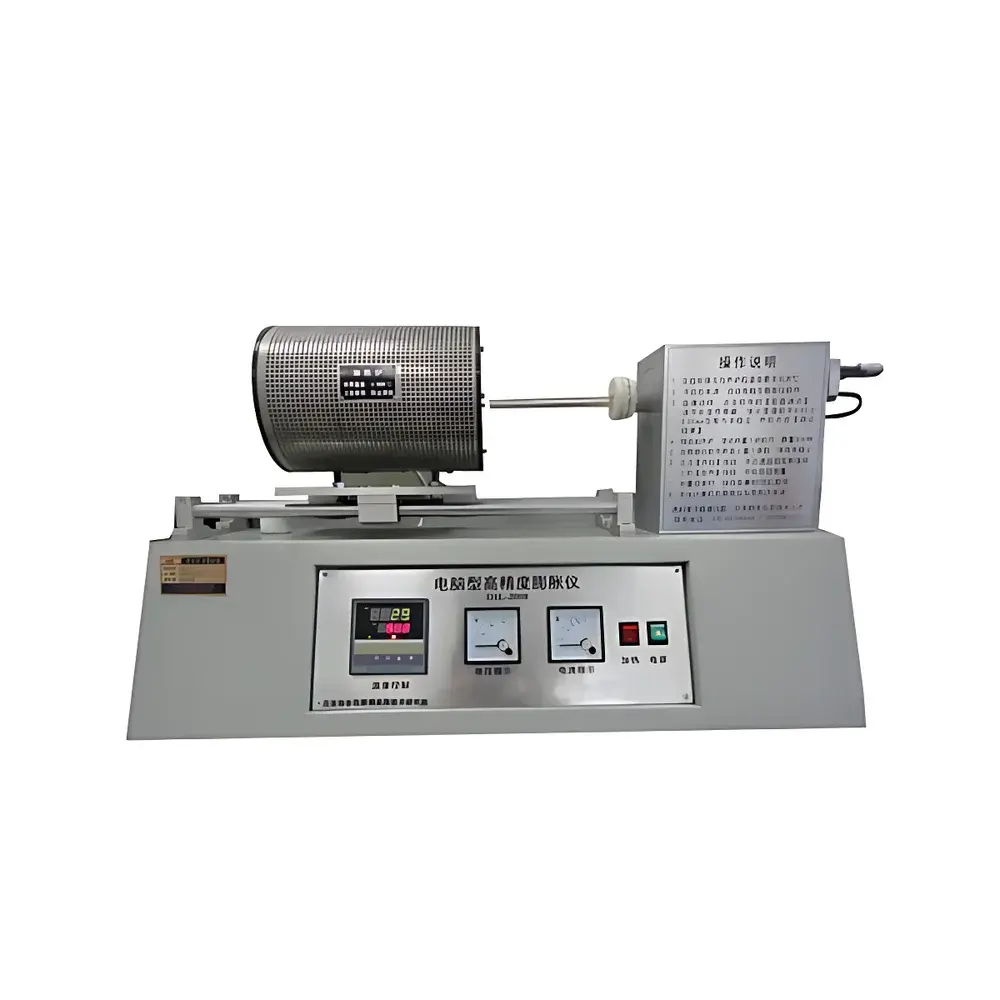
GBPI HYD-DIL-III-1000 High-Precision Horizontal Dilatometer
| Brand | GBPI |
|---|---|
| Origin | Guangdong, China |
| Manufacturer Type | Direct Manufacturer |
| Origin Category | Domestic (China) |
| Model | HYD-DIL-III-1000 |
| Pricing | Available Upon Request |
| Temperature Range | Ambient to 1000 °C |
| Heating Rate | 1–20 °C/min (5 °C/min recommended for glass) |
| Power Supply | AC 220 V / 50 Hz |
| Rated Power | 4 kW |
| Measurement Accuracy | ±2.5% |
| Repeatability | ±1.0% |
| Sample Length Range | 40–70 mm (standard: 50 ±1 mm) |
| Resolution | 0.1 µm |
Overview
The GBPI HYD-DIL-III-1000 is a high-precision horizontal dilatometer engineered for the quantitative determination of linear thermal expansion behavior in solid materials across a broad temperature range—from ambient up to 1000 °C. It operates on the push-rod principle, a standardized method defined in ASTM E228, ISO 7991, and DIN 51045-1, where dimensional changes of a specimen are mechanically transmitted via a low-thermal-expansion quartz or alumina push rod to a high-resolution digital length sensor. The instrument’s resistance self-balancing transduction system ensures minimal mechanical hysteresis and thermal drift, enabling stable, real-time acquisition of expansion increments with 0.1 µm resolution. Designed specifically for demanding applications in packaging-related material development—such as glass vial annealing characterization, ceramic sealant compatibility testing, and metal foil thermal stability assessment—the HYD-DIL-III-1000 delivers metrologically traceable data essential for process validation, formulation optimization, and regulatory documentation.
Key Features
- Horizontal furnace architecture with optimized thermal uniformity and minimized gravitational sag effects during high-temperature measurement
- Digital length sensor with 0.1 µm resolution and integrated resistance self-balancing circuitry for enhanced signal stability
- Programmable heating rate control (1–20 °C/min), with dedicated 5 °C/min ramp profile pre-configured for glass transition and annealing point analysis per ISO 7888
- Integrated PC-based control interface supporting multi-step temperature programs, dwell stabilization, and automatic zero-point correction
- Robust mechanical design featuring low-expansion ceramic guidance components and precision-ground stainless steel sample holders
- Compliance-ready architecture: supports audit trail generation, user access levels, and electronic signature capability aligned with FDA 21 CFR Part 11 requirements when operated with validated software modules
Sample Compatibility & Compliance
The HYD-DIL-III-1000 accommodates cylindrical or prismatic solid specimens ranging from 40 to 70 mm in length (standardized at 50 ±1 mm), with cross-sectional dimensions compatible with common packaging substrate geometries—including pharmaceutical glass tubing (e.g., Type I borosilicate), aluminum alloy foils, laminated polymer films, and refractory ceramic spacers. Specimen mounting follows ISO 11359-1 guidelines for contact-type dilatometry, ensuring consistent axial loading and thermal contact integrity. The system meets essential performance criteria outlined in ASTM E228 (Standard Test Method for Linear Thermal Expansion of Solid Materials With a Push-Rod Dilatometer), ISO 7991 (Ceramic materials — Determination of linear thermal expansion), and USP (Containers – Glass), making it suitable for GLP-compliant laboratories engaged in container closure integrity studies and thermal stress qualification.
Software & Data Management
The instrument is operated via GBPI’s proprietary Dilatometer Control Suite—a Windows-based application developed in accordance with IEC 62304 software lifecycle standards. The suite provides synchronized acquisition of temperature, displacement, and time-stamped metadata; real-time curve visualization with overlay comparison tools; and automated calculation of mean linear expansion coefficient (αL) over user-defined intervals. All raw data files are saved in vendor-neutral CSV format with embedded calibration coefficients and environmental timestamps. Audit trail functionality records operator ID, parameter modifications, calibration events, and report generation actions—fully compliant with ALCOA+ principles (Attributable, Legible, Contemporaneous, Original, Accurate, Complete, Consistent, Enduring, Available). Export options include PDF reports with embedded uncertainty budgets per GUM (JCGM 100:2008) conventions.
Applications
- Determination of average linear expansion coefficient (αL) for glass packaging components (vials, ampoules, syringes) across sterilization-relevant temperature ranges
- Identification of characteristic temperatures in glass: strain point, annealing point, and softening point per ISO 7888 and ASTM C336
- Thermal compatibility evaluation of multi-layer packaging laminates under cyclic thermal load conditions
- Quality control of metallic closures and sealing rings subjected to autoclave or depyrogenation processes
- Research into thermal mismatch-induced delamination in pharmaceutical blister packaging structures
- Supporting ICH Q5C stability studies through quantification of dimensional drift in primary packaging under accelerated aging protocols
FAQ
What is the maximum allowable sample diameter for the HYD-DIL-III-1000?
The standard sample holder accepts specimens up to 12 mm in diameter; custom fixtures are available for diameters up to 20 mm upon request.
Does the system support continuous cooling measurements below ambient temperature?
No—this model is configured for heating-only operation from ambient to 1000 °C. Low-temperature variants with cryogenic modules are available under separate model designation.
Can the software calculate instantaneous expansion coefficients (dL/dT)?
Yes—the Dilatometer Control Suite includes derivative analysis mode, enabling numerical differentiation of displacement vs. temperature curves to derive local αL values with configurable smoothing filters.
Is calibration traceable to national metrology institutes?
All length sensors are factory-calibrated using NIST-traceable interferometric standards; certificate of calibration (with uncertainty budget) is supplied with each unit.
How is thermal expansion data validated for regulatory submissions?
The system supports IQ/OQ documentation packages and can be qualified per ASTM E2554 for analytical instrument verification, including repeatability, intermediate precision, and robustness testing across multiple operators and days.