
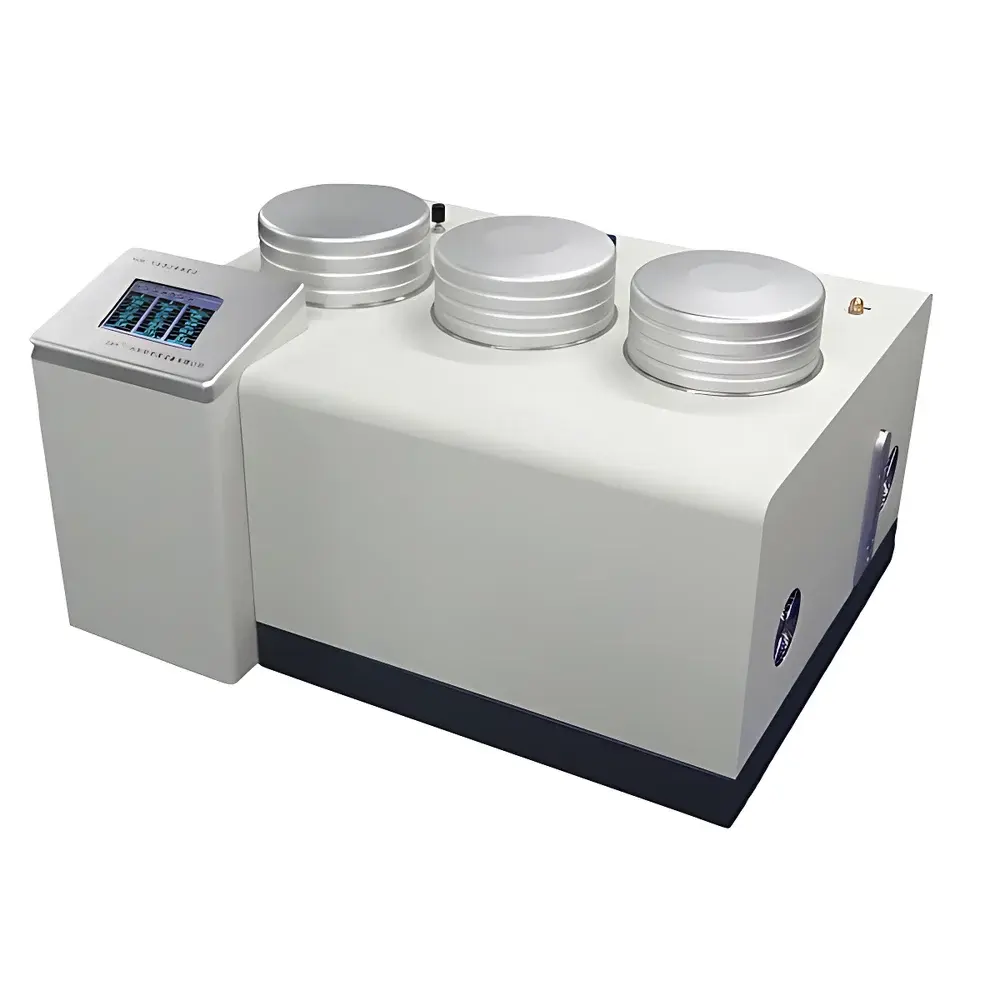
GBPI N530G2 Differential-Pressure Gas Permeability Tester
| Brand | GBPI |
|---|---|
| Origin | Guangdong, China |
| Manufacturer Type | OEM Manufacturer |
| Country of Origin | China |
| Model | N530G2 |
| Price Range | USD 14,000 – 70,000 |
| Testing Gases | O₂, CO₂, N₂ |
| Measurement Principle | Differential-pressure (manometric) method per ASTM D1434 & ISO 15105-1 |
| Test Area | 50.24 cm² |
| Sample Diameter | Φ110 mm |
| Max Sample Thickness | ≤2 mm |
| Temperature Control Range | 5–50 °C |
| Temp. Stability | ±0.01 °C |
| Vacuum Level | <20 Pa |
| Vacuum Resolution | 0.1 Pa |
| Test Pressure Range | −0.1 to +0.1 MPa |
| Gas Supply Pressure | 0.2–0.8 MPa |
| Gas Inlet Port | 1/8″ NPT |
| Permeation Range | 0.02–50,000 cm³/(m²·24h·0.1MPa) |
| Extended Range (with shroud) | up to 600,000 cm³/(m²·24h·0.1MPa) |
| Measurement Accuracy | 0.01 cm³/(m²·24h·0.1MPa) |
| Repeatability | <10% RSD |
| Chamber Configuration | Triple independent test chambers |
| Power Supply | AC 220 V, 50 Hz |
| Power Consumption | 1000 W |
| Dimensions | 800 × 560 × 400 mm |
| Weight | 100 kg |
| Compliance Standards | GB/T 1038–2000, ISO 2556:1974, ISO 15105-1:2007, ASTM D1434–2022, YBB 00082003–2015, JIS K7126-1:2006 |
Overview
The GBPI N530G2 Differential-Pressure Gas Permeability Tester is an engineered solution for precise, traceable, and repeatable measurement of gas transmission rates (GTR) through polymeric films, laminates, foils, rigid sheets, and packaging containers. It operates on the differential-pressure (manometric) principle defined in ASTM D1434 and ISO 15105-1, wherein a controlled pressure gradient is established across a sealed test specimen, and the rate of gas accumulation in the low-pressure side is quantified via high-stability pressure transducers. This method ensures direct, absolute measurement of permeation without reliance on carrier gas flow calibration or sensor drift compensation—critical for regulatory-grade data integrity in pharmaceutical, food, and medical device packaging validation.
Key Features
- Triple independent test chambers: Each chamber features a dedicated high-resolution pressure sensor, independent vacuum control, and autonomous thermal regulation—enabling concurrent testing of three distinct materials, three different gases (O₂, CO₂, N₂), or replicate runs under identical conditions. No cross-contamination or thermal interference occurs between chambers.
- Automated pressure-differential maintenance: Proprietary closed-loop feedback system dynamically adjusts upstream and downstream pressures to sustain user-defined ΔP (e.g., 0.1 MPa) throughout the entire test duration—eliminating manual intervention and ensuring compliance with standardized test protocols.
- Sub-millikelvin temperature stability: Electromagnetic stepwise thermal control delivers ±0.01 °C uniformity across all chambers, verified by integrated PT100 sensors and traceable to national metrology standards (GBW(E)130541/2).
- ARM-based embedded architecture: Fully autonomous operation without external PC dependency; color TFT touchscreen interface displays real-time pressure, differential pressure, temperature, and cumulative permeation curves—with configurable visibility toggles and local database storage.
- GMP-aligned software framework: Compliant with Annex 11 (Computerized Systems) and FDA 21 CFR Part 11 requirements, supporting role-based access control (administrator, operator, reviewer), full audit trail (system, method, run-level), electronic signatures, and immutable data archiving.
Sample Compatibility & Compliance
The N530G2 accommodates flat specimens up to Φ110 mm and ≤2 mm thick—including biaxially oriented polypropylene (BOPP), ethylene-vinyl alcohol (EVOH) coextrusions, aluminum foil laminates, siliconized PET, ceramic-coated barrier films, and fluoropolymer membranes. With optional container fixtures (bottle, pouch, cup adapters), it extends to ASTM F2622-compliant headspace analysis of rigid and semi-rigid packaging. All hardware and firmware comply with ISO/IEC 17025 preconditions for accredited laboratories. Calibration traceability is maintained via certified reference materials (CRMs) issued by China’s National Institute of Metrology (NIM), with documented uncertainty budgets aligned to ISO/IEC 17025:2017 Clause 6.5.
Software & Data Management
GBPI PermeTest v4.2 provides full lifecycle data governance: automated report generation (PDF, Excel, Word), customizable templates compliant with USP , EP 2.9.17, and ICH Q5C, and SQL-based local database indexing. All raw sensor outputs—including time-stamped pressure decay profiles, temperature logs, and vacuum ramp sequences—are retained with hash-verified integrity. Audit trails record user login/logout events, parameter modifications, report exports, and calibration actions—including timestamps, operator IDs, and justification fields. Data export supports CSV batch extraction for LIMS integration and statistical process control (SPC) analysis using Minitab or JMP.
Applications
- Pharmaceutical primary packaging qualification per YBB 00082003–2015 and USP
- Oxygen transmission rate (OTR) validation of blister lidding foils and cold-forming aluminum composites
- CO₂ permeability assessment of carbonated beverage bottle preforms and PET thermoforms
- N₂ barrier performance verification for retort pouches and vacuum-sealed medical device trays
- Accelerated aging correlation studies linking permeation kinetics to Arrhenius modeling (Eₐ determination)
- Regulatory submission dossiers requiring GLP-compliant instrumentation records and metrological traceability
FAQ
What gas types can be tested with the N530G2?
O₂, CO₂, and N₂ are fully supported. Other permanent gases (e.g., He, Ar, H₂) may be used subject to sensor compatibility verification and CRM availability.
Is the instrument suitable for testing flexible packaging containers?
Yes—via optional container test kits that conform to ASTM F2622 and ISO 15105-2, enabling headspace gas analysis of bottles, pouches, and trays.
How is calibration traceability ensured?
The system accepts certified gas permeation standards (GBW(E)130541/2) for in-situ verification; all pressure and temperature sensors carry NIM-traceable calibration certificates with stated uncertainties.
Can test methods be saved and reused across users?
Yes—method templates store all parameters (ΔP, T, dwell time, gas type, pass/fail criteria) and are version-controlled with change history and approver sign-off.
Does the system support 21 CFR Part 11 compliance?
Yes—electronic signatures, audit trails, role-based permissions, and data immutability are natively implemented without third-party middleware.







