
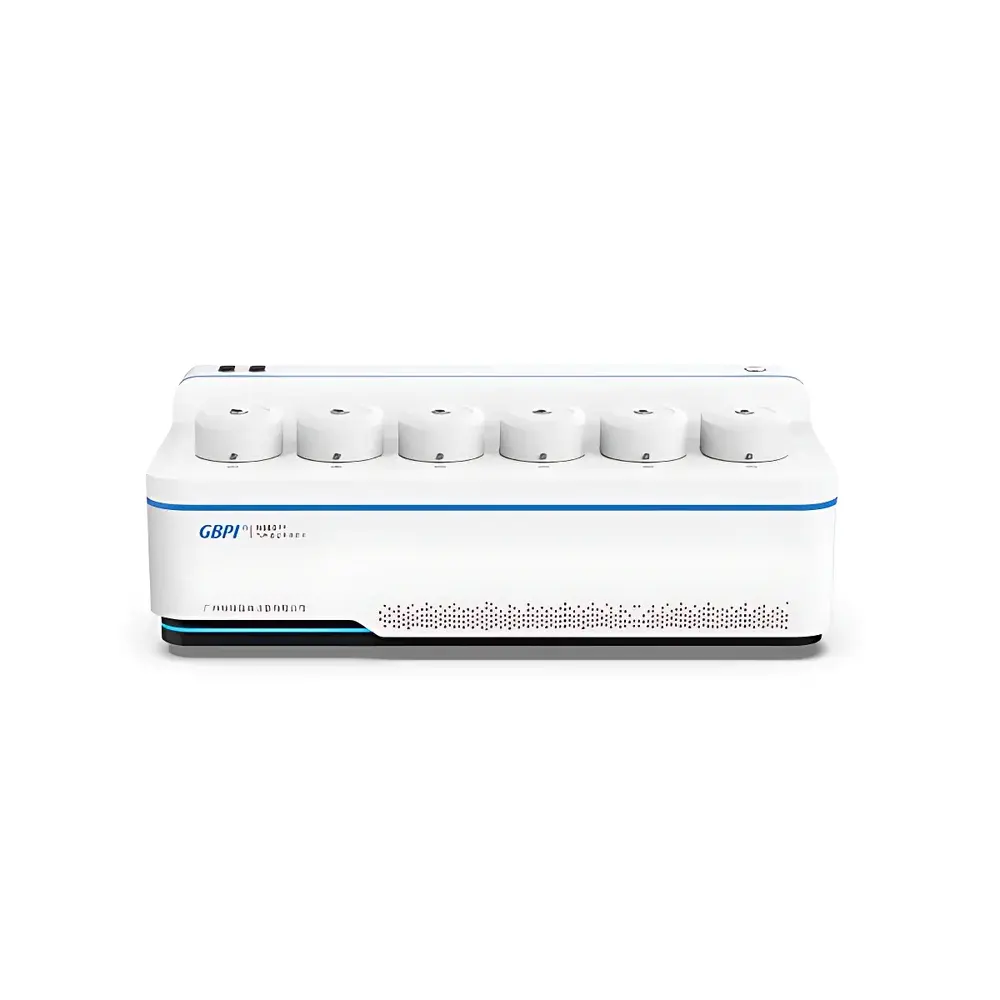
GBPI N560 2.0A Six-Chamber Gas Permeability Tester
| Brand | GBPI |
|---|---|
| Origin | Guangdong, China |
| Manufacturer Type | Direct Manufacturer |
| Country of Origin | China |
| Model | N560 2.0A |
| Quotation | Upon Request |
| Test Principle | Differential Pressure Method (ASTM D1434, ISO 2556, GB/T 1038.1, ISO 15105-1, YBB 00082003, ChP 2025 <4007>) |
| Measurement Range | 0.01–25,000 cm³/(m²·24 h·0.1 MPa) |
| Resolution | 0.0001 cm³/(m²·24 h·0.1 MPa) |
| Temperature Control Range | 15–60 °C |
| Temperature Accuracy | ±0.1 °C |
| Vacuum Accuracy | ±0.2% of reading |
| Ultimate Vacuum | <10 Pa |
| Vacuum Resolution | 0.01 Pa |
| Test Pressure | 0.1 MPa |
| Permeation Area | 50.24 cm² |
| Specimen Diameter | Φ110 mm |
| Max. Specimen Thickness | ≤2 mm |
| Chamber Count | 6 |
| Pneumatic Pressure | ≥0.3 MPa |
| Power | 1500 W |
| Supply | AC 220 V, 50 Hz |
| Dimensions | 1140 × 600 × 440 mm |
| Test Gases | O₂, CO₂, N₂, air, He |
| Compliance | ASTM, ISO, GB/T, JIS, YBB, ChP 2025 |
Overview
The GBPI N560 2.0A Six-Chamber Gas Permeability Tester is an engineered precision instrument designed for quantitative determination of gas transmission rates (GTR) through packaging materials and containers under controlled differential pressure conditions. It operates on the well-established manometric differential pressure method—where a test specimen separates two sealed chambers; the upstream chamber is pressurized with a defined test gas (e.g., O₂, CO₂, or N₂), while the downstream chamber is maintained under high vacuum. The resulting gas flux across the sample generates a measurable pressure rise in the downstream chamber over time, from which the steady-state gas permeability is calculated per standardized units: cm³/(m²·24 h·0.1 MPa). This principle conforms rigorously to international regulatory test methods including ASTM D1434, ISO 2556, ISO 15105-1, GB/T 1038.1, JIS K7126-1, YBB 00082003, and the newly promulgated Chinese Pharmacopoeia 2025 monograph . Its primary application domain spans quality control, formulation development, shelf-life prediction, and regulatory compliance verification for barrier materials used in pharmaceutical, food, beverage, medical device, and consumer packaging industries.
Key Features
- Six independent test chambers enable concurrent evaluation of up to six specimens—identical or heterogeneous—each with autonomous pressure monitoring, temperature regulation, and data acquisition. No cross-talk or shared pneumatic interference occurs between chambers.
- High-fidelity vacuum architecture integrates a certified low-noise vacuum pump with ultimate vacuum capability ≤0.05 Pa, paired with a temperature-compensated silicon piezoresistive pressure sensor (0.01 Pa resolution, drift ≤0.01% FS/°C), ensuring continuous, gap-free measurement across the full dynamic range.
- Patented auto-pressure-hold algorithm dynamically adjusts upstream gas supply to maintain constant transmembrane differential pressure (configurable within 0–300 kPa), eliminating manual recalibration and minimizing baseline drift during extended tests.
- Bidirectional thermoelectric (Peltier) temperature control delivers uniform thermal conditioning across all chambers at ±0.1 °C accuracy, critical for Arrhenius-based permeability modeling and comparative studies across temperature gradients.
- Electro-pneumatic clamping system ensures repeatable, leak-tight sealing of specimens up to 2 mm thickness with minimal operator intervention—validated via helium leak testing to ≤1×10⁻⁹ mbar·L/s.
- Modular hardware design supports optional high-pressure modules, container adapters (for bottles, pouches, trays, tubes), and multi-gas switching manifolds without firmware modification.
Sample Compatibility & Compliance
The N560 2.0A accommodates planar and three-dimensional specimens across diverse material classes: polymeric films (BOPP, PET, PE, CPP, PLA, PBAT), laminates (AlOx-, SiOx-, metallized), pharmaceutical foils (PVC/PVDC, cold-forming aluminum), coated papers, rubber elastomers, and rigid containers (PET bottles, aluminum cans, composite cartons, blister packs). All configurations comply with Good Laboratory Practice (GLP) and Good Manufacturing Practice (GMP) requirements. The system implements full 21 CFR Part 11-compliant audit trails—including user action logs, parameter change history, electronic signatures, and immutable raw data storage—supporting FDA, EMA, PMDA, and NMPA submissions. Calibration traceability is maintained using GBW(E) 130541 and GBW(E) 130542 certified reference materials issued by the State Administration for Market Regulation (SAMR), China.
Software & Data Management
The embedded GBPI PermeaSoft™ v4.2 platform features a modular GUI built on Qt framework, supporting multi-language UI (English, Chinese, Japanese, Spanish), role-based access control (admin/operator/auditor tiers), and configurable report templates compliant with ISO/IEC 17025 reporting clauses. Real-time visualization includes five synchronized time-series plots: permeation rate vs. time, chamber temperature vs. time, upstream/downstream pressure vs. time, and ΔP vs. time—all exportable as SVG/PNG/CSV. Advanced analytics include Fickian diffusion modeling, solubility-diffusivity coefficient separation, activation energy calculation via Arrhenius fitting, and accelerated aging projections. Data is stored in encrypted SQLite databases with SHA-256 hashing; backups are scheduled automatically to network drives or cloud endpoints (AWS S3, Azure Blob).
Applications
- Pharmaceutical packaging validation: blister foil integrity, sachet laminate performance, vial stopper permeability, and child-resistant container barrier assessment per ICH Q5C and USP .
- Food packaging R&D: optimization of modified atmosphere packaging (MAP) films, evaluation of compostable barrier layers, and shelf-life modeling of oxygen-sensitive products (e.g., nuts, coffee, dairy).
- Medical device packaging: ISO 11607-1/2 compliance testing for sterile barrier systems (Tyvek®/PE laminates, thermoformed trays).
- Automotive & electronics: moisture vapor transmission rate (MVTR) correlation studies for conformal coatings and encapsulation resins.
- Academic research: structure-property relationships in nanocomposite films, polymer blend phase behavior, and degradation kinetics under elevated humidity/temperature stress.
FAQ
What standards does the N560 2.0A comply with?
It meets ASTM D1434, ISO 2556, ISO 15105-1, GB/T 1038.1, JIS K7126-1, YBB 00082003, and Chinese Pharmacopoeia 2025 , with full documentation for regulatory audits.
Can it test rigid containers like bottles or cans?
Yes—using optional container adapters that seal against neck finishes or flat surfaces, enabling direct GTR measurement of PET bottles, aluminum beverage cans, and composite tubs.
Is calibration traceable to national standards?
Yes—calibration uses SAMR-certified reference materials GBW(E) 130541 and GBW(E) 130542, with full certificate of analysis and uncertainty budget included.
Does the software support 21 CFR Part 11 compliance?
Yes—audit trail, electronic signatures, user permission hierarchy, and data immutability are implemented per FDA guidance for computerized systems in regulated environments.
What maintenance is required for long-term stability?
Annual vacuum sensor recalibration, quarterly pump oil replacement (if oil-sealed), and biannual verification using certified permeation standards—procedures documented in the GLP-aligned maintenance logbook.
Related Products






