
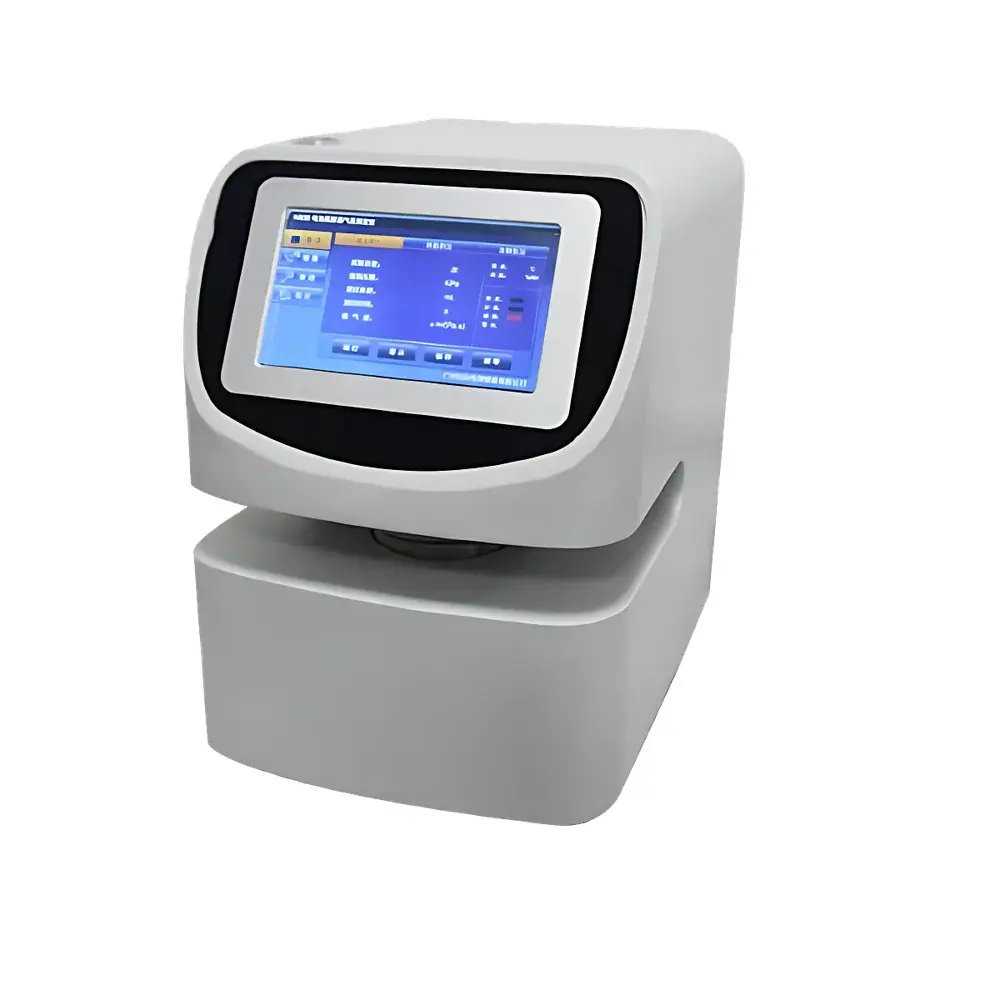
GBPI N600L Battery Separator Air Permeability Tester
| Brand | GBPI |
|---|---|
| Origin | Guangdong, China |
| Manufacturer | GBPI Packaging Instruments Co., Ltd. |
| Model | N600L |
| Testing Methods | Gurley (1.23 kPa ± 0.01 kPa), Schopper (1.00 kPa ± 0.01 kPa or 2.50 kPa ± 0.01 kPa), Bendtsen (1.47 kPa ± 0.02 kPa) |
| Test Area Options | 6.42 cm² or 10.0 ± 0.2 cm² |
| Pressure Range | 0–3 kPa (adjustable), Accuracy: ±0.01 kPa |
| Flow Rate Range | 0.01–120 mL/min |
| Permeability Range | 0.01–2.5 µm/(Pa·s) |
| Resolution | 0.001 µm/(Pa·s) |
| Test Duration | 10–6000.0 s |
| Sample Dimensions | 50 mm × 50 mm (Gurley/Bendtsen) or 60 mm × 100 mm (Schopper) |
| Environmental Monitoring | Integrated temperature & humidity sensor |
| Seal Integrity | ≤1.0 mL/h leakage |
| Power | 100 W, 220 V, 50 Hz |
| Dimensions (L×W×H) | 500 mm × 400 mm × 300 mm |
| Compliance | SJ/T 10171–2016, GB/T 458–2008, GB/T 36363–2018 |
Overview
The GBPI N600L Battery Separator Air Permeability Tester is a precision-engineered instrument designed specifically for quantitative evaluation of gas permeability in microporous polyolefin separators used in lithium-ion batteries. It operates on three internationally recognized pneumatic resistance principles—Gurley, Schopper, and Bendtsen—each defined by standardized pressure differentials and volumetric flow measurement protocols. The device measures the time required for a fixed volume of air (e.g., 100 mL under Gurley conditions) to pass through a defined test area under controlled differential pressure, yielding permeability values expressed in µm/(Pa·s)—a unit directly traceable to ISO 5636-5 and ASTM D726. Its architecture supports rigorous quality control workflows in battery material R&D, production line QC, and supplier qualification, where separator porosity, pore tortuosity, and interfacial resistance critically influence ionic conductivity, thermal shutdown behavior, and cell safety.
Key Features
- Triple-method integration: Simultaneous support for Gurley (1.23 kPa ± 0.01 kPa), Schopper (1.00 kPa or 2.50 kPa ± 0.01 kPa), and Bendtsen (1.47 kPa ± 0.02 kPa) testing modes—fully compliant with SJ/T 10171–2016 and GB/T 36363–2018.
- High-precision pressure regulation: Digital closed-loop control maintains differential pressure within ±0.01 kPa across the full 0–3 kPa range, eliminating manual calibration drift and ensuring repeatability <±1.2% RSD (n=10) per ISO 5636-3.
- Modular test area configuration: Interchangeable masks enable rapid switching between 6.42 cm² (Gurley/Bendtsen) and 10.0 ± 0.2 cm² (Schopper) effective areas without recalibration.
- Integrated environmental monitoring: Real-time logging of chamber temperature and relative humidity (RH) during test execution—critical for evaluating hygroscopic effects on separator morphology per GB/T 458–2008 conditioning requirements.
- Leak-tight test chamber: Verified seal integrity ≤1.0 mL/h (helium leak rate equivalent), validated per ASTM E493, minimizing baseline error in low-flow regimes (<5 mL/min).
- Dual-mode operation: Standalone touchscreen interface with local data storage + USB/RS232 connectivity for synchronized acquisition via Windows-based GBPI PermeaSoft™ v3.2 software.
Sample Compatibility & Compliance
The N600L accommodates standard lithium-ion battery separator formats including mono- and biaxially oriented polyethylene (PE) and polypropylene (PP) films, ceramic-coated variants, and nonwoven composites. Sample handling follows strict preconditioning protocols: specimens are equilibrated at ≤40 °C and 10–35% RH for ≥24 h (per SJ/T 10171–2016 Clause 5.2), with mass stability confirmed via sequential weighing (Δm/m ≤ 0.25% over 1 h). All test methods adhere to metrological traceability requirements outlined in ISO/IEC 17025:2017. Instrument validation includes documented pressure transducer calibration (NIST-traceable deadweight tester), flow sensor verification (volumetric prover), and system-level uncertainty analysis per GUM (JCGM 100:2008). Data output meets GLP audit requirements with timestamped metadata, operator ID, environmental logs, and electronic signature capability.
Software & Data Management
GBPI PermeaSoft™ v3.2 provides full test method configuration, real-time flow/pressure curve visualization, automatic calculation of Gurley seconds, Schopper air resistance (kPa·min/mL), and Bendtsen air permeance (mL/min), plus derived metrics such as mean pore size (via Hagen–Poiseuille approximation) and tortuosity factor. Raw data export is supported in CSV, XML, and PDF formats compliant with FDA 21 CFR Part 11 Annex 11 requirements—including audit trail, user access control, and electronic record retention. Software supports batch reporting templates aligned with IEC 62660-1 and UL 1642 test documentation standards. Local database stores ≥10,000 test records with searchable metadata (sample ID, method, date, operator, environmental conditions).
Applications
- QC release testing of incoming separator rolls against GB/T 36363–2018 specification limits (e.g., permeability ≤1.8 µm/(Pa·s) for high-power cells).
- R&D screening of novel coating formulations (e.g., Al₂O₃, SiO₂) to quantify pore blocking effects on gas diffusion kinetics.
- Process validation of stretching parameters during dry/wet process manufacturing—correlating permeability shifts with crystallinity changes measured via DSC/XRD.
- Failure analysis of field-returned cells exhibiting elevated internal resistance—cross-referencing permeability degradation with SEM pore structure imaging.
- Supplier qualification audits requiring third-party verified test reports per ISO 9001:2015 Clause 8.5.2.
FAQ
Which international standards does the N600L directly support?
The instrument implements test procedures and tolerances specified in SJ/T 10171–2016 (Chinese national standard for alkaline & Li-ion separator testing), GB/T 458–2008 (paper/board air permeance), and GB/T 36363–2018 (Li-ion polyolefin separator technical specifications).
Can the N600L be integrated into an automated production line?
Yes—via RS232/Modbus RTU protocol, the device supports PLC-triggered test sequences and real-time pass/fail status output to MES systems, with configurable digital I/O for pneumatic clamp actuation and alarm signaling.
Is operator training required for method switching?
No—method selection, pressure setpoint, test duration, and area configuration are fully menu-driven; firmware enforces interlocks preventing invalid parameter combinations (e.g., Gurley mode with 10 cm² mask).
How is calibration maintained between accredited lab audits?
The system includes embedded calibration routines for pressure and flow sensors, with certificate generation (including uncertainty budgets) compatible with ISO/IEC 17025 documentation packages. Annual external verification is recommended using NIST-traceable reference standards.
Does the instrument support non-standard test pressures beyond the three defined methods?
Yes—the 0–3 kPa adjustable pressure range allows custom protocol development; however, such deviations require user-defined uncertainty quantification and are not covered under standard compliance statements.




