
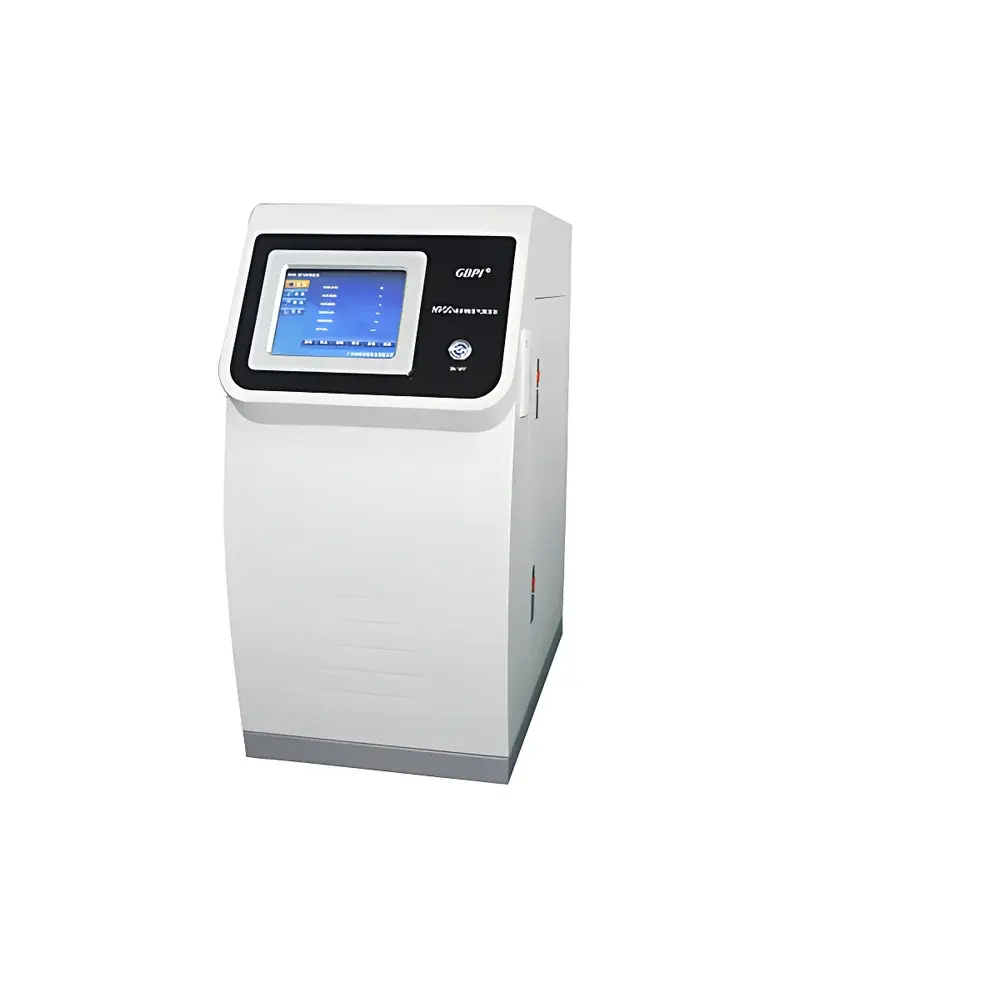
GBPI N900-3 Textile Air Permeability Tester
| Brand | GBPI |
|---|---|
| Origin | Guangdong, China |
| Manufacturer Type | Direct Manufacturer |
| Country of Origin | China |
| Model | N900-3 |
| Price Range | USD 4,200 – 7,000 |
| Pressure Drop Range | 1–4000 Pa (user-definable) |
| Air Permeability Range | 1–40,000 mm/s |
| Measurement Accuracy | ≤ ±2% |
| Specimen Size | 150 mm × 150 mm |
| Effective Test Area | 5 cm², 20 cm², 50 cm², or 100 cm² |
| Max Sample Thickness | ≤10 mm |
| Nozzle Diameters | 1.2, 2, 3, 4, 6, 8, 10, 12, 16, 20 mm |
| Dimensions (L×W×H) | 640 × 380 × 865 mm |
| Weight | 70 kg |
| Power Supply | AC 220 V, 50 Hz |
Overview
The GBPI N900-3 Textile Air Permeability Tester is a precision-engineered instrument designed in strict compliance with ISO 9237 and ASTM D737, and fully aligned with the Chinese national standard GB/T 5453–1997 for textile air permeability testing. It operates on the principle of constant-pressure differential airflow measurement: a regulated air stream is forced through a standardized specimen area under controlled pressure drop, and the volumetric flow rate is measured via high-accuracy differential pressure and mass flow sensors. Unlike legacy water-column manometer systems, the N900-3 employs solid-state pressure transducers and digital closed-loop pneumatic control to eliminate fluid-level drift, temperature-dependent calibration errors, and operator-induced variability. Its architecture integrates real-time microcontroller-based data acquisition, automatic sample clamping via pneumatic cylinder actuation, and on-device computation of normalized air permeability (in mm/s), coefficient of variation (CV%), and 95% confidence intervals—enabling full traceability without manual interpolation or lookup tables.
Key Features
- Pneumatically actuated clamping system ensures consistent specimen compression and eliminates human-induced torque variance across repeated tests.
- Multi-nozzle interchangeable orifice plate assembly (10 calibrated nozzles: Ø1.2–20 mm) enables precise range matching for low-, medium-, and high-permeability textiles—from dense technical membranes to open-weave geotextiles.
- Full-color 7-inch capacitive touchscreen interface with intuitive icon-driven navigation; all test parameters—including pressure setpoint, test duration, effective area selection, and unit preference—are configured directly on the device without external PC dependency.
- Onboard thermal mass flow sensor and dual-range differential pressure transducer deliver ≤±2% full-scale measurement uncertainty across the entire 1–40,000 mm/s permeability range.
- Integrated thermal printer outputs GLP-compliant reports including sample ID, test date, operator ID (optional login), test area, applied pressure drop, directional airflow notation (e.g., “face-to-back”), CV%, 95% CI, and pass/fail status against user-defined specification limits.
- USB and RS-232 interfaces support bidirectional data exchange with LIMS or ERP systems; optional Ethernet module enables remote monitoring and audit trail export per FDA 21 CFR Part 11 requirements.
Sample Compatibility & Compliance
The N900-3 accommodates rigid and flexible planar specimens up to 150 mm × 150 mm and 10 mm thick—including woven and knitted fabrics, nonwovens, coated textiles, laminated composites, filtration media, and medical barrier materials. Its modular test head supports four standardized effective areas (5, 20, 50, and 100 cm²) to meet ISO 9237 Annex A (5 cm² for high-resistance fabrics) and ASTM D737 Section 7.2 (100 cm² for low-resistance industrial textiles). All mechanical and electronic subsystems are CE-marked and comply with IEC 61000-6-2 (EMC immunity) and IEC 61010-1 (electrical safety). Calibration certificates traceable to NIM (National Institute of Metrology, China) are provided with each unit, and annual recalibration protocols align with ISO/IEC 17025–2017 laboratory accreditation requirements.
Software & Data Management
The embedded firmware implements a deterministic real-time operating system (RTOS) with non-volatile flash memory for secure storage of ≥10,000 test records. Data fields include raw flow readings, pressure transients, timestamped environmental logs (ambient T/P/H), and operator annotations. The optional GBPI AirPermea™ PC software (Windows 10/11 compatible) provides advanced statistical analysis—Shewhart X-bar/R charts, capability indices (Cp/Cpk), trend forecasting, and batch comparison overlays. Audit trails record every parameter change, report generation event, and user login/logout with immutable timestamps. Export formats include CSV (for Excel/SPC tools), PDF/A-1b (archival), and XML (LIMS integration). All software modules undergo periodic validation per GAMP5 guidelines for regulated environments.
Applications
- Quality assurance of apparel and protective clothing (e.g., flame-retardant workwear, surgical gowns, breathable rain shells).
- R&D evaluation of smart textiles incorporating micro-porous membranes or electrospun nanofiber layers.
- Regulatory submission support for medical device packaging (ISO 11607-1) and sterile barrier systems requiring documented air exchange rates.
- Performance benchmarking of filtration media used in HVAC, automotive cabin filters, and respirator facepieces (EN 149, NIOSH 42 CFR 84).
- Process validation for textile coating, laminating, and plasma treatment lines where permeability shift indicates surface energy modification.
- Academic research in textile physics, including correlation studies between pore structure (via SEM/mercury intrusion) and macroscopic airflow behavior.
FAQ
What standards does the N900-3 comply with?
It conforms to ISO 9237, ASTM D737, GB/T 5453–1997, JIS L 1096, and BS EN ISO 9237. Optional firmware updates can extend support to ISO 13938 (impact air permeability) upon request.
Can the instrument be calibrated in-house?
Yes—users may perform daily verification using certified reference orifices (NIST-traceable, supplied separately). Full metrological calibration requires GBPI-certified service engineers or accredited third-party labs.
Is the test data exportable to LIMS?
Yes—via USB drive, RS-232 serial output, or optional Ethernet module with configurable TCP/IP protocol stack and HL7-compatible metadata tagging.
Does it support bidirectional airflow testing?
No—the standard configuration measures unidirectional airflow (typically from front to back); however, reversible mounting fixtures and custom nozzle plates can be supplied for bidirectional comparative studies.
What maintenance is required?
Monthly cleaning of nozzle orifices with isopropyl alcohol and lint-free swabs; annual inspection of pneumatic seals and pressure sensor zero-drift verification. No consumables beyond standard calibration orifices are required.





