
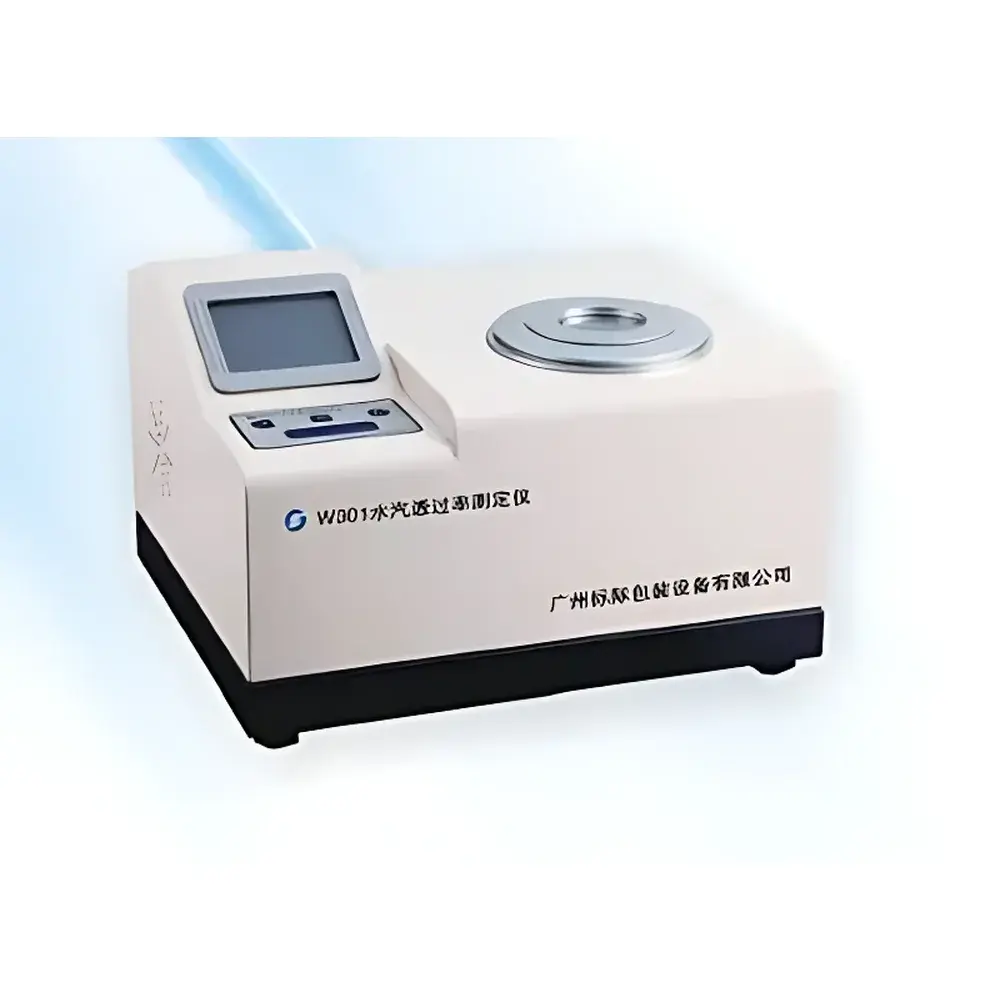
GBPI W301-P Gravimetric Water Vapor Transmission Rate Tester
| Brand | GBPI |
|---|---|
| Model | W301-P |
| Measurement Principle | Gravimetric (Weight Loss Method) |
| Measurement Range | 0.02–10,000 g/m²·day |
| Resolution | 0.001 g/m²·day |
| Temperature Control Range | 15–45 °C (optional 5–50 °C) |
| Temperature Accuracy | ±0.1 °C |
| Humidity Control | 0–20 %RH (dry-side method) or 10–90 %RH (dual-stream humidity control, optional) |
| Humidity Accuracy | ±2 %RH |
| Sample Thickness Limit | ≤2 mm |
| Test Area | 50.24 cm² (Ø80 mm) |
| Sample Capacity | 1 specimen per test |
| Compliance | GB 1037, GB/T 16928, ASTM E96, ASTM D1653, TAPPI T464, ISO 2528, DIN 53122-1, JIS Z0208, YBB00092003 |
Overview
The GBPI W301-P Gravimetric Water Vapor Transmission Rate (WVTR) Tester is an engineered solution for precise, standardized determination of water vapor permeability in flexible packaging materials—particularly ethylene-vinyl acetate (EVA) films, laminates, and multilayer barrier structures. Based on the gravimetric weight-loss principle defined in ASTM E96 and ISO 2528, the instrument quantifies mass loss of a desiccant-filled test cell under controlled temperature and relative humidity gradients across the specimen. This method delivers high reproducibility for low-to-moderate WVTR materials (<100 g/m²·day), making it ideal for QC laboratories in food, pharmaceutical, and personal care packaging manufacturing where regulatory traceability and method validation are critical.
Key Features
- Integrated dual-climate chamber with independent electronic PID temperature control (±0.1 °C) and precision dry-gas mixing for humidity regulation (0–20 %RH standard; 10–90 %RH optional via dual-stream configuration)
- 240,000-color capacitive touchscreen HMI with embedded Linux OS—enables full test setup, real-time curve monitoring, and standalone operation without PC dependency
- High-stability microbalance sensor with overload protection and continuous data acquisition at configurable intervals (1–60 min)
- Optimized desiccant chamber geometry with uniform gas flow distribution to minimize edge effects and ensure consistent vapor gradient development
- Automated endpoint detection based on slope convergence of cumulative mass loss vs. time, eliminating subjective judgment in test termination
- Password-protected parameter lockout during active testing prevents accidental modification; calibration parameters require admin-level access
- Dynamic curve zoom, pan, and overlay functions within the native software interface for comparative analysis across batches or material variants
Sample Compatibility & Compliance
The W301-P accommodates flat, non-porous, and semi-crystalline polymeric films up to 2 mm thickness—including EVA copolymers, PE, PP, PET, aluminum foil laminates, and metallized substrates. Its standardized test area of 50.24 cm² (Ø80 mm) aligns with major international protocols, ensuring cross-laboratory comparability. The system is fully compliant with GB 1037 (China), ASTM E96 (desiccant method), ASTM D1653 (coated paper), TAPPI T464 (paperboard), ISO 2528 (plastic films), DIN 53122-1 (German standard), JIS Z0208 (Japan), and YBB00092003 (Chinese pharmaceutical packaging standard). All calibration and verification procedures support GLP documentation requirements, including audit trails for environmental setpoints, sensor readings, and operator actions.
Software & Data Management
GBPI’s proprietary WinWVTR software runs on Windows OS and communicates via USB or RS-232. It provides real-time synchronized plotting of four primary variables: chamber temperature, test-side RH, specimen mass, and calculated WVTR (g/m²·day). Raw data files are stored in .CSV format with timestamps and metadata (operator ID, sample ID, test date, environmental logs). The software supports FDA 21 CFR Part 11-compliant user authentication, electronic signatures, and immutable audit trails when configured with networked domain authentication. Export options include PDF reports with embedded curves, Excel-ready datasets, and XML for LIMS integration. Calibration history, maintenance logs, and instrument diagnostics are retained locally and exportable for internal quality audits.
Applications
- Quality assurance of EVA-based photovoltaic encapsulant films for solar module durability assessment
- Barrier performance validation of blister packaging for moisture-sensitive oral solid dosage forms (per USP & YBB standards)
- Comparative WVTR screening of biodegradable films (PLA, PBAT blends) against conventional PE/PP controls
- R&D evaluation of nanocomposite coatings and plasma-treated surfaces for enhanced moisture resistance
- Stability testing of retort pouches and vacuum-sealed meat packaging under accelerated aging conditions
- Method transfer and inter-laboratory proficiency testing in contract testing organizations (CTOs)
FAQ
What measurement principle does the W301-P employ, and why is gravimetry preferred for certain applications?
The W301-P uses the standardized gravimetric (weight-loss) method per ASTM E96 Procedure B. It is particularly suited for low-permeability films where sensor-based methods (e.g., modulated IR or coulometric detection) may lack resolution or suffer from baseline drift over extended test durations (up to 7 days).
Can the instrument test rigid containers or pre-formed packages?
Standard configuration supports only flat film specimens. Optional package-testing accessories (sold separately) enable limited testing of small-volume pouches or cups using custom sealing fixtures—though results require empirical correlation to flat-film data per ASTM F1249 guidance.
Is humidity control limited to dry-side conditions?
The base system delivers 0–20 %RH on the desiccant side. Dual-stream humidity control (optional) allows independent regulation of both test and carrier gas streams, enabling precise RH gradients from 10–90 %RH—critical for evaluating hygroscopic polymers or humidity-dependent barrier behavior.
How is calibration verified and maintained?
Calibration includes certified reference weights (200 g stainless steel), NIST-traceable temperature/humidity probes, and certified reference films (available as optional accessories). Internal self-diagnostics monitor sensor linearity, thermal stability, and gas flow consistency at startup and during idle periods.
Does the system support 21 CFR Part 11 compliance out-of-the-box?
Yes—when deployed on a domain-authenticated Windows environment with enabled audit logging, digital signature prompts, and role-based access control, the WinWVTR software meets core technical requirements for electronic records and signatures in regulated pharmaceutical and medical device manufacturing.





