
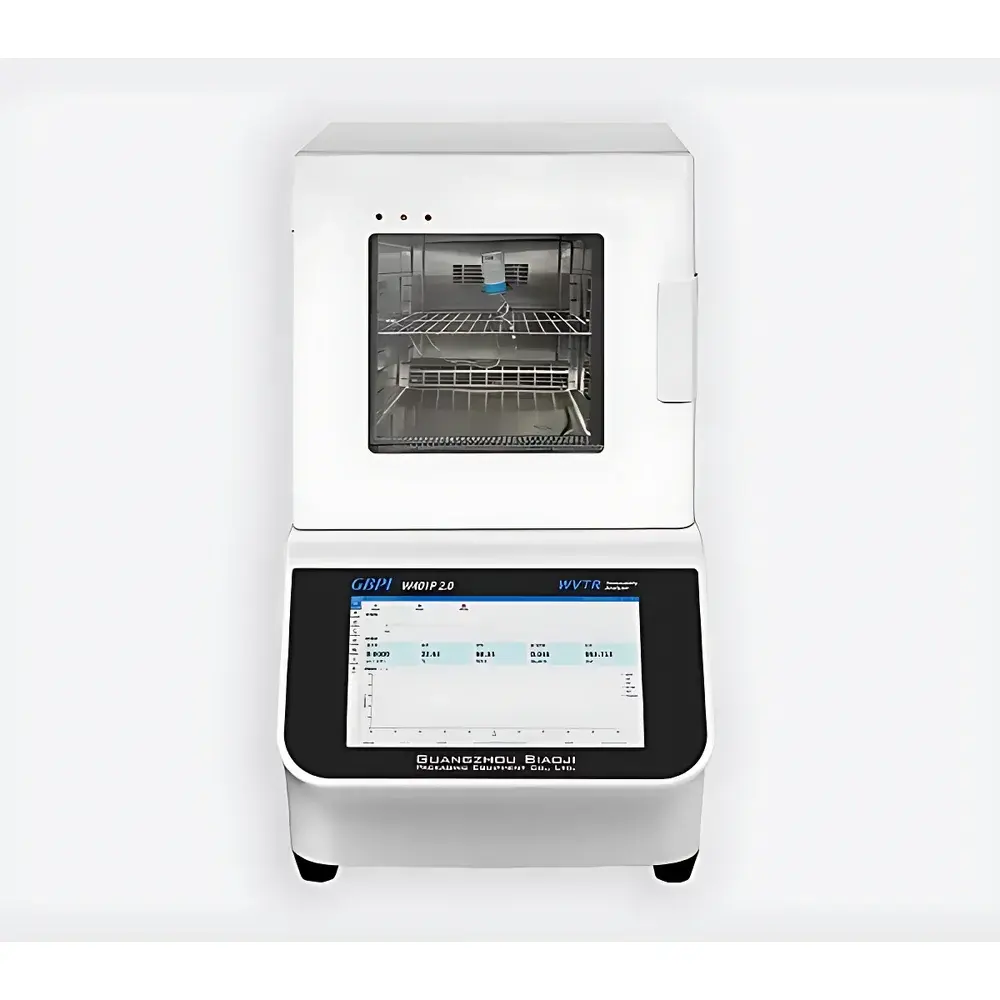
GBPI W401P 2.0B Packaging-Scale Water Vapor Transmission Rate (WVTR) Tester
| Brand | GBPI |
|---|---|
| Origin | Guangdong, China |
| Manufacturer Type | Direct Manufacturer |
| Model | W401P 2.0B |
| Test Principle | Infrared Detection of Moisture via Carrier Gas (N₂) |
| Standards Compliance | GB/T 31355-2014, GB/T 26253-2010, YBB 00092003, ChP IV <4010>, ASTM F1249, ISO 15106-2, JIS K7129 |
| Temperature Control Range | 15–45 °C ±0.5 °C |
| Humidity Control Range | 20–95 %RH ±2 %RH |
| WVTR Range (Packaging) | 0.00001–0.5 g/(pkg·day) |
| WVTR Range (Film) | 0.002–100 g/(m²·24h) |
| Resolution (Packaging) | 0.0001 cc/(pkg·day) |
| Resolution (Film) | 0.0001 g/(m²·24h) |
| Carrier Gas Pressure | 0.1–0.2 MPa |
| Gas Interface | 1/8″ stainless steel tubing |
| Sample Capacity | 1 packaging unit per test cycle |
| Integrated Water Reservoir | High-capacity for extended unattended operation |
Overview
The GBPI W401P 2.0B Packaging-Scale Water Vapor Transmission Rate (WVTR) Tester is an engineered solution for quantitative barrier performance evaluation of rigid and semi-rigid packaging systems—including bottles, blister packs, pouches, trays, BFS containers, and laminated tubes—under controlled environmental conditions. It operates on the principle of infrared moisture detection in a carrier gas stream, conforming to the gravimetrically traceable, non-destructive methodology defined in ASTM F1249 and ISO 15106-2. The instrument establishes a precise humidity gradient across the test specimen: the exterior surface is exposed to a saturated or regulated humid environment, while the interior cavity is purged continuously with ultra-high-purity nitrogen (≥99.999%). Water vapor permeating through the package wall is swept by the dry carrier gas to a high-sensitivity infrared moisture sensor, where real-time quantification yields mass-based transmission rates (g/pkg·day) with traceable calibration against NIST-traceable reference standards.
Key Features
- Modular, tool-free packaging test chamber with fully detachable support fixtures—enabling rapid sample exchange and minimizing cross-contamination risk between dissimilar container geometries.
- Dual-mode environmental control: semiconductor-based thermoelectric cooling/heating for ±0.5 °C temperature stability; closed-loop humidity generation and feedback regulation achieving ±2 %RH accuracy across 20–95 %RH range.
- Integrated high-volume water reservoir supporting continuous operation up to 120 hours without manual replenishment—critical for long-duration validation studies on photovoltaic encapsulants or pharmaceutical primary packaging.
- Comprehensive software architecture compliant with FDA 21 CFR Part 11 and EU Annex 11 requirements: role-based user access, electronic signatures, full audit trail, and immutable data logging for GLP/GMP-regulated environments.
- Automated test sequencing with adaptive endpoint detection: automatic start/stop logic triggered by signal stabilization criteria; real-time plotting of transmission kinetics with configurable curve visibility and export-ready overlay functionality.
- Expandable hardware interface: USB 3.0 port for local data backup; optional Ethernet/Wi-Fi module for integration into enterprise LIMS or laboratory IoT platforms (e.g., LabVantage, Thermo Fisher SampleManager).
Sample Compatibility & Compliance
The W401P 2.0B accommodates diverse packaging formats via customizable fixture sets—including threaded bottle adapters, collapsible tube clamps, and vacuum-sealed tray mounts—ensuring uniform sealing integrity and minimal edge leakage during measurement. All mechanical interfaces are precision-machined from corrosion-resistant stainless steel and validated per ISO 11607-1 for sterile barrier system testing. Regulatory alignment extends beyond method standards: the system’s firmware and data handling protocols satisfy the computerized system validation (CSV) expectations outlined in WHO TRS 937 Annex 11 and PIC/S PI 011-3. Calibration traceability is maintained using certified reference films supplied by GBPI’s National Standard Substance Production Unit (CNAS-accredited), enabling on-site verification without third-party intervention.
Software & Data Management
Control and analysis are executed via GBPI’s proprietary BarrierSuite™ v4.2 software, built on a deterministic real-time kernel to ensure temporal fidelity in kinetic data capture. The interface supports multi-level user permissions (Administrator, Supervisor, Analyst), each with granular control over method editing, report generation, and raw data export. All analytical runs generate timestamped, digitally signed PDF reports containing metadata (operator ID, environmental logs, calibration certificates, raw sensor output), compliant with ICH M7 and USP documentation requirements. Data exports include CSV, XLSX, and XML formats—with optional integration into ELN systems via RESTful API. Audit trails record every parameter change, login event, and report modification, retained for ≥30 years per configurable retention policy.
Applications
- Pharmaceutical packaging qualification: moisture ingress assessment of HDPE bottles, Alu-PVC blisters, and cold-chain shipping containers per USP and EMA CPMP/QWP/380/95 guidelines.
- Food packaging shelf-life modeling: correlation of WVTR values with accelerated aging studies for retort pouches, coffee bags, and modified atmosphere packaging (MAP).
- Medical device packaging validation: verification of seal integrity and material barrier consistency for Class II/III sterile barrier systems under ISO 11607-2.
- Renewable energy materials testing: long-term water vapor diffusion monitoring in PV backsheet laminates and encapsulant films per IEC 61215-2 MQT10.
- Regulatory submission support: generation of GxP-compliant datasets for ANDA, NDA, and MAA dossiers requiring documented barrier performance evidence.
FAQ
What carrier gas purity is required for valid ASTM F1249-compliant measurements?
Ultra-high-purity nitrogen (≥99.999% N₂, oxygen content <1 ppm) is mandatory; impurities such as CO₂ or residual moisture will saturate the IR sensor and invalidate baseline drift correction.
Can the W401P 2.0B test flexible pouches with irregular sealing edges?
Yes—customizable perimeter sealing gaskets and vacuum-assisted clamping fixtures ensure leak-tight contact for non-planar surfaces, validated per ASTM D3078 for seal integrity prior to permeation measurement.
Is remote diagnostic capability available out-of-the-box?
Remote diagnostics require optional IoT gateway module installation and TLS 1.2-secured cloud registration; on-premise network configuration must comply with ISO/IEC 27001 firewall policies.
How frequently must the infrared sensor be recalibrated?
Annual factory recalibration is recommended; field verification using GBPI-certified reference films (SRM-WVTR-01/02) is performed before each qualification batch per ISO/IEC 17025 clause 5.9.
Does the system support dynamic RH ramping during a single test cycle?
No—humidity is held constant per test sequence to satisfy the steady-state flux assumption in ISO 15106-2; multi-step RH profiling requires sequential discrete tests with manual parameter reconfiguration.





