
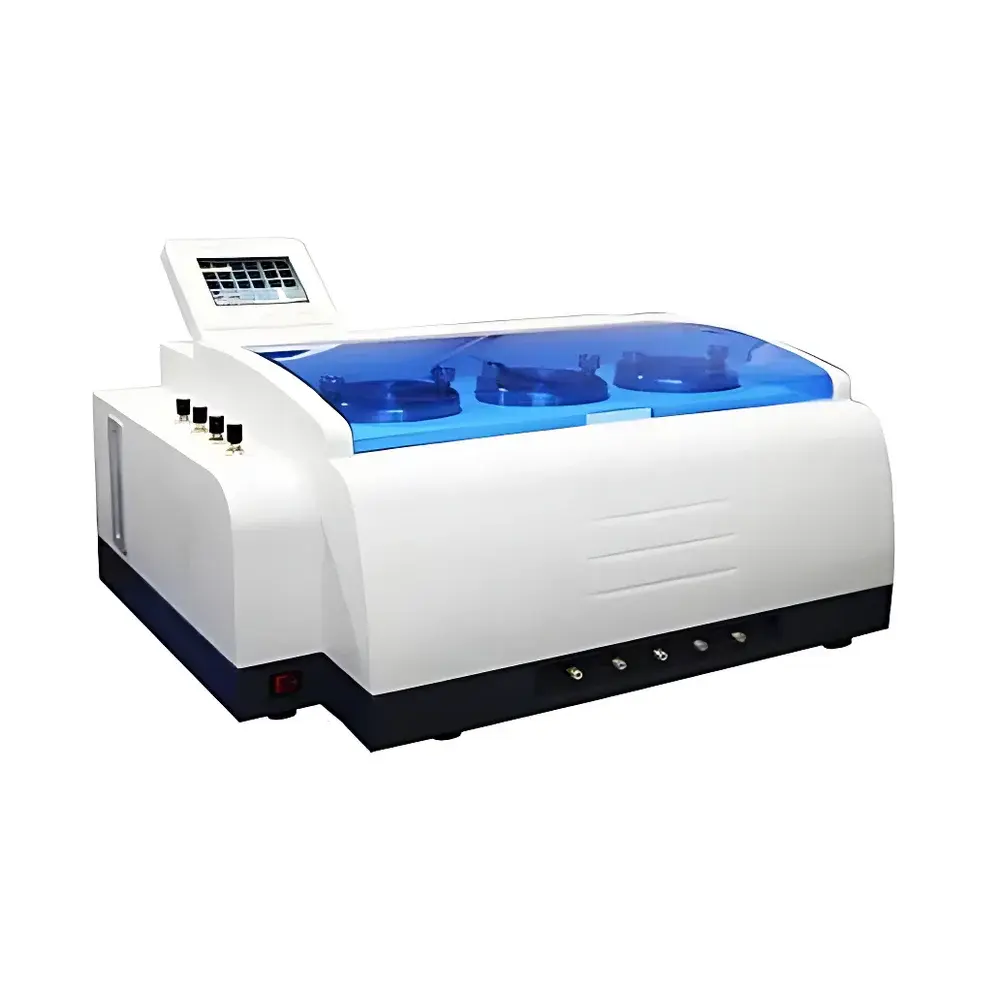
GBPI W403B Infrared Water Vapor Transmission Rate (WVTR) Tester
| Brand | GBPI |
|---|---|
| Origin | Guangdong, China |
| Manufacturer Type | Original Equipment Manufacturer (OEM) |
| Model | W403B |
| Measurement Principle | Infrared Sensor Method |
| Standards Compliance | ISO 15106-2, ASTM F1249, TAPPI T557, JIS K7129, GB/T 26253 |
| WVTR Range | 0.001–100 g/(m²·24h) |
| Resolution | 0.001 g/(m²·24h) (for films & sheets) |
| Temperature Control Range | 15–45 °C (optional 5–55 °C) |
| Temperature Accuracy | ±0.1 °C |
| Humidity Control Range | 0 %RH, 30–90 %RH, 100 %RH |
| Humidity Accuracy | ±1 %RH |
| Sample Capacity | 3 test positions |
| Sensor Count | 3 infrared hygrometric sensors |
| Specimen Size | Ø100 mm (effective area: 50.24 cm²) |
| Max. Sample Thickness | ≤2 mm |
| Carrier Gas | Ultra-high-purity nitrogen (≥99.999 %), inlet pressure ≥0.1 MPa |
| Gas Flow Rate | 0–100 mL/min |
| Interface | 1/8″ stainless steel tubing |
| Dimensions | 610 × 550 × 400 mm |
| Weight | 80 kg |
| Power Supply | 220 V, 50 Hz (110 V optional) |
| Power Consumption | 500 W |
Overview
The GBPI W403B Infrared Water Vapor Transmission Rate (WVTR) Tester is an engineered analytical instrument designed for precise, trace-level quantification of water vapor permeation through packaging materials and rigid or flexible containers. It operates on the principle of infrared absorption spectroscopy—where water vapor molecules transported across a test specimen are swept by dry carrier gas into a high-sensitivity infrared detector. The resulting absorbance signal is linearly correlated to vapor concentration, enabling calculation of WVTR in accordance with gravimetric-equivalent mass flux (g/(m²·24h)). This method eliminates reliance on desiccant weight gain or condensation-based detection, offering superior repeatability, reduced baseline drift, and immunity to ambient humidity fluctuations during extended testing cycles. The system is calibrated traceably to certified reference gases and standardized reference films accredited under national metrological protocols, ensuring data integrity suitable for regulatory submissions and inter-laboratory comparison.
Key Features
- Triple independent test chambers with synchronized or asynchronous operation—enabling parallel evaluation of up to three distinct samples or cross-validation of material batches.
- Electromagnetic precision temperature control architecture with programmable ramp-and-hold profiles; achieves ±0.1 °C stability across 15–45 °C (extended range available).
- Dual-stream humidity generation system: humidified N₂ flows over the upstream side while ultra-dry N₂ sweeps the downstream side—eliminating external humidity generators and minimizing footprint and maintenance points.
- Three integrated, factory-calibrated infrared hygrometric sensors—each independently monitored and compensated for thermal drift and zero-point offset.
- Full onboard embedded operating system: supports stand-alone testing without PC connection; includes real-time curve logging for WVTR, temperature, RH, and sensor output voltage.
- Dual calibration pathways—certified gas standard verification and NIST-traceable reference film validation—both compliant with ISO/IEC 17025 documentation requirements.
- Automated endpoint detection: halts test upon reaching user-defined stability criteria (e.g., <±0.5 % variation over 60 min), preserving gas consumption and operator time.
- Comprehensive safety architecture: power-fail data retention, over-range alarm lockout, misloading detection, and hardware-enforced flow-pressure interlocks.
- Modular software interface (Windows-compatible): functionally segregated modules for parameter setup, baseline acquisition, calibration management, report generation (PDF/CSV/XLSX), and GLP-compliant audit trail export.
Sample Compatibility & Compliance
The W403B accommodates flat specimens (films, sheets, foils, laminates) up to 2 mm thick and Ø100 mm diameter, as well as rigid or semi-rigid containers—including bottles, pouches, trays, blister packs, and composite cans—via optional fixture kits. Its design conforms to international regulatory expectations for barrier property characterization: test methodology aligns with ISO 15106-2 (infrared detection), ASTM F1249 (standard practice for WVTR using modulated IR), TAPPI T557 (moisture vapor transmission of packaging materials), JIS K7129 (plastic film WVTR), and GB/T 26253 (Chinese national standard for plastic film barrier testing). Data output supports 21 CFR Part 11 compliance when paired with validated software configuration and electronic signature protocols. All firmware and calibration records adhere to GLP/GMP documentation standards, including version-controlled change logs and user-access audit trails.
Software & Data Management
GBPI’s proprietary WinWVTR software provides full lifecycle data governance—from method creation and instrument configuration to raw signal visualization and statistical reporting. Each test session automatically archives time-stamped metadata: environmental setpoints, gas flow profiles, sensor diagnostics, and raw absorbance waveforms. Users may overlay multiple test curves, apply moving-average smoothing, compute mean/SD/CV across replicates, and generate IQ/OQ/PQ-ready validation reports. Export formats include CSV (for LIMS integration), PDF (with digital signature fields), and Excel (with embedded formulas for derived metrics such as activation energy or Arrhenius slope). Firmware updates and diagnostic logs are performed via USB port without disassembly or network dependency—ensuring continuity in regulated environments where air-gapped operation is mandated.
Applications
The W403B serves critical quality control and R&D functions across regulated and industrial sectors. In pharmaceutical packaging, it validates moisture barrier integrity of blister lidding foils, sachets, and HDPE/PP bottles per USP <671> and ICH Q5C stability guidance. For food packaging, it assesses shelf-life predictors in retort pouches, vacuum-sealed trays, and metallized snack bags—supporting HACCP and FSMA verification. In photovoltaics, it measures WVTR of backsheet laminates (<0.005 g/(m²·24h)) to prevent EVA delamination and cell corrosion. Additional use cases include: oxygen-barrier correlation studies in fuel tanks (ASTM D3079), electrolyte containment validation for lithium-ion battery housings, moisture ingress analysis in medical device pouches (ISO 11607), and functional evaluation of hydrophobic coatings on display films and wearable electronics substrates.
FAQ
What carrier gas is required—and why must it be ≥99.999% pure?
Ultra-high-purity nitrogen is mandatory to avoid spectral interference from CO₂, CH₄, or hydrocarbon impurities that absorb in adjacent IR bands. Trace contaminants compromise zero stability and introduce nonlinearity above 10 ppm.
Can the W403B test non-planar or irregularly shaped containers?
Yes—when equipped with optional container fixtures (e.g., bottle cradles, pouch clamps, or custom-machined adapters), the system maintains sealed boundary conditions while exposing only the designated surface area to the humidity gradient.
Is temperature/humidity uniformity validated across all three test stations?
Each chamber features independent PID-controlled heating elements and dual-path humidity delivery; spatial uniformity is verified annually per ISO 17025 using NIST-traceable thermocouples and chilled-mirror hygrometers.
How does the instrument handle edge effects during film testing?
The clamping mechanism employs precision-ground O-ring seals and radial compression geometry to ensure >95% utilization of the defined 50.24 cm² test area—minimizing perimeter leakage and eliminating need for guard rings.
Does the software support multi-user role-based access control?
Yes—administrator, analyst, and reviewer roles are enforced with password policies, session timeouts, and immutable electronic signatures aligned with FDA 21 CFR Part 11 Annex 11 requirements.





