
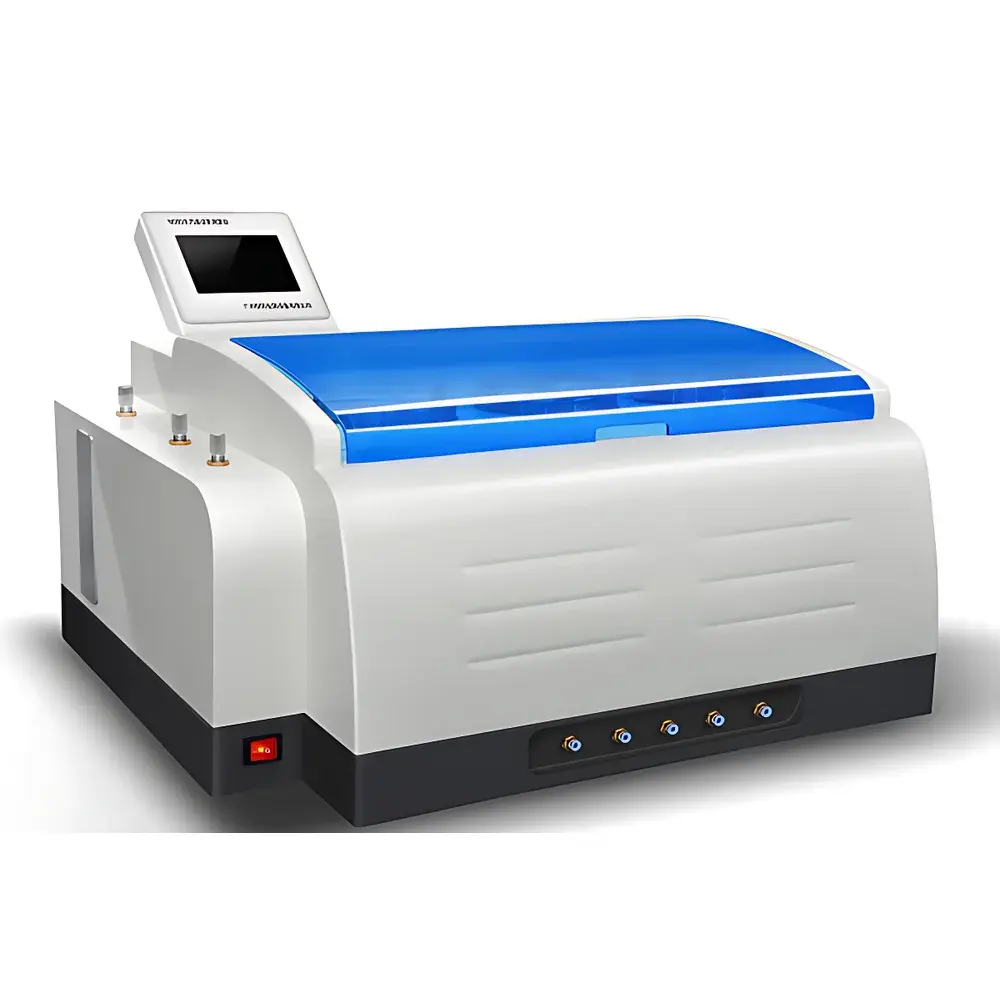
GBPI W405B Water Vapor Transmission Rate (WVTR) Tester
| Brand | GBPI |
|---|---|
| Origin | Guangdong, China |
| Manufacturer Type | Direct Manufacturer |
| Country of Origin | China |
| Model | W405B |
| Test Range | 0.0005–500 g/(m²·24h) (films & sheets) |
| Measurement Accuracy | 0.001 g/(m²·24h) |
| Temperature Control Range | 15–45 °C (optional up to 60 °C) |
| Temperature Stability | ±0.1 °C |
| Humidity Control Range | 30–90 %RH (and 100 %RH) |
| Humidity Stability | ±1 %RH |
| Test Area | 50.24 cm² (down to 0.785 cm² with optional fixtures) |
| Specimen Diameter | Φ100 mm |
| Max Specimen Thickness | ≤3 mm |
| Sample Capacity | 1–3 independent chambers |
| Carrier Gas | ≥99.999 % N₂ (user-supplied) |
| Gas Pressure | ≥0.1 MPa |
| Gas Flow Rate | 5–120 mL/min |
| Gas Inlet | 1/8″ stainless steel tubing |
| Dimensions | 700 × 560 × 370 mm |
| Weight | 80 kg |
| Power | 750 W |
| Supply | AC 220 V, 50 Hz (110 V available on request) |
Overview
The GBPI W405B Water Vapor Transmission Rate (WVTR) Tester is a gravimetric-coulometric hybrid instrument engineered for precise, reproducible quantification of water vapor permeation through packaging materials and functional barrier films. It operates on the principle of dynamic humidity-controlled carrier gas transport: a dry nitrogen stream sweeps across the downstream side of a conditioned test specimen mounted in a sealed diffusion cell, while the upstream side is exposed to controlled humidified air or saturated water vapor. The transmitted water vapor is quantified in real time using a high-stability infrared (IR) moisture sensor—calibrated traceably to national standard reference materials certified by China’s State Administration for Market Regulation (SAC). This methodology ensures compliance with internationally recognized gravimetric and sensor-based WVTR measurement paradigms, delivering data suitable for regulatory submissions, quality control release testing, and R&D benchmarking in highly regulated sectors including pharmaceuticals, medical devices, and food packaging.
Key Features
- Traceable metrology: Validated against GBW(E)130543/4 certified reference materials; includes dual certification under China’s National Standard Substance Accreditation and Manufacturing License for Measuring Instruments (CMC).
- Triple-chamber independent operation: Three parallel test cells enable simultaneous evaluation of heterogeneous samples—each with autonomous start/stop, real-time curve logging, and individual report generation—without cross-contamination or thermal/hygrometric interference.
- High-resolution environmental control: Electromagnetic step-programmed temperature regulation (±0.1 °C) and dual-stream humidity generation (dry + wet gas mixing) ensure stable, programmable RH profiles from 30–100 %RH (±1 %RH), critical for ISO 15106-2 and ASTM F1249 validation.
- Modular sensor architecture: IR moisture sensor with automatic over-range protection and long-term baseline stability; field-replaceable design supports GMP-mandated preventive maintenance without system downtime.
- Embedded ARM-based control platform: Standalone operation via 7″ color touchscreen—no external PC required for routine testing; full method setup, real-time monitoring (temperature, RH, concentration, transmission rate), and report preview are accessible on-device.
- GMP-aligned software architecture: Role-based user management (Administrator, Operator, Reviewer), audit trail per ICH E6(R3) and FDA 21 CFR Part 11 (system-level, method-level, run-level), electronic signatures, and immutable database logging with timestamped change history.
Sample Compatibility & Compliance
The W405B accommodates flat specimens—including polymer films (PET, PE, PP), metallized laminates, aluminum foils, ceramic substrates, rubber sheets, and rigid boards—up to 3 mm thick and 100 mm in diameter. With optional fixtures (e.g., cup adapters, pouch clamps, and container holders), it extends to 3D packaging forms: blister cavities, sachets, stand-up pouches, PET bottles, and thermoformed trays. All configurations maintain ISO-defined diffusion area integrity and edge-seal reliability. The system conforms to ISO 15106-2:2005 (infrared detection), ASTM F1249-2013 (moisture sensor method), TAPPI T557, JIS Z 7129:2008, and GB/T 26253–2010. Its calibration protocol satisfies GLP and GMP requirements for analytical instrument qualification (IQ/OQ/PQ), including documented sensor linearity, repeatability (RSD <1.2 % at mid-range), and intermediate precision across operators and days.
Software & Data Management
GBPI’s proprietary WinWVTR software provides intuitive workflow configuration—customizable test duration, ramp profiles, alarm thresholds, and auto-stop criteria based on slope convergence. Raw sensor output, environmental parameters, and calculated WVTR values are stored in an encrypted local SQLite database with daily backup capability. Reports comply with ALCOA+ principles: attributable, legible, contemporaneous, original, accurate, complete, consistent, enduring, and available. Export formats include PDF (with digital signature), Excel (.xlsx), and XML for LIMS integration. All data modifications trigger an immutable audit entry—including user ID, timestamp, pre-/post-change values, and reason code—enabling full forensic reconstruction during regulatory inspections.
Applications
- Pharmaceutical primary packaging validation (blister foil, cold-forming foil, desiccant-containing sachets)
- Medical device barrier film qualification (sterile barrier systems per ISO 11607-1)
- Food packaging shelf-life modeling (moisture-sensitive products: nuts, powders, confectionery)
- Flexible electronics encapsulation assessment (OLED, solar backsheet, touch sensor laminates)
- Transdermal patch membrane characterization (hydrogel, silicone, polyisobutylene matrices)
- Quality agreement testing between suppliers and brand owners per ASTM D3985 or ISO 15106 series
FAQ
What carrier gas is required—and why must it be ≥99.999% pure nitrogen?
High-purity nitrogen eliminates interfering volatile compounds (e.g., O₂, hydrocarbons) that could saturate or poison the IR sensor, ensuring linear response and minimizing baseline drift over extended runs.
Can the W405B test rigid containers such as glass vials or HDPE bottles?
Yes—using optional container-specific fixtures that maintain hermetic seal integrity and defined diffusion area; validation per ASTM F2622-18 is recommended for container WVTR claims.
Is third-party calibration support available?
GBPI provides annual on-site calibration services traceable to NIM (National Institute of Metrology, China); users may also perform in-house verification using supplied certified standard membranes.
How does the system handle high-barrier materials like aluminum foil or SiOₓ-coated PET?
The 0.001 g/(m²·24h) resolution and low-noise IR detection enable reliable measurement down to ultra-low transmission rates; “low-permeability mode” optimizes gas flow and integration time for statistical confidence.
Does the software meet FDA 21 CFR Part 11 requirements for electronic records?
Yes—role-based access, electronic signatures, full audit trail, and data immutability are implemented per Part 11 Annex A guidance; validation documentation (URS, FS, DS, IQ/OQ/PQ protocols) is provided upon request.
Related Products





