
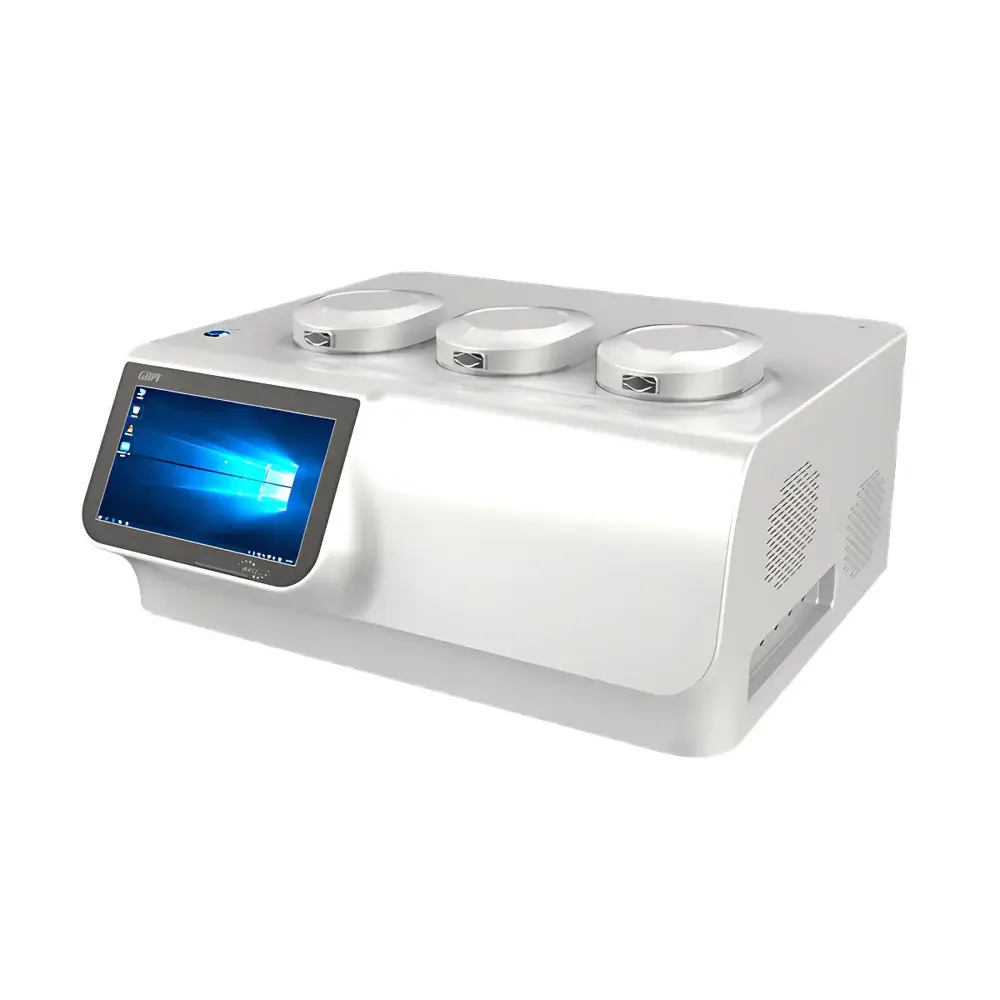
GBPI W413 2.0K Infrared-Based Water Vapor Transmission Rate (WVTR) Tester
| Brand | GBPI |
|---|---|
| Origin | Guangdong, China |
| Manufacturer Type | Direct Manufacturer |
| Origin Category | Domestic (China) |
| Model | W413 2.0K |
| Price Range | USD 42,000 – 70,000 |
| Test Principle | Infrared Detection of Moisture Permeation |
| Standards Compliance | GB/T 26253-2010, ASTM F1249-2013, ISO 15106-2:2005, JIS K7129-2008, YBB 00092003-2015 |
| Measurement Range | 0.002–500 g/(m²·24h) |
| Resolution | 0.001 g/(m²·24h) |
| Temperature Control Range | 15–45 °C |
| Temp. Accuracy | ±0.1 °C |
| Humidity Control Range | 0% RH (dry gas), 30–90% RH, and 100% RH |
| Humidity Accuracy | ±1% RH |
| Test Area | 50.24 cm² |
| Specimen Diameter | Φ100 mm |
| Max. Specimen Thickness | ≤3 mm |
| Sample Capacity | 3 specimens per cycle |
| Carrier Gas | 99.999% high-purity N₂ (user-supplied) |
| N₂ Pressure | ≥0.1 MPa |
| N₂ Flow Rate | 5–100 mL/min |
| Pneumatic Clamping Pressure | ≥0.3 MPa |
| Power | 750 W, AC 220 V, 50 Hz |
Overview
The GBPI W413 2.0K is a precision-engineered infrared-based Water Vapor Transmission Rate (WVTR) tester designed for quantitative determination of moisture permeation through flexible barrier materials under controlled temperature and humidity conditions. It operates on the principle of dynamic infrared detection: water vapor permeating through a test specimen is carried by a dry nitrogen stream into an infrared moisture sensor, where absorbance at characteristic wavelengths (e.g., 2.6 µm) is measured in real time. This non-destructive, calibration-stable method enables trace-level quantification of vapor flux without chemical reagents or consumables. The instrument complies with internationally harmonized standards including ASTM F1249 (for plastic film and sheeting), ISO 15106-2 (infrared detection method), and GB/T 26253 (Chinese national standard for plastic films). Its architecture supports routine QC in regulated environments—particularly packaging development labs, pharmaceutical primary packaging validation, and advanced material R&D where barrier integrity directly impacts shelf life, sterility, and functional performance.
Key Features
- High-resolution infrared moisture sensor with 0.001 g/(m²·24h) resolution—capable of characterizing ultra-high-barrier substrates such as aluminum foil laminates and SiOₓ-coated PET.
- Integrated electromagnetic programmable temperature control system (15–45 °C, ±0.1 °C accuracy), eliminating external chiller/heater units and minimizing thermal lag and spatial gradients across the test chamber.
- Dual-stream humidity generation (dry + humidified N₂ blending) ensures stable, repeatable RH setpoints from 30% to 90% RH (±1% RH tolerance) and full-saturation capability at 100% RH.
- Modular pneumatic clamping mechanism (≥0.3 MPa actuation pressure) guarantees uniform, leak-free sealing of specimens up to 3 mm thick—compatible with rigid sheets, foils, and formed packages (bottles, trays, pouches).
- Embedded 10.1-inch color touchscreen interface with standalone operation; no external PC required for real-time monitoring of temperature, RH, WVTR, carrier gas flow, and system voltage.
- Fully automated test sequencing: auto-start, endpoint detection based on signal stabilization criteria, and auto-shutdown—reducing operator dependency and inter-test variability.
- Comprehensive data visualization suite: five synchronized real-time trend curves with preview/hide toggles, historical database query, and export to PDF-formatted compliance reports.
Sample Compatibility & Compliance
The W413 2.0K accommodates flat and semi-rigid specimens with diameters of Φ100 mm and thicknesses ≤3 mm—including monolayer polymers (LDPE, PP), coextruded films, metallized and oxide-coated substrates, paperboard laminates, rubber elastomers, ceramic membranes, and medical-grade hydrocolloid patches. Its 50.24 cm² defined test area conforms to ASTM and ISO geometric requirements. For package testing (e.g., blister cavities, sachets), optional custom fixtures are available under ISO 15106-3 guidance. Regulatory alignment includes full support for GMP Annex 11 (Computerized Systems) and FDA 21 CFR Part 11 via electronic signature workflows, role-based access control, and immutable audit trails documenting every test initiation, parameter modification, result export, and user login event.
Software & Data Management
GBPI’s proprietary WinWVTR software implements ALCOA+ principles (Attributable, Legible, Contemporaneous, Original, Accurate, Complete, Consistent, Enduring, Available) for data integrity. All raw sensor outputs, environmental logs, and calculated WVTR values are timestamped and stored in a local encrypted SQLite database with automatic backup. Audit trail records include operator ID, action type, pre- and post-change values, and system state metadata. Reporting modules generate GLP-compliant certificates with instrument calibration history, reference standard traceability (GBW(E)130543/4 certified moisture standards), and uncertainty estimation per ISO/IEC 17025 guidelines. Export formats include PDF (print-ready), CSV (for LIMS integration), and XML (for enterprise data lakes).
Applications
- Pharmaceutical packaging validation: moisture barrier assessment of blister foil, cold-forming aluminum, and child-resistant pouches per USP and YBB 00092003-2015.
- Food packaging R&D: optimization of multilayer barrier structures for snacks, dairy, and ready-to-eat meals under accelerated aging protocols.
- Electronics encapsulation: evaluation of moisture ingress resistance in OLED display backplanes and flexible printed circuit protective films.
- Medical device packaging: verification of sterile barrier system (SBS) integrity per ISO 11607-1, especially for Tyvek®/foil combinations and peelable lids.
- Renewable energy materials: WVTR benchmarking of encapsulant films and backsheet layers in photovoltaic module qualification (IEC 61215).
- Academic research: kinetic modeling of diffusion-sorption mechanisms in polymer nanocomposites and bio-based films.
FAQ
What calibration standards are used to ensure measurement traceability?
The W413 2.0K is calibrated using GBW(E)130543/4 certified national moisture permeation reference materials issued by China’s National Institute of Metrology, with documented uncertainty budgets and annual recalibration verification.
Is the instrument suitable for testing formed packages (e.g., bottles or cups)?
Yes—when equipped with optional package-specific test cells compliant with ISO 15106-3; these maintain laminar flow dynamics and minimize edge effects during headspace analysis.
Does the system meet FDA 21 CFR Part 11 requirements for electronic records?
Yes—through integrated electronic signatures, audit trail logging, and role-based permissions validated per GAMP 5 lifecycle methodology.
What carrier gas specifications are mandatory for optimal sensor performance?
99.999% pure nitrogen (N₂) at ≥0.1 MPa inlet pressure and adjustable flow (5–100 mL/min); impurities such as O₂, H₂O, or hydrocarbons must be below 1 ppm to prevent sensor drift or poisoning.
How is temperature and humidity uniformity verified across the test chamber?
Uniformity is validated per ISO 17025 using NIST-traceable portable probes placed at nine spatial points during IQ/OQ protocols; typical deviation is ≤±0.15 °C and ≤±1.2% RH over the active test zone.
Related Products






