
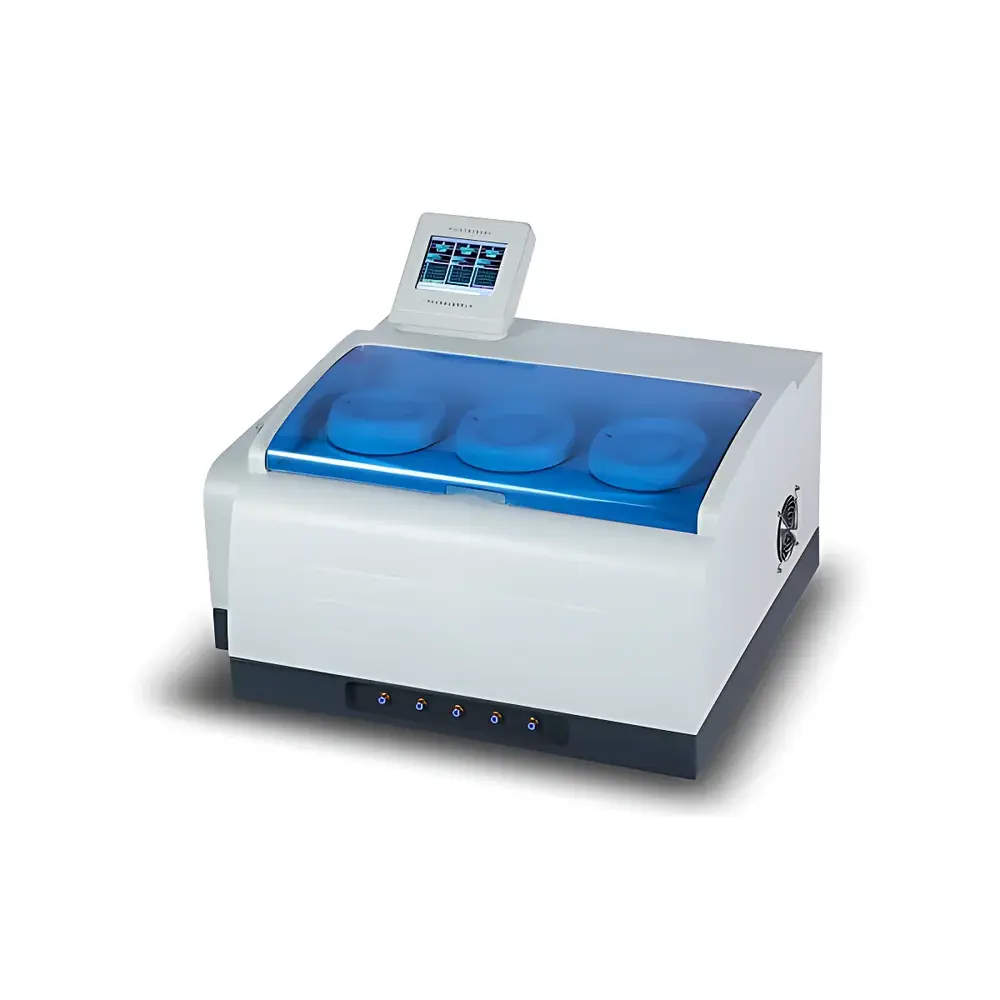
GBPI W413Z Infrared Sensor-Based Water Vapor Transmission Rate (WVTR) Tester
| Brand | GBPI |
|---|---|
| Origin | Guangdong, China |
| Manufacturer Type | Direct Manufacturer |
| Country of Origin | China |
| Model | W413Z |
| Price Range | USD 42,000 – 70,000 |
| Test Range | 0.002–1000 g/(m²·24h) |
| Test Accuracy | 0.001 g/(m²·24h) |
| Temperature Control Range | 15–45°C (optional up to 60°C) |
| Temp. Control Accuracy | ±0.1°C |
| Humidity Control Range | 30–90% RH |
| Humidity Control Accuracy | ±1% RH |
| Test Area | 50.24 cm² (down to 0.785 cm² with optional fixtures) |
| Specimen Diameter | Φ100 mm |
| Max. Specimen Thickness | ≤3 mm |
| Sample Capacity | 1–3 independent chambers |
| Carrier Gas | 99.999% N₂ (user-supplied) |
| Gas Pressure | ≥0.1 MPa |
| Gas Flow Rate | 5–120 mL/min |
| Gas Inlet | 1/8″ metal tubing |
| Dimensions | 700 × 560 × 370 mm |
| Weight | 80 kg |
| Power | 750 W |
| Voltage | AC 220 V, 50 Hz (110 V available on request) |
Overview
The GBPI W413Z is a high-precision, infrared sensor-based water vapor transmission rate (WVTR) tester engineered for quantitative permeation analysis of packaging materials and functional barriers under controlled temperature and humidity conditions. It operates on the principle of modulated infrared detection: water vapor diffusing through a test specimen is carried by a dry nitrogen carrier gas stream into an IR absorption cell, where its concentration is measured in real time via selective absorption at 2.7 µm wavelength. This non-destructive, continuous measurement method ensures high sensitivity, long-term stability, and minimal drift—critical for compliance-driven environments such as pharmaceutical packaging validation and food shelf-life modeling. The instrument conforms to international standard test methods including ASTM F1249–2013, ISO 15106-2:2005, JIS K7129:2008, GB/T 26253–2010, and YBB 00092003–2015, making it suitable for regulatory submissions and cross-laboratory data harmonization.
Key Features
- Triple-chamber independent testing architecture: Three isolated test cells enable concurrent evaluation of heterogeneous samples (e.g., PET/Alu/PE laminate vs. ethylene-vinyl alcohol copolymer vs. metallized CPP), each generating fully traceable, individual WVTR reports without cross-contamination or thermal/hygrometric interference.
- High-resolution infrared detection system: Dual-beam IR sensor with auto-zero compensation and range-adaptive gain control delivers consistent resolution down to 0.001 g/(m²·24h), validated using GBW(E)130543/4 certified reference materials traceable to China’s National Institute of Metrology.
- Advanced dual-stream humidity control: Precise mixing of dry and saturated nitrogen streams enables stable, programmable RH setpoints from 30% to 90% RH at ±1% RH accuracy—essential for simulating real-world storage conditions across tropical, temperate, and arid climates.
- ARM-based embedded control platform: Fully autonomous operation without external PC dependency; integrated 7-inch color touchscreen displays real-time curves for temperature, RH, vapor concentration, and cumulative transmission—supporting immediate visual assessment and on-device report generation.
- GMP-compliant software architecture: Role-based access control (administrator, operator, reviewer), full audit trail per 21 CFR Part 11 and EU Annex 11 requirements—including system-level, method-level, and run-level event logging with immutable timestamps and user attribution.
- Modular fixture ecosystem: Standard 50.24 cm² test area (Φ100 mm) expandable via optional mini-cell adapters (0.785 cm²) and container-specific holders for bottles, pouches, trays, and blister packs—enabling direct measurement of finished-package WVTR per ASTM F2622.
Sample Compatibility & Compliance
The W413Z accommodates rigid and flexible substrates up to 3 mm thick, including polymer films (PET, OPP, PE, PP), metallized and vacuum-deposited layers, aluminum foils, laminates, coated papers, ceramics, elastomers, and medical-grade hydrogel patches. Its design supports both flat-sheet testing and packaged-product evaluation—critical for validating barrier integrity of sterile medical device pouches (ISO 11607-1), pharmaceutical blister cards (USP ), solar backsheet assemblies (IEC 61215), and OLED encapsulation films. All hardware and firmware comply with electromagnetic compatibility (EMC) directives IEC 61326-1 and safety standard IEC 61010-1. Calibration traceability is maintained through periodic verification using NIST-traceable or CNAS-accredited moisture permeation standards.
Software & Data Management
GBPI’s proprietary WinWVTR v4.x software provides full lifecycle data governance: method creation with configurable ramp profiles, automated baseline subtraction, kinetic curve fitting (zero-order, Fickian diffusion), and statistical reporting per ISO 5725. Raw sensor outputs, environmental logs, and user actions are stored in encrypted SQLite databases with daily backup scheduling and export capability to PDF, Excel (.xlsx), CSV, and XML formats. Electronic signatures, version-controlled method templates, and forced re-authentication after 15 minutes of inactivity enforce data integrity throughout the analytical workflow. Software validation documentation (IQ/OQ/PQ protocols) is supplied to support laboratory accreditation under ISO/IEC 17025 and FDA inspection readiness.
Applications
- Pharmaceutical packaging qualification for blister foil, sachets, and HDPE bottles per USP and EMA CPMP/QWP/380/95 guidelines.
- Food packaging shelf-life prediction via accelerated WVTR mapping at multiple RH/temperature combinations (e.g., 40°C/90% RH for tropical distribution simulation).
- Development and QC of high-barrier flexible electronics encapsulation—validating moisture ingress resistance in foldable display stacks and thin-film photovoltaic modules.
- Regulatory submission support for combination products (e.g., transdermal patches), where WVTR directly correlates with drug release kinetics and adhesive performance.
- Material supplier certification against ASTM D3045 (thermal aging) + F1249 sequential testing to assess degradation-induced permeability shifts.
FAQ
What carrier gas is required, and why must it be ultra-high-purity nitrogen?
Ultra-high-purity (99.999%) nitrogen is mandatory to eliminate background moisture and hydrocarbon interference in the IR detection path. Lower purity grades introduce spectral noise and baseline instability, compromising detection limits below 0.01 g/(m²·24h).
Can the W413Z measure containers without disassembly?
Yes—using optional container fixtures, the instrument performs gravimetric-equivalent dynamic measurement on sealed bottles, pouches, and trays per ASTM F2622, eliminating destructive sampling while preserving package integrity.
How is calibration traceability ensured?
Each unit ships with calibration certificates referencing GBW(E)130543/4 national standard substances. Users perform routine verification using these SRMs; results are logged automatically into the audit trail with pass/fail flags based on ±2% tolerance per ISO/IEC 17025.
Is the system compatible with LIMS integration?
Yes—WinWVTR supports ASTM E1578-compliant instrument driver protocols and provides ODBC-compliant database access for direct LIMS ingestion of test parameters, results, and metadata.
What maintenance intervals are recommended for the IR sensor?
The IR detector requires no routine optical servicing. Annual verification of zero-point stability and span response using dry N₂ and certified moisture standards is advised; sensor lifetime exceeds 10 years under normal operating conditions.




