
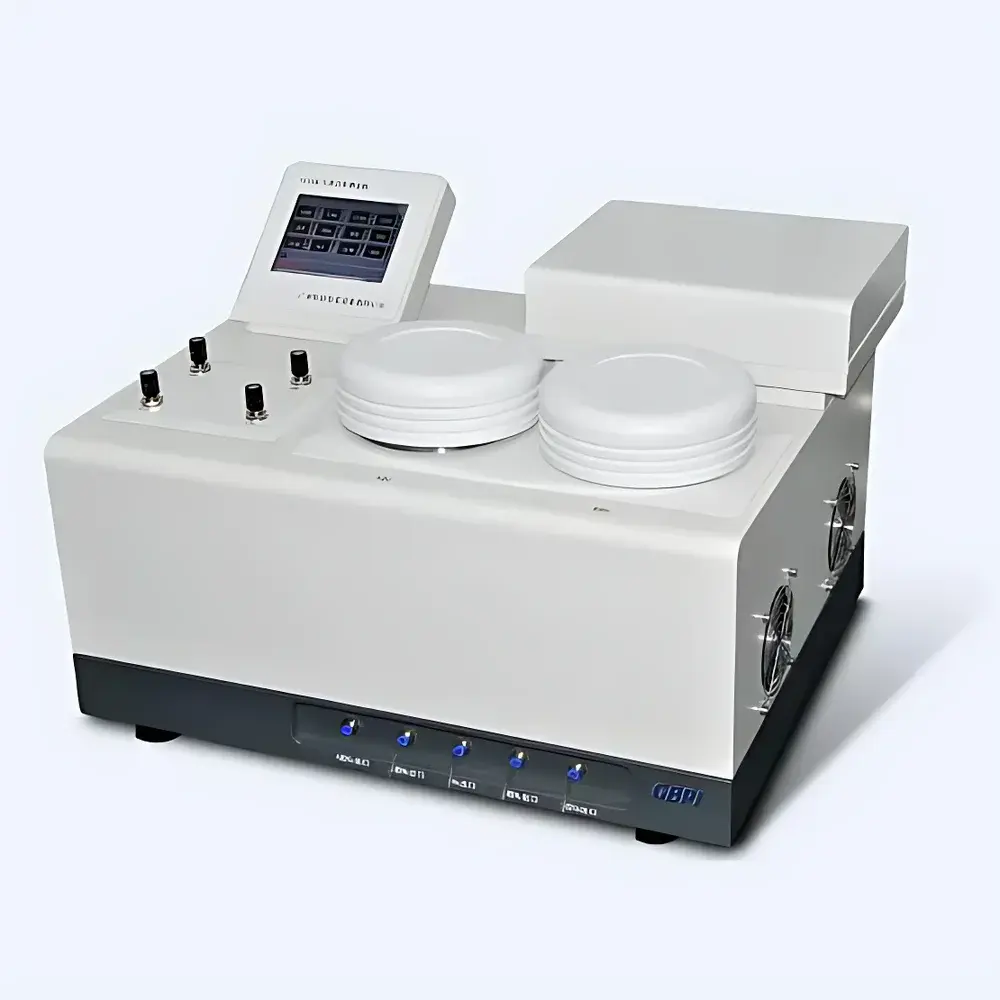
GBPI Y210-BB Coulometric Oxygen Transmission Rate (OTR) Analyzer
| Brand | GBPI (Guangzhou Biaoji) |
|---|---|
| Origin | Guangdong, China |
| Manufacturer Type | OEM/ODM Manufacturer |
| Country of Origin | China |
| Model | Y210-BB |
| Price Range | USD 14,000 – 70,000 |
Overview
The GBPI Y210-BB Coulometric Oxygen Transmission Rate (OTR) Analyzer is an ISO- and ASTM-compliant benchtop instrument engineered for precise, traceable measurement of oxygen permeation through polymeric films, laminates, foils, rigid containers, and advanced functional barriers. It operates on the coulometric sensor principle—a gravimetrically traceable electrochemical detection method—where oxygen molecules permeating across a test specimen are quantitatively reduced at a solid polymer electrolyte (SPE) sensor, generating a current proportional to O₂ flux. This principle ensures high reproducibility, long-term sensor stability, and intrinsic compliance with primary reference methods defined in ASTM D3985 and ISO 15105-2. The dual-chamber design isolates upstream (O₂-rich) and downstream (N₂-carrier) gas streams, enabling rigorous control of partial pressure gradients per Fick’s first law. Unlike optical or paramagnetic OTR systems, the coulometric approach delivers absolute quantification without calibration drift, making it the preferred platform for regulatory submissions in pharmaceutical packaging (e.g., USP , YBB00082003-2015) and food shelf-life modeling.
Key Features
- High-resolution OTR quantification down to 0.001 cm³/(m²·24 h), validated against NIST-traceable standard reference materials (SRMs) certified by CNAS-accredited GBPI Reference Material Center
- Dual independent test chambers with simultaneous, asynchronous operation—enabling parallel testing of two dissimilar specimens (e.g., PET/AlOx film vs. HDPE bottle) with separate start/stop and report generation
- Integrated environmental control: programmable temperature range 15–45 °C (±0.1 °C accuracy) and humidity range 0–90 %RH (±1 %RH accuracy) via dual-stream dry/wet gas mixing
- ARM-based embedded controller supporting standalone operation—no PC dependency for routine measurements; full data logging and real-time curve visualization on 7-inch TFT-LCD interface
- GMP-aligned software architecture compliant with FDA 21 CFR Part 11 and EU Annex 11 requirements: role-based user authentication (Admin/Operator/Reviewer), full audit trail (system, method, result-level), electronic signatures, and immutable database logging
- Modular hardware design with hot-swappable coulometric sensors, self-diagnostic routines, and over-range protection circuitry to prevent sensor saturation damage
- Expandable configuration: optional faceplate adapter kit enables OTR testing of rigid and semi-rigid containers (bottles, trays, pouches) per ASTM F1307; high-flux mask extends upper detection limit to 260,000 cm³/(m²·24 h)
Sample Compatibility & Compliance
The Y210-BB accommodates flat specimens up to Ø100 mm and ≤3 mm thickness—including metallized PET, SiOₓ-coated PP, EVOH laminates, aluminum foil, ceramic-coated films, and medical-grade hydrogels—using standardized 50.24 cm² test area per ISO 15105-2. For container testing, nitrogen purge flows internally while ambient air or 100 % O₂ surrounds the exterior, satisfying ASTM F1307 geometry constraints. All measurement protocols align with globally recognized standards: GB/T 19789–2005, ASTM D3985 (film), ASTM F1927 (low-permeability films), ASTM F1307 (containers), ASTM F2622 (high-flux), ISO 15105-2, DIN 53380-3, JIS K 7126-B, and YBB00082003–2015 (Chinese pharmaceutical packaging). GBPI holds CNAS accreditation (No. CNAS L9257) for OTR reference material production and instrument calibration, ensuring metrological traceability to SI units.
Software & Data Management
The GBPI OTR Control Suite v4.x provides intuitive Windows-native operation with customizable test templates, dynamic curve overlay (OTR, O₂ concentration, temperature, RH), zoom/pan functionality, and background SQL database querying. Reports conform to GLP/GMP documentation standards: auto-generated PDF/Office exports include instrument ID, operator ID, environmental logs, raw sensor output, uncertainty budgets, and pass/fail evaluation against specification limits. All data modifications—parameter edits, result overrides, method revisions—are time-stamped, user-identified, and archived in tamper-evident audit logs. Remote monitoring via Ethernet/IP is supported; optional OPC UA integration enables seamless connection to LIMS and MES platforms.
Applications
- Pharmaceutical packaging validation: blister foil integrity, PTP cavity OTR, cold-chain vial stopper barrier assessment
- Food packaging development: shelf-life prediction for modified atmosphere packaging (MAP), retort pouch barrier optimization
- Flexible electronics: encapsulation barrier performance of OLED lighting substrates and solar backsheet films
- Medical devices: oxygen transmission rate verification for transdermal patch backing layers and contact lens packaging
- Advanced materials R&D: nanocomposite film structure–property correlation, plasma-enhanced ALD coating efficacy screening
- Regulatory compliance: submission-ready data packages for FDA IND/NDA, EMA CMC dossiers, and NMPA registration
FAQ
What is the measurement principle used in the Y210-BB?
It employs coulometric detection based on oxygen reduction at a solid polymer electrolyte sensor, delivering absolute, drift-free OTR values traceable to national standards.
Can the instrument test both flat films and rigid containers?
Yes—standard configuration supports films and sheets; optional container adapters enable ASTM F1307-compliant testing of bottles, cups, and pouches.
Is the system compliant with 21 CFR Part 11?
Yes—the software implements full electronic signature, role-based access control, and immutable audit trails meeting FDA and EMA computerized system validation requirements.
How is calibration performed?
Using GBPI-certified OTR reference films (GBW(E)130497/8) or certified O₂/N₂ gas mixtures; calibration is executed via guided workflow within the embedded interface without external tools.
What environmental conditions can be controlled during testing?
Temperature (15–45 °C, ±0.1 °C), relative humidity (0–90 %RH, ±1 %RH), and differential pressure (0.1–0.2 MPa) are independently regulated and logged throughout each test cycle.






