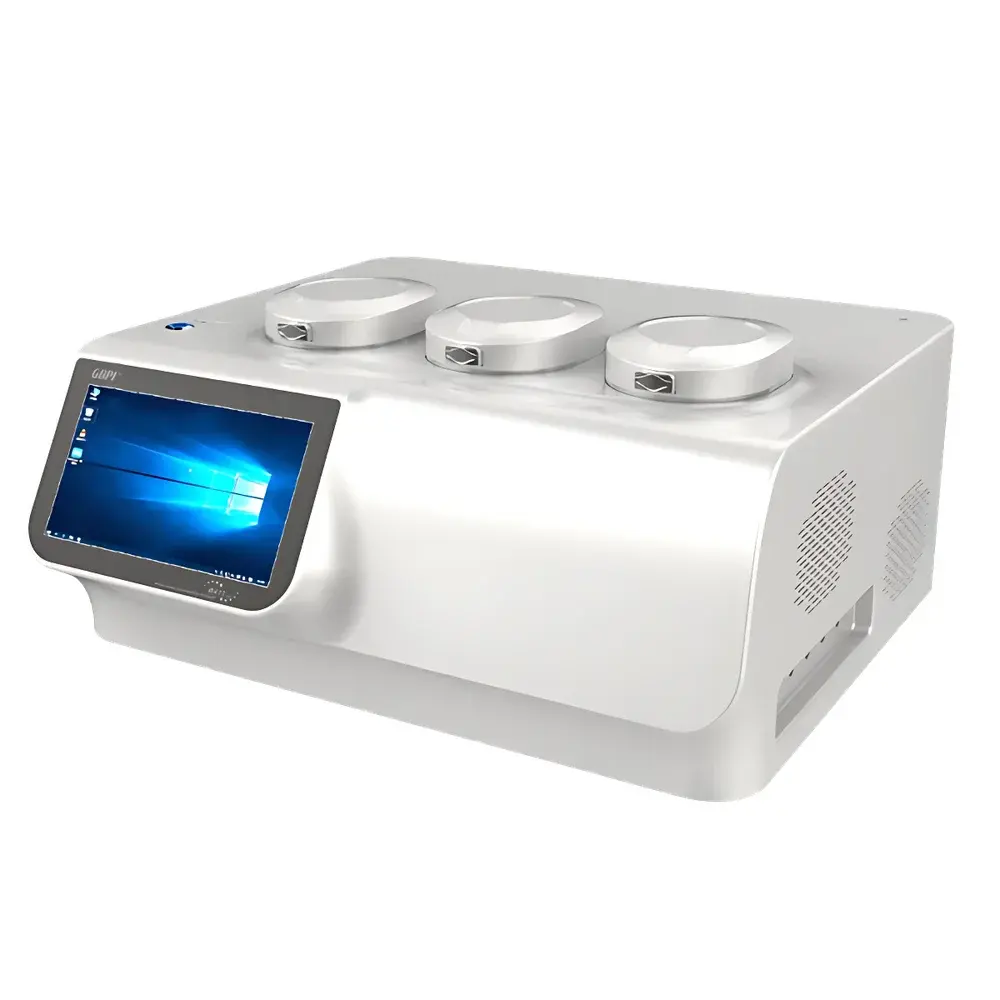
GBPI Y310 2.0A Oxygen Transmission Rate Analyzer (OTR) for Pharmaceutical Packaging
| Brand | GBPI |
|---|---|
| Origin | Guangdong, China |
| Manufacturer Type | Direct Manufacturer |
| Model | GBPI Y310 2.0A |
| Test Principle | Coulometric Sensor Method |
| Standards Compliance | GB/T 19789, ASTM D3985, ASTM F1307, ASTM F1927, ASTM F2622, ISO 15105-2, YBB 00082003, DIN 53380-3, JIS K-7126-B |
| Measurement Range | 0.05–1000 cm³/(m²·24h) (up to 260,000 cm³/(m²·24h) with custom mask) |
| Resolution | 0.001 cm³/(m²·24h) |
| Temperature Control Range | 15–45 °C |
| Temperature Stability | ±0.1 °C |
| Test Area | 50.24 cm² (customizable down to 0.785 cm²) |
| Sample Diameter | Φ100 mm |
| Max Sample Thickness | ≤3 mm |
| Sample Capacity | 3 independent test chambers |
| Carrier Gas Pressure | ≥0.1 MPa |
| Pneumatic Clamping Pressure | ≥0.3 MPa |
| Power | 750 W |
| Input | AC 220 V, 50 Hz |
Overview
The GBPI Y310 2.0A Oxygen Transmission Rate (OTR) Analyzer is a fully automated, multi-chamber instrumentation platform engineered for precise and reproducible measurement of oxygen permeation through packaging materials used in pharmaceutical, biopharmaceutical, medical device, food, and specialty industrial applications. It operates on the coulometric sensor principle—where oxygen molecules permeating through a conditioned specimen are carried by high-purity nitrogen (carrier gas) across a diffusion boundary into a sealed electrochemical sensor chamber. The resulting current generated by oxygen reduction at the cathode is directly proportional to the molar flow rate of O₂, enabling quantitative determination of OTR in accordance with internationally recognized gravimetric and coulometric methodologies. This principle ensures traceable, linear response over six orders of magnitude and eliminates interference from CO₂, moisture, or hydrocarbons—critical for regulatory-grade stability-indicating testing of barrier films, blister foils, pouch laminates, and rigid containers.
Key Features
- Triple independent test chambers enable parallel evaluation of three specimens under identical environmental conditions—significantly increasing throughput while maintaining inter-chamber comparability and minimizing operator-induced variability.
- High-stability coulometric oxygen sensor (imported, certified), delivering resolution of 0.001 cm³/(m²·24h) and long-term baseline drift <0.5% per 30 days—validated against NIST-traceable standard reference materials (GBW(E)130497/130498).
- Electromagnetic temperature control system with PID feedback loop ensures uniform thermal distribution across all chambers and maintains setpoint stability within ±0.1 °C over full 15–45 °C operating range—essential for ISO 15105-2 and ASTM F1307 compliance.
- Pneumatically actuated clamping mechanism with adjustable pressure (≥0.3 MPa) guarantees leak-tight sealing for heterogeneous substrates—including textured foils, embossed blisters, and multi-layer coextrusions—without manual torque dependency.
- Integrated 11.6-inch capacitive touchscreen interface running a GMP-aligned embedded OS compliant with FDA 21 CFR Part 11 requirements: role-based access control, electronic signatures, full audit trail (system events + test data + parameter changes), and configurable user permissions.
- Real-time six-channel visualization suite displays OTR vs. time, temperature vs. time, carrier gas flow vs. time, O₂ concentration vs. time, and dual-axis humidity tracking—all with zoom, overlay, and export-to-CSV functionality.
Sample Compatibility & Compliance
The Y310 2.0A accommodates flat and formed specimens across diverse geometries and compositions. Flat formats include monolayer and multilayer polymer films (e.g., PET, PE, PP, BOPP, CPP, PVC), metallized substrates (AlOx, SiOx, vacuum-deposited Al), paperboard laminates, aluminum foil composites, and bio-based films (PLA, PBAT, PBS). Formed packages tested include cold-form blisters, sachets, stand-up pouches, HDPE/PP bottles, aluminum tubes, thermoformed trays, and composite cartons. Custom fixtures support container-on-container (COC) and modified atmosphere packaging (MAP) configurations per ASTM F1307 Annex A. All hardware and firmware comply with GLP/GMP documentation standards, and calibration is performed using certified national reference materials traceable to China’s National Institute of Metrology (NIM). Instrument validation protocols support IQ/OQ/PQ execution aligned with ICH Q5C and USP .
Software & Data Management
The embedded operating system supports full lifecycle data governance—from method definition and instrument qualification to report generation and archival. Users define test parameters (temperature, dwell time, purge cycles, pass/fail thresholds) via intuitive graphical modules. All raw sensor outputs, environmental logs, and metadata are timestamped and cryptographically hashed. Audit trails record every action—including login/logout, parameter edits, result overrides, and report approvals—with immutable timestamps and operator IDs. Export options include PDF (with digital signature), Excel, XML, and CSV; reports embed instrument ID, calibration status, standard material lot numbers, and environmental deviation flags. Optional LIMS integration is supported via HL7 v2.5 or RESTful API endpoints. Remote diagnostics and firmware updates are enabled via secure TLS 1.2–encrypted connection to GBPI’s cloud-based IoT platform.
Applications
This analyzer serves critical quality control and development functions across regulated sectors. In pharmaceutical manufacturing, it verifies OTR performance of primary packaging (e.g., PTP blisters, HDPE bottles, alu-alu foils) to ensure shelf-life predictions align with accelerated stability protocols (ICH Q1A–Q1E). For contract development and manufacturing organizations (CDMOs), it supports comparative barrier studies during formulation-packaging compatibility assessments. Medical device manufacturers use it to validate sterility maintenance of Tyvek®-based pouches and peelable lids per ISO 11607-1. Food producers rely on its wide dynamic range (0.05–260,000 cm³/(m²·24h)) to benchmark high-barrier metallized PET against medium-barrier LDPE or low-barrier kraft paper. Photovoltaic module suppliers apply it to quantify edge seal degradation in backsheet laminates under damp heat cycling (IEC 61215).
FAQ
What gas purity specifications are required for operation?
High-purity oxygen (≥99.999%) and nitrogen (≥99.999%), each equipped with calibrated pressure-reducing regulators capable of delivering stable output between 0–0.4 MPa.
Is external PC connectivity mandatory for routine testing?
No—the instrument operates autonomously with full data acquisition, analysis, and reporting via its onboard OS. PC connection is optional for LIMS integration or advanced statistical post-processing.
Can the system be validated for 21 CFR Part 11 compliance?
Yes—role-based authentication, electronic signatures, complete audit trail, and configuration lockdown features satisfy predicate rule requirements for electronic records and signatures.
How is sensor calibration maintained over time?
Calibration uses GBW(E)130497 and GBW(E)130498 certified reference materials issued by China’s National Institute of Metrology. Scheduled recalibration intervals are configurable and logged within the audit trail.
Does the system support container testing beyond flat films?
Yes—through optional accessories including dome-shaped test cells, bottle adapters, and cup fixtures, enabling OTR quantification for rigid and semi-rigid packaging per ASTM F1307 and ISO 15105-2 Annex B.