
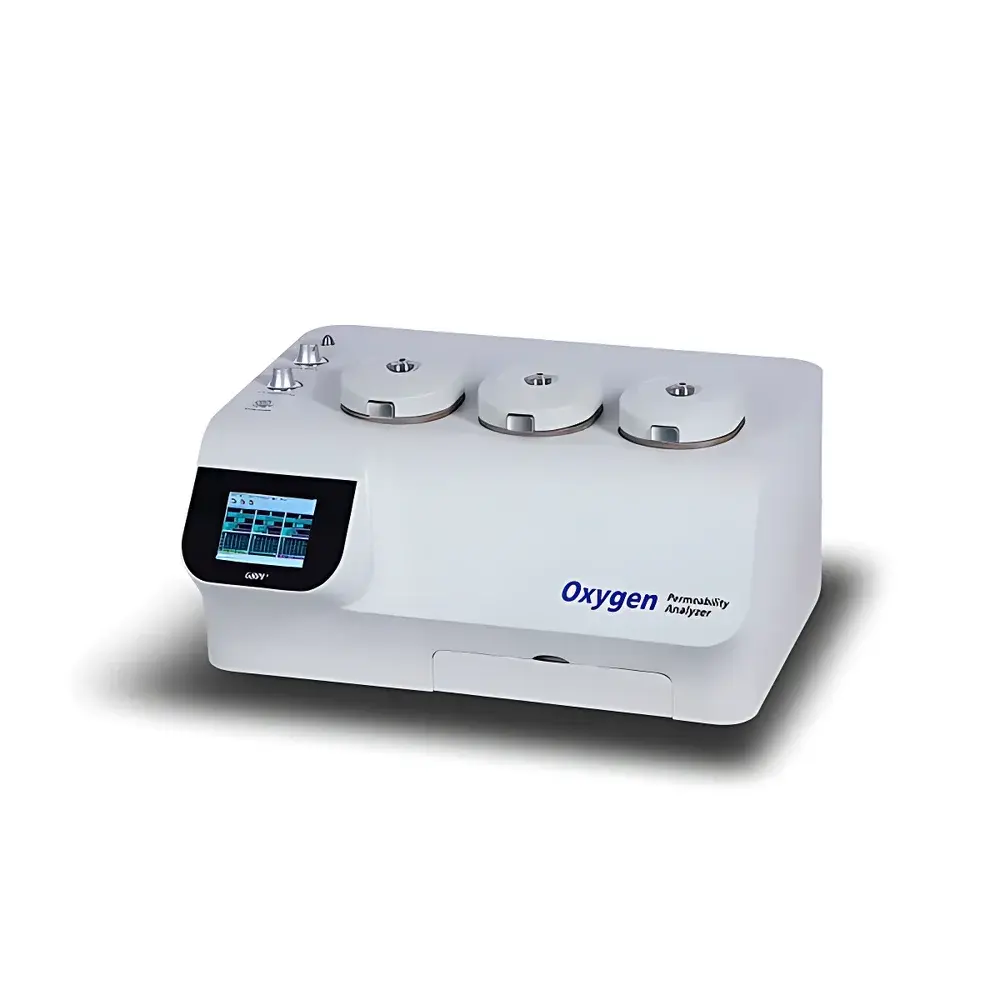
GBPI Y310-8 Oxygen Transmission Rate (OTR) Analyzer for Pharmaceutical Packaging
| Brand | GBPI |
|---|---|
| Origin | Guangdong, China |
| Manufacturer Type | OEM/ODM Producer |
| Country of Origin | China |
| Model | Y310-8 |
| Price Range | USD 14,000 – 70,000 |
| Test Range | 0.02–16,500 cm³/(m²·24h) (film) |
| O₂ Resolution | 0.001 cm³/(m²·24h) |
| Temp Control | 15–45°C (5–50°C optional) |
| Temp Accuracy | ±0.1°C |
| RH Control | 0% (dry), 30–90% RH |
| RH Accuracy | ±1% RH |
| Test Area | 50.24 cm² |
| Specimen Size | Ø100 mm |
| Max Thickness | ≤3 mm |
| Sample Capacity | 1–3 specimens per test cycle |
| Carrier Gas Pressure | 0.1–0.2 MPa |
| Gas Inlet | 1/8″ stainless steel tubing |
| Dimensions | 700 × 560 × 370 mm |
| Weight | 100 kg |
| Power | 750 W, AC 220 V, 50 Hz |
| Compliance | GB/T 19789–2005, ASTM D3985, ASTM F1927, ASTM F1307, ASTM F2622, ISO 15105-2, YBB00082003–2015, DIN 53380-3, JIS K-7126-B |
Overview
The GBPI Y310-8 Oxygen Transmission Rate (OTR) Analyzer is a gravimetric and coulometric sensor-based instrumentation platform engineered for precise, reproducible measurement of oxygen permeation through polymeric films, laminates, foils, rigid containers, and advanced functional barriers used in pharmaceutical packaging. It operates on the principle of dynamic gas transmission under controlled temperature and relative humidity (RH), where oxygen diffuses across a conditioned test specimen into a nitrogen carrier stream; the permeated O₂ is quantified in real time using a high-stability electrochemical oxygen sensor calibrated traceably to NIST-traceable standard gases and certified reference materials (CRMs). Designed explicitly for regulatory-grade applications, the system meets the physical and metrological requirements of pharmacopoeial standards—including YBB00082003–2015—and supports full compliance with FDA 21 CFR Part 11, EU Annex 11, and GMP Annex 11 for computerized systems in quality-critical environments.
Key Features
- Triple-test chamber architecture enabling simultaneous, independent evaluation of up to three distinct specimens—with individual start/stop control, autonomous data logging, and separate report generation per cavity.
- High-resolution O₂ detection (0.001 cm³/(m²·24h)) validated for ultra-low-permeability materials including aluminum foil, SiOₓ-coated PET, and multilayer barrier laminates used in blister packaging and cold-chain vials.
- Programmable dual-gas humidity control (dry air + saturated humid air) delivering stable, uniform RH from 0% to 90% ±1% RH—critical for evaluating moisture-sensitive barrier performance in lyophilized drug product packaging.
- Electromagnetic stepwise temperature regulation with ±0.1°C stability across 15–45°C (optional 5–50°C range), ensuring adherence to ISO 15105-2 conditioning protocols and accelerated aging simulation.
- ARM-based embedded controller allowing standalone operation without host PC dependency—ideal for cleanroom-integrated deployment or remote lab monitoring via Ethernet or RS232.
- GMP-aligned software architecture featuring role-based access control (administrator, operator, reviewer), method-level audit trails, system event logging, and immutable electronic records compliant with ALCOA+ principles.
Sample Compatibility & Compliance
The Y310-8 accommodates flat specimens (films, sheets, foils) up to 3 mm thick and Ø100 mm diameter, as well as 3D packaging formats—including bottles, pouches, trays, and bowls—via optional fixture kits and custom sealing adapters. Its expanded dynamic range (up to 260,000 cm³/(m²·24h) with face-mask configuration) enables characterization of both ultra-high-barrier medical device pouches and highly permeable breathable films for transdermal patches. All testing procedures conform to internationally harmonized methods: ASTM D3985 (coulometric sensor), ASTM F1927 (moisture-modulated OTR), ASTM F1307 (container testing), and ISO 15105-2 (differential pressure method). Instrument calibration is traceable to GBW(E)130497/8 national reference materials certified by the State Administration for Market Regulation (SAMR), and routine verification uses SRM-certified O₂-permeable membranes per GB/T 19789–2005.
Software & Data Management
The GBPI OTR Studio software provides a Windows-native interface with intuitive workflow navigation, real-time multi-parameter visualization (OTR, O₂ concentration, temperature, RH), and interactive curve manipulation (zoom, pan, overlay). All test sequences are fully scriptable and saved as version-controlled methods. Raw data—including sensor voltage outputs, environmental logs, and timestamped events—are stored in an encrypted SQLite database with automatic daily backups. Reports comply with GLP/GMP documentation requirements: each includes instrument ID, operator credentials, calibration history, environmental conditions, raw and processed results, uncertainty estimation (per GUM guidelines), and digital signature fields. Export options include PDF/A-2, Excel (.xlsx), and XML for LIMS integration. Audit trail records capture user login/logout, parameter changes, result modifications, and report generation—retained for ≥36 months with tamper-evident hashing.
Applications
- Pharmaceutical primary packaging qualification: blister foil lamination integrity, HDPE vial cap liner OTR, PTP aluminum/PVC composite barrier efficacy.
- Biologics container closure system validation: pre-filled syringe stopper permeability, cryovial lid seal performance under low-T/low-RH storage conditions.
- Medical device packaging: ISO 11607-1 compliant shelf-life modeling for sterile barrier systems (Tyvek®/PET-foil pouches).
- Functional film R&D: OLED encapsulation layer screening, solar backsheet moisture-oxygen dual-barrier optimization, hydrogel contact lens O₂ flux modeling.
- Regulatory submission support: generation of OTR datasets for ANDA, NDA, and MAA dossiers aligned with ICH Q5C stability guidance and USP <671> Permeation Testing.
FAQ
What standards does the Y310-8 support for pharmaceutical packaging validation?
It fully implements YBB00082003–2015, USP <671>, ISO 15105-2, ASTM F1307 (for containers), and ASTM F1927 (for humidity-variable OTR)—all essential for FDA and EMA submissions.
Can the system validate container-level OTR for prefilled syringes or vials?
Yes—using optional container fixtures and helium leak correlation protocols per ASTM F2338, enabling quantitative OTR assignment to complex 3D geometries.
Is the instrument compliant with 21 CFR Part 11 and Annex 11?
Yes—the software enforces electronic signatures, role-based permissions, audit trails with immutable timestamps, and secure data archiving meeting both FDA and EMA computerized system requirements.
How is sensor calibration maintained over time?
Calibration uses NIST-traceable O₂ standard gases and GBW(E)130497/8 certified reference membranes; automated recalibration routines are triggered before each test series or at user-defined intervals.
What maintenance is required for long-term operational reliability?
Annual sensor replacement and biannual verification with CRMs are recommended; modular hardware design allows field-swappable oxygen sensors, humidity generators, and temperature modules without full-system downtime.






