
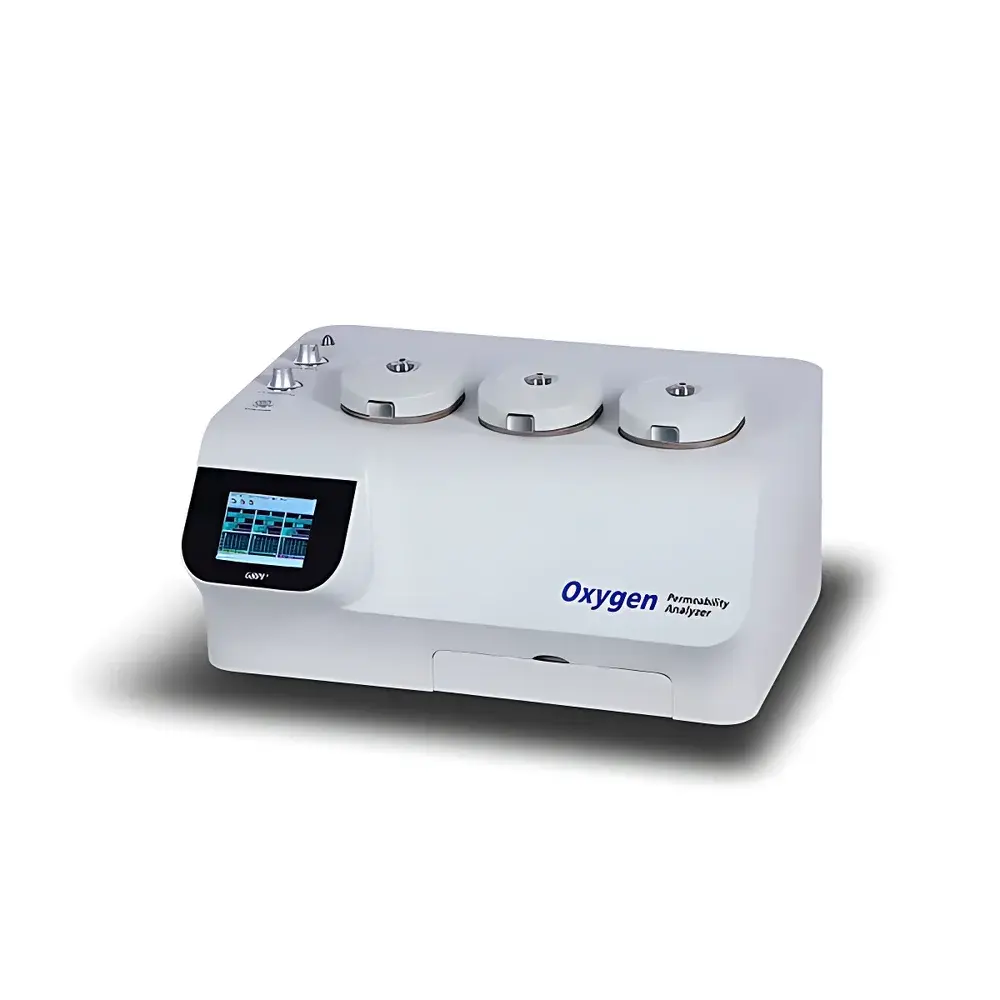
GBPI Y310-A0 Oxygen Transmission Rate (OTR) Analyzer for Pharmaceutical Packaging Materials
| Brand | GBPI |
|---|---|
| Origin | Guangdong, China |
| Manufacturer Type | Direct Manufacturer |
| Regional Classification | Domestic (China) |
| Model | Y310-A0 |
| Price Range | USD 14,000 – 70,000 |
| Test Range | 0.02–16,500 cm³/(m²·24h) (film) |
| O₂ Resolution | 0.001 cm³/(m²·24h) |
| Temp Control | 15–45°C (5–50°C optional), ±0.1°C accuracy |
| RH Control | 0% (dry), 30–90% RH, ±1% RH accuracy |
| Test Area | 50.24 cm² |
| Specimen Size | Ø100 mm |
| Max Thickness | ≤3 mm |
| Sample Capacity | 1–3 independent chambers |
| Carrier Gas Pressure | 0.1–0.2 MPa |
| Interface | 1/8″ stainless steel tubing |
| Dimensions | 700 × 560 × 370 mm |
| Weight | 100 kg |
| Power | 750 W, AC 220 V, 50 Hz |
| Compliance | GB/T 19789–2005, ASTM D3985, ASTM F1927, ASTM F1307, ASTM F2622, ISO 15105-2, YBB00082003–2015, DIN 53380-3, JIS K-7126-B |
Overview
The GBPI Y310-A0 Oxygen Transmission Rate (OTR) Analyzer is a gravimetric and coulometric sensor-based instrument engineered for precise, trace-level measurement of oxygen permeation through packaging materials used in pharmaceutical, medical device, food, and high-barrier electronics applications. It operates on the principle of dynamic gas flow analysis: a controlled stream of nitrogen (carrier gas) flows across the downstream side of a conditioned test specimen while high-purity oxygen flows over the upstream side; oxygen molecules permeating through the material are carried to a high-stability electrochemical oxygen sensor, where concentration is quantified in real time. The system calculates OTR in standard units—cm³/(m²·24h)—under defined temperature and relative humidity conditions, ensuring metrological traceability to national and international reference standards.
Key Features
- Triple-chamber independent testing architecture enables concurrent evaluation of up to three dissimilar specimens—including films, foils, laminates, rigid trays, bottles, and pouches—with fully autonomous start/stop control per chamber.
- High-resolution coulometric oxygen sensor (detection limit: 0.001 cm³/(m²·24h)) certified for long-term stability and calibrated using NIST-traceable standard membranes (GBW(E)130497/8) and certified gases.
- Precision environmental control: electromagnetic PID temperature regulation (±0.1°C) and dual-stream humidity generation (dry + saturated gas mixing) achieving ±1% RH accuracy across 0–90% RH range.
- ARM-based embedded controller allows stand-alone operation without PC dependency; full test execution, data logging, and real-time curve visualization occur locally on the 7-inch industrial LCD interface.
- GMP-compliant software architecture aligned with Annex 11 and FDA 21 CFR Part 11 requirements: role-based user access (Administrator, Operator, Reviewer), electronic signatures, and comprehensive audit trails covering system events, method changes, and raw data modifications.
- Modular hardware design facilitates field serviceability; critical components—including oxygen sensor, humidity generator, and pressure regulators—are isolated into replaceable functional units with standardized SS316 gas pathways.
Sample Compatibility & Compliance
The Y310-A0 accommodates flat specimens (Ø100 mm, ≤3 mm thick) and, via optional fixtures, three-dimensional containers including blister packs, HDPE bottles, aluminum-plastic tubes, and thermoformed trays. Its extended-range face mask configuration supports ultra-high-permeability materials (up to 260,000 cm³/(m²·24h)), enabling characterization of non-barrier substrates such as PETG or LDPE. The analyzer meets all essential regulatory and technical requirements for pharmaceutical packaging validation, including Chinese Pharmacopoeia YBB00082003–2015, ISO 15105-2 (gas chromatography–based correlation mode), ASTM F1307 (for containers), and ASTM D3985 (for planar films). All measurement protocols are fully documented and support GLP/GMP audit readiness.
Software & Data Management
The proprietary OTRControl v4.x software provides intuitive workflow configuration, real-time multi-parameter plotting (OTR, O₂ concentration, temperature, RH), and dynamic curve scaling. Test methods are saved as encrypted templates with version control. Raw data is stored in a local SQLite database with immutable timestamps and user attribution. Reports comply with ICH M4 Q5 and USP guidelines—automatically generated in PDF and editable Office formats, featuring header metadata (operator ID, calibration date, environmental logs), statistical summaries (mean, SD, RSD), and pass/fail flags against user-defined acceptance criteria. Backup exports include full audit trail archives compatible with enterprise LIMS integration.
Applications
This analyzer serves critical quality control and development functions across regulated industries: evaluating primary packaging barrier integrity for sterile injectables and lyophilized products; validating cold-chain transport packaging for biologics; qualifying barrier layers in flexible printed electronics (e.g., OLED encapsulation films); assessing moisture/oxygen co-permeation in transdermal patches; and supporting root-cause analysis of shelf-life failures in nutraceuticals and infant formula. Its compliance with ASTM F1927 makes it suitable for accelerated aging studies under elevated RH/temperature stress conditions.
FAQ
What calibration standards are supported?
The instrument accepts both certified reference membranes (125 µm polyethylene film, GBW(E)130497/8) and NIST-traceable oxygen/nitrogen gas mixtures for dual-mode verification.
Is the system compliant with FDA 21 CFR Part 11?
Yes—software enforces electronic signature workflows, audit trail retention ≥36 months, and role-based permissions consistent with computerized system validation (CSV) expectations.
Can it test rigid containers like glass vials or plastic syringes?
Yes, using the optional container fixture kit; test protocols follow ASTM F1307 and include purge cycle optimization and headspace normalization routines.
What maintenance intervals are recommended?
Oxygen sensor replacement every 18–24 months under continuous use; humidity generator desiccant refresh every 6 months; annual metrological recalibration using national standard substances.
Does the system require external PC hardware?
No—embedded ARM controller enables full operation via front-panel interface; PC connectivity is optional for report export, remote monitoring, or LIMS synchronization.




