
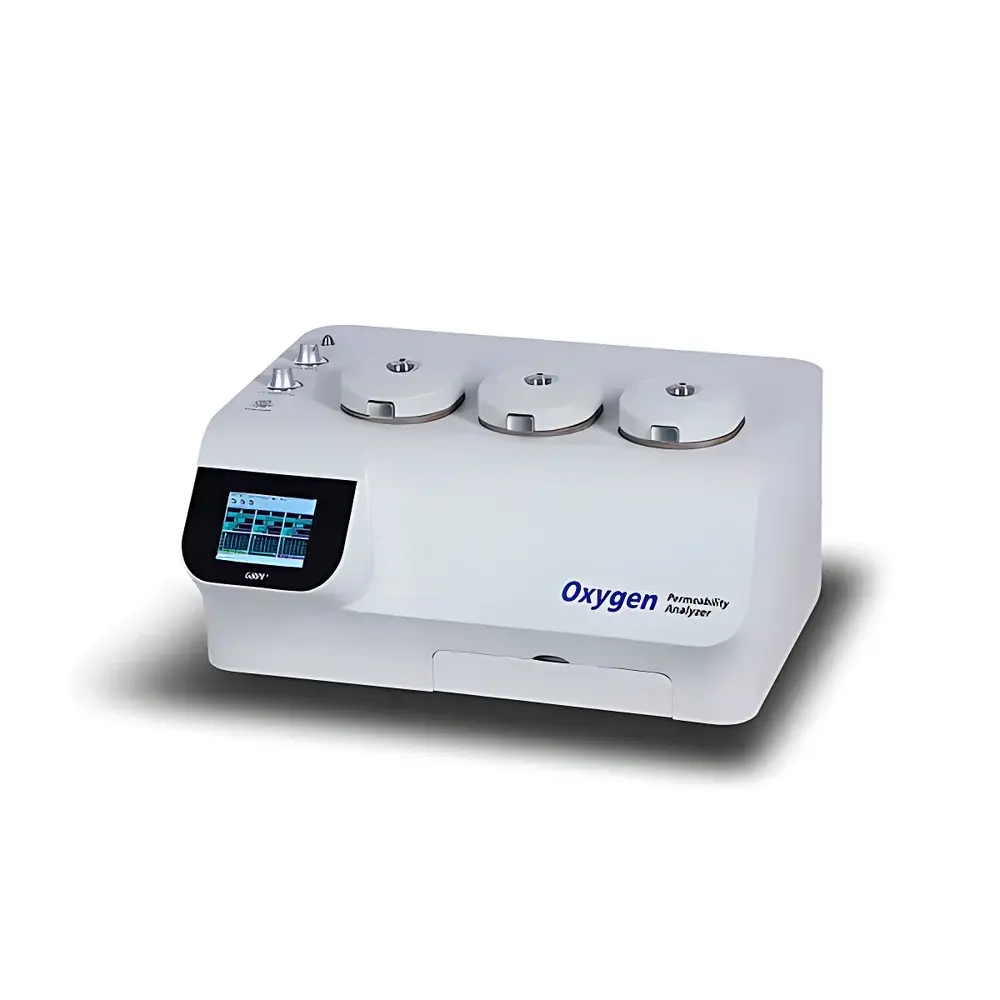
GBPI Y310-A7 Oxygen Transmission Rate (OTR) Analyzer for Pharmaceutical Packaging and Multilayer Films
| Brand | GBPI |
|---|---|
| Origin | Guangdong, China |
| Manufacturer Type | Direct Manufacturer |
| Country of Origin | China |
| Model | Y310-A7 |
| Price Range | USD 14,000 – 70,000 |
| Test Range | 0.02–16,500 cm³/(m²·24h) (film) |
| O₂ Resolution | 0.001 cm³/(m²·24h) |
| Temperature Control | 15–45°C (5–50°C optional), ±0.1°C accuracy |
| Humidity Control | 0%RH (dry), 30–90%RH, ±1%RH accuracy |
| Test Area | 50.24 cm² |
| Specimen Size | Ø100 mm |
| Max Thickness | ≤3 mm |
| Sample Capacity | 1–3 independent chambers |
| Carrier Gas Pressure | 0.1–0.2 MPa |
| Gas Inlet | 1/8″ stainless steel tubing |
| Dimensions | 700 × 560 × 370 mm |
| Weight | 100 kg |
| Power | 750 W, AC 220 V, 50 Hz |
Overview
The GBPI Y310-A7 Oxygen Transmission Rate (OTR) Analyzer is a gravimetric- and coulometric-based instrumentation platform engineered for precise, traceable, and repeatable measurement of oxygen permeation through polymeric films, laminates, foils, and rigid packaging structures. It operates on the principle of dynamic sensor-based detection: oxygen diffusing through a conditioned test specimen is carried by a dry nitrogen purge stream into a high-sensitivity electrochemical oxygen sensor (coulometric cell), where quantitative current output correlates linearly with O₂ partial pressure—enabling direct calculation of transmission rate in standardized units (cm³/[m²·24h]). Designed specifically for pharmaceutical packaging validation, the system complies with critical regulatory frameworks governing barrier performance assessment—including USP , ISO 15105-2, ASTM D3985 (for film), ASTM F1927 (for flexible packaging), ASTM F1307 (for rigid containers), and Chinese Pharmacopoeia YBB00082003-2015. Its dual-chamber architecture supports concurrent testing of heterogeneous materials under identical environmental conditions, ensuring inter-sample comparability essential for QC release testing and formulation development.
Key Features
- Triple independent test chambers with individual temperature/humidity control and autonomous termination—enabling parallel analysis of up to three distinct specimens (e.g., blister foil, cold-forming aluminum, and PVDC-coated PET) and generation of separate, audit-ready reports per chamber.
- High-resolution coulometric oxygen sensor (detection limit: 0.001 cm³/[m²·24h]) calibrated using NIST-traceable standard reference materials; certified by China’s National Institute of Metrology (GBW(E)130497/8) and authorized under Manufacturing License for Measuring Instruments (CMC).
- Precise environmental conditioning: electromagnetic step-programmable temperature control (±0.1°C stability) and dual-stream humidity regulation (dry + humidified N₂ mixing) achieving ±1%RH accuracy across 0–90%RH range.
- Embedded ARM-based real-time controller allows standalone operation without continuous PC connection; all test parameters, raw sensor outputs, and calibration logs are stored onboard with timestamped metadata.
- GMP-aligned software architecture compliant with FDA 21 CFR Part 11 and EU Annex 11 requirements: role-based access control (Administrator, Operator, Reviewer), full system/method/project-level audit trails, electronic signatures, and immutable data archiving.
- Modular hardware design with field-replaceable sensor modules, gas manifolds, and sealing assemblies—reducing mean time to repair (MTTR) and supporting ISO/IEC 17025-compliant maintenance records.
Sample Compatibility & Compliance
The Y310-A7 accommodates planar and three-dimensional specimens per ISO 15105-2 Annex B and ASTM F1307 protocols. Flat materials—including biaxially oriented polypropylene (BOPP), ethylene-vinyl alcohol (EVOH) coextrusions, metallized PET, and SiOₓ-coated films—are tested using the standard 50.24 cm² diffusion area (Ø100 mm). For rigid or semi-rigid containers (e.g., HDPE bottles, Alu-PVC blisters, CPET trays), optional permeation masks and custom fixtures extend applicability while maintaining laminar flow geometry and eliminating edge leakage. All test methods adhere to pharmacopeial compendial requirements: YBB00082003-2015 mandates ≤0.5 cm³/[m²·24h] for high-barrier parenteral vial stoppers; USP specifies OTR thresholds for sterile barrier systems used in terminally sterilized products. The instrument’s metrological traceability to national standards ensures equivalence across global regulatory submissions (e.g., EMA CHMP, PMDA, Health Canada).
Software & Data Management
GBPI OTR Studio v4.2 is a validated Windows application supporting method creation, sequence scheduling, real-time multi-parameter visualization (OTR, O₂ concentration, T, RH), and automated report generation in PDF, Excel, and CSV formats. All data—including raw sensor voltage, temperature ramp profiles, humidity setpoint deviations, and operator login events—are written directly to an embedded SQLite database with SHA-256 hashing for integrity verification. Audit trail entries record user ID, timestamp, action type (e.g., “calibration executed”, “test aborted”), and pre-/post-change values—satisfying ALCOA+ principles (Attributable, Legible, Contemporaneous, Original, Accurate, Complete, Consistent, Enduring, Available). Data export is restricted to authorized roles; encrypted backups support 21 CFR Part 11-compliant long-term archival.
Applications
- Pharmaceutical primary packaging qualification: OTR verification of PTP blisters, sachets, IV bags, and prefilled syringe stoppers per ICH Q5C stability guidance.
- Medical device packaging validation: ASTM F1980 accelerated aging correlation studies using OTR-derived shelf-life modeling.
- Flexible electronics encapsulation: barrier layer evaluation for OLED lighting panels and thin-film photovoltaic backsheets (IEC 61215-2 MQT 17).
- Food packaging R&D: comparative analysis of biopolymer blends (PLA, PHA) versus conventional PE/EVOH laminates under varying RH conditions.
- Regulatory submission support: generation of GLP-compliant datasets for ANDA, NDA, and MDR technical files requiring ISO/IEC 17025-accredited test evidence.
FAQ
What calibration standards are required for daily verification?
NIST-traceable OTR reference films (e.g., 125 µm polyethylene standard, certified value ±2%) and certified zero-oxygen nitrogen (99.999% purity) are mandatory for system suitability checks prior to each test batch.
Can the Y310-A7 meet FDA 21 CFR Part 11 requirements for electronic records?
Yes—software enforces electronic signatures, audit trail retention (>10 years), and role-based permissions; full validation documentation (IQ/OQ/PQ protocols) is available upon request.
Is container testing possible without third-party adapters?
Standard configuration includes mask-based container fixtures compliant with ASTM F1307; custom geometries (e.g., ampoules, cartridges) require engineering review and mechanical validation.
How is sensor longevity maintained during high-OTR testing?
The coulometric cell features automatic over-range protection and adaptive gain adjustment; typical service life exceeds 24 months at ≤10,000 cm³/[m²·24h] average load.
Does GBPI provide ISO/IEC 17025 accreditation support?
Yes—application notes, uncertainty budgets, and interlaboratory comparison data packages are supplied to support laboratory accreditation against ISO/IEC 17025:2017 Clause 6.4.1 (Equipment Verification).





