
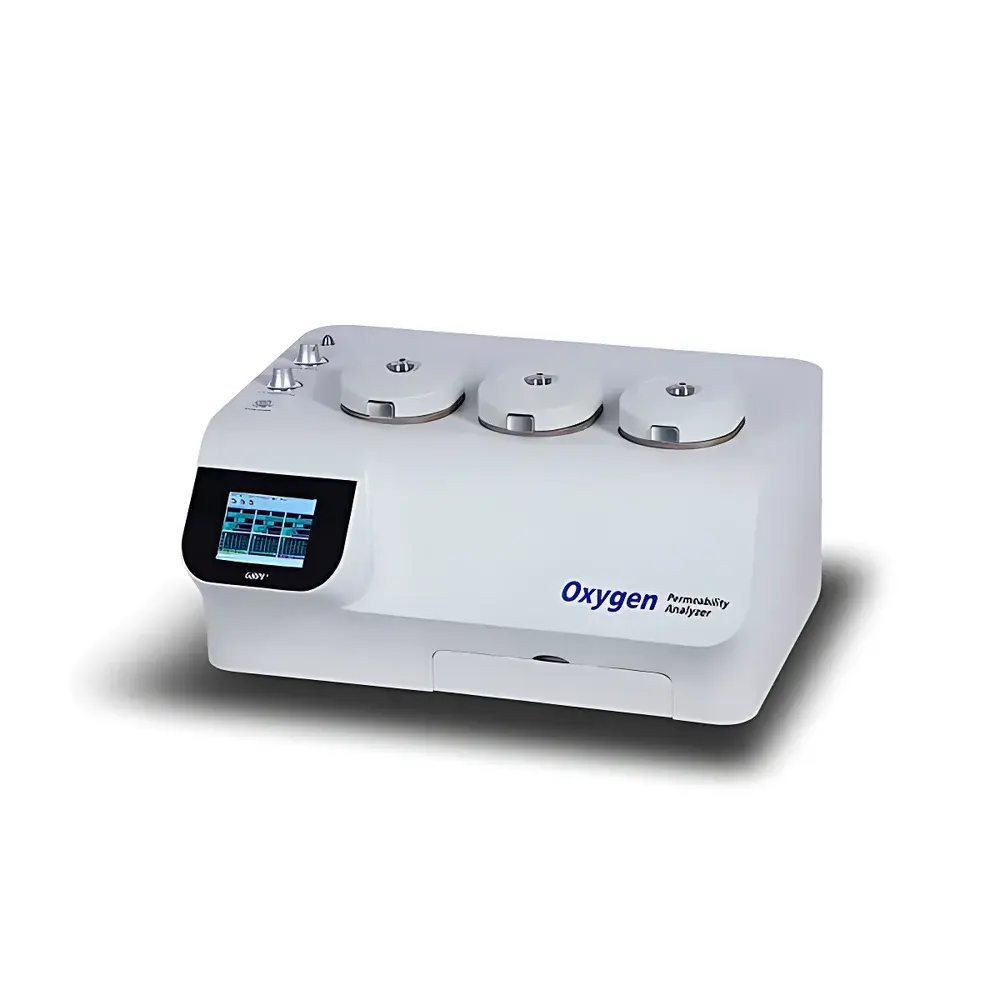
GBPI Y310-T Oxygen Transmission Rate (OTR) Analyzer
| Brand | GBPI |
|---|---|
| Model | Y310-T |
| Origin | Guangdong, China |
| Manufacturer Type | Direct Manufacturer |
| Country of Origin | China |
| Price Range | USD 14,000 – 70,000 |
| Test Range | 0.02–16,500 cm³/(m²·24h) (film) |
| O₂ Resolution | 0.001 cm³/(m²·24h) |
| Temperature Control | 15–45°C (5–50°C optional), ±0.1°C accuracy |
| Humidity Control | 30–90% RH, ±1% RH accuracy |
| Test Area | 50.24 cm² |
| Specimen Size | Ø100 mm |
| Max Thickness | ≤3 mm |
| Sample Capacity | 1–3 independent chambers |
| Carrier Gas Pressure | 0.1–0.2 MPa |
| Power | AC 220 V, 50 Hz, 750 W |
| Dimensions | 700 × 560 × 370 mm |
| Weight | 100 kg |
Overview
The GBPI Y310-T Oxygen Transmission Rate (OTR) Analyzer is a gravimetric- and coulometric-based permeation measurement system engineered for precise, traceable quantification of oxygen permeability through polymeric films, laminates, foils, rigid containers, and functional barrier materials. It operates on the principle of dynamic gas transmission under controlled temperature and relative humidity conditions, utilizing high-stability electrochemical oxygen sensors and dual-stream humidity generation to establish steady-state diffusion across the test specimen. The instrument complies with core international standards governing barrier performance evaluation—including ASTM D3985 (coulometric sensor method), ASTM F1927 (moisture-assisted OTR), ASTM F1307 (container testing), ISO 15105-2 (differential pressure method), and Chinese pharmacopoeial standard YBB00082003-2015—ensuring data interoperability across global regulatory submissions and quality control workflows.
Key Features
- Triple independent test chambers enable concurrent, statistically independent measurements of up to three specimens—identical or dissimilar—each generating a discrete, audit-ready report.
- High-resolution coulometric oxygen sensor (0.001 cm³/(m²·24h)) delivers metrological-grade sensitivity suitable for ultra-high-barrier materials including aluminum foil, SiOx-coated PET, and multilayer pharmaceutical blister films.
- Electromagnetic step-programmable temperature control (±0.1°C) and dual-gas (dry/wet N₂) humidity regulation (±1% RH) ensure thermodynamic stability critical for reproducible permeation kinetics.
- ARM-based embedded controller supports standalone operation without PC dependency; full instrument logic, calibration routines, and real-time curve visualization run natively on the 7-inch LCD interface.
- GMP-aligned software architecture implements role-based access control (administrator, operator, reviewer), configurable permission matrices, and comprehensive audit trails per FDA 21 CFR Part 11 and EU Annex 11 requirements.
- Modular hardware design simplifies field maintenance: oxygen sensor modules, humidity generators, and gas manifolds are mechanically and electrically decoupled for rapid replacement and recalibration.
Sample Compatibility & Compliance
The Y310-T accommodates flat specimens (films, sheets, ceramics, rubber) up to 3 mm thick and Ø100 mm in diameter, as well as 3D packaging formats—including bottles, pouches, cups, and blister cavities—via optional container adapters and custom permeation shrouds. Its extended-range shroud configuration extends measurable OTR up to 260,000 cm³/(m²·24h), supporting validation of non-barrier materials such as LDPE agricultural films or breathable medical packaging. All measurement protocols adhere to ISO/IEC 17025 traceability principles: certified reference standards (GBW(E)130497/8) are supplied for routine verification, and dual-mode calibration—using both certified polymer films and primary-standard oxygen/nitrogen gas mixtures—is fully integrated into the software workflow.
Software & Data Management
The proprietary GBPI OTR Control Suite runs on Windows OS and provides full lifecycle data governance. Real-time plotting includes synchronized time-series curves for OTR, O₂ concentration, chamber temperature, and RH—each independently scalable, overlayable, and exportable. Automated report generation conforms to GLP/GMP documentation standards: reports include instrument ID, operator credentials, environmental logs, raw sensor outputs, statistical summaries (mean, SD, CV%), and digital signatures. All data modifications—method edits, result overrides, calibration updates—are immutably timestamped and user-attributed within the audit trail database. Data export supports CSV, PDF/A-2, and Microsoft Office formats; optional SQL Server backend integration enables enterprise-level LIMS synchronization.
Applications
This analyzer serves critical quality assurance functions across regulated and industrial sectors. In pharmaceutical manufacturing, it validates primary packaging integrity for sterile injectables, lyophilized products, and transdermal patches per USP and ICH Q5C. Food producers apply it to assess shelf-life predictors for vacuum-sealed meats, modified-atmosphere coffee bags, and retort pouches. Electronics manufacturers characterize moisture/oxygen ingress in OLED encapsulation and solar backsheet laminates. Medical device firms evaluate oxygen permeability of wound dressings, IV bag films, and silicone elastomer tubing. Research institutions utilize its high-resolution capability for structure–property studies of novel biodegradable polymers and nanocomposite barriers.
FAQ
What calibration standards are required for daily verification?
Certified reference films (e.g., 125 µm PE standard) and N₂/O₂ gas mixtures (99.999% purity, traceable to NIST or CNAS) are used for dual-mode calibration. GBPI supplies GBW(E)130497/8 certified national standard substances compliant with JJG 813–2013.
Can the system validate container OTR per ASTM F1307?
Yes—when equipped with the optional container test fixture and permeation shroud, the Y310-T meets all geometric, sealing, and purge protocol requirements specified in ASTM F1307-22 for rigid and semi-rigid packaging.
Is remote monitoring supported?
The embedded ARM controller supports TCP/IP Ethernet connectivity; real-time status, alarms, and live curves can be accessed via secure HTTPS interface or integrated into SCADA systems using Modbus TCP.
How is sensor longevity ensured under high-O₂ exposure?
The coulometric sensor incorporates automatic over-range shutdown logic and thermal derating algorithms. Typical service life exceeds 24 months at ≤10,000 cm³/(m²·24h) average load; sensor replacement kits include factory pre-calibration certificates.
Does software support 21 CFR Part 11 compliance out-of-the-box?
Yes—the system ships with electronic signature enforcement, role-based permissions, and immutable audit logs meeting all predicate rule requirements for computerized system validation in FDA-regulated environments.
Related Products




