
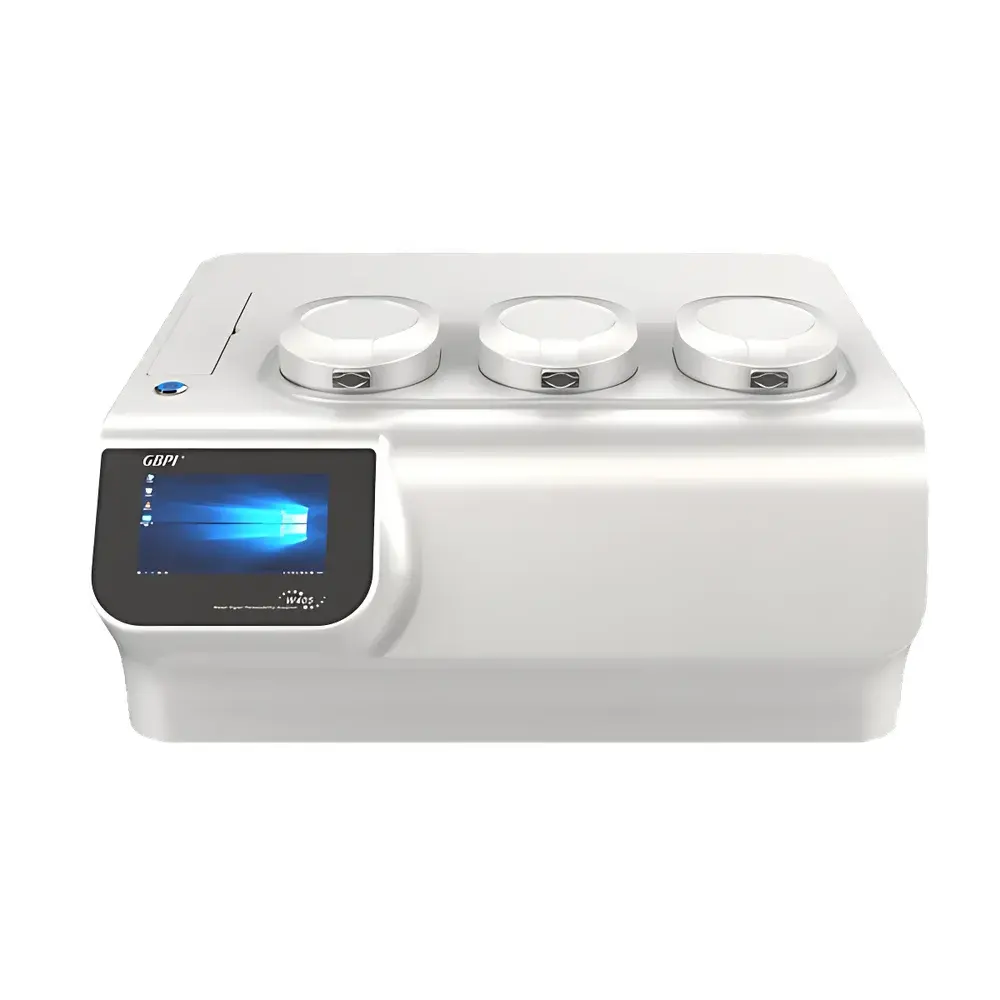
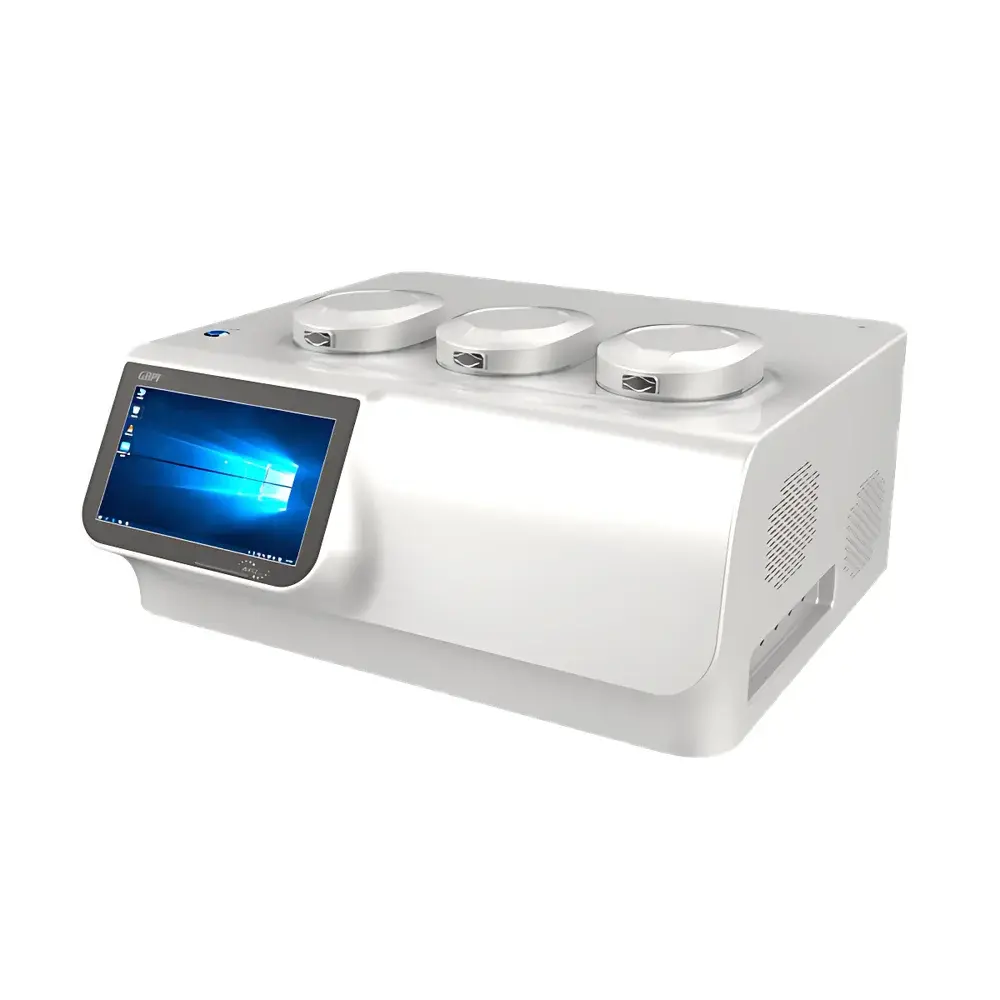
GBPI Y310C Coulometric Oxygen Transmission Rate (OTR) Analyzer
| Brand | GBPI |
|---|---|
| Origin | Guangdong, China |
| Manufacturer Type | OEM Manufacturer |
| Region of Origin | Domestic (China) |
| Model | Y310C |
| Price | USD 54,800 (FOB Guangzhou) |
| Test Principle | Coulometric Sensor (ASTM D3985 / ISO 15105-2) |
| Measurement Range | 0.05–1000 cm³/(m²·24 h) (up to 260,000 cm³/(m²·24 h) with mask accessory) |
| Resolution | 0.001 cm³/(m²·24 h) |
| Temperature Control | 15–45 °C ±0.1 °C |
| Permeation Area | 50.24 cm² (customizable down to 0.785 cm²) |
| Sample Size | Ø100 mm |
| Max Sample Thickness | ≤3 mm |
| Sample Capacity | 3 independent test cells |
| Carrier Gas Pressure | ≥0.1 MPa |
| Pneumatic Clamping Pressure | ≥0.3 MPa |
| Power | 750 W |
| Electrical Supply | AC 220 V, 50 Hz |
Overview
The GBPI Y310C Coulometric Oxygen Transmission Rate (OTR) Analyzer is an engineered metrology platform designed for precise, traceable, and standards-compliant measurement of oxygen permeability through polymeric films, laminates, foils, and rigid or flexible packaging structures. It operates on the coulometric detection principle—where oxygen molecules permeating across a conditioned specimen are swept by high-purity nitrogen carrier gas into a solid-electrolyte coulometric sensor. The sensor quantifies oxygen via Faraday’s law of electrolysis, generating a current proportional to the molar flux of O₂. This first-principles electrochemical method ensures inherent linearity, long-term stability, and minimal drift—critical for regulatory-grade material qualification in pharmaceutical, food, medical device, and photovoltaic applications. The instrument complies with ISO 15105-2, ASTM D3985, ASTM F1307, ASTM F1927, ASTM F2622, GB/T 19789, and YBB 00082003, supporting both ambient and controlled environmental testing under defined temperature and pressure differentials.
Key Features
- Triple independent test chambers enable parallel, statistically robust OTR measurements—reducing total assay time by up to 67% versus single-cell systems.
- High-fidelity coulometric oxygen sensor (imported, certified), delivering resolution of 0.001 cm³/(m²·24 h) and <±1.5% repeatability (n=10, standard film).
- Pneumatically actuated clamping system ensures uniform 0.3 MPa sealing force across all sample geometries—eliminating manual torque variability and leakage artifacts.
- Dual-zone electromagnetic temperature control maintains chamber setpoint within ±0.1 °C over full 15–45 °C range, with ramp rate programmability and thermal equilibrium validation.
- Integrated 11.6-inch capacitive touchscreen HMI running embedded real-time OS—supporting fully automated test sequences, dynamic curve overlays (OTR vs. time, T vs. time, flow vs. time), and on-device data review/export.
- GMP-aligned software architecture compliant with FDA 21 CFR Part 11 requirements: role-based user permissions, electronic signatures, immutable audit trails (system events + test-level metadata), and ALCOA+ data integrity controls.
Sample Compatibility & Compliance
The Y310C accommodates flat specimens (films, sheets, foils, coated papers) up to Ø100 mm and 3 mm thickness, as well as 3D packaging formats—including bottles, pouches, cups, tubes, and blister cavities—via optional fixtures and diffusion masks. Validated substrates include BOPP, PET, PE, PVC, aluminum-laminated composites, PLA/PBAT bioplastics, PVDC-coated films, pharmaceutical PVC/PP hard sheets, Tyvek®-based medical packaging, solar backsheet laminates (e.g., PET/EVA/EVA), and barrier-coated paperboard. All test methods adhere to ISO/IEC 17025 traceability frameworks; calibration is performed using NIM-certified reference materials (GBW(E)130497 and GBW(E)130498), with documented uncertainty budgets per ISO/IEC 17025:2017 Clause 6.4.
Software & Data Management
The proprietary GBPI LabOS v4.2 provides modular workflow configuration—enabling method templates aligned with USP , Ph. Eur. 5.3, or internal SOPs. Raw sensor signals, environmental logs, and calculated OTR values are stored in encrypted SQLite databases with SHA-256 hashing. Export options include CSV, PDF (with electronic signature fields), XML (for LIMS ingestion), and XLSX. Audit trail records capture operator ID, timestamp, parameter changes, calibration events, and result approvals. Remote access is enabled via secure TLS-encrypted web interface for instrument status monitoring, historical data retrieval, and firmware updates—fully compatible with enterprise IT security policies.
Applications
- Pharmaceutical packaging: OTR validation of cold-form blisters, sachets, and child-resistant closures per ICH Q5C and FDA guidance on container closure integrity.
- Food packaging R&D: Accelerated shelf-life modeling for MAP (modified atmosphere packaging) films and retort pouches under varying humidity and temperature profiles.
- Medical device packaging: Verification of sterile barrier system performance per ISO 11607-1, including peel strength–OTR correlation studies.
- Photovoltaic module qualification: Quantification of edge seal degradation kinetics in encapsulant/backsheet assemblies exposed to damp heat (IEC 61215).
- Regulatory submissions: Generation of GLP-compliant reports for ANDA, NDA, and MDR technical documentation requiring full data traceability and instrument qualification records (IQ/OQ/PQ).
FAQ
What gases are required for operation?
High-purity oxygen (≥99.999%) and nitrogen (≥99.999%), each equipped with precision pressure regulators (0–0.4 MPa output).
Is the instrument compliant with 21 CFR Part 11?
Yes—software includes electronic signatures, audit trail logging, user access controls, and data immutability features validated per Annex 11 and Part 11 requirements.
Can the Y310C test rigid containers like bottles or trays?
Yes—using optional custom fixtures and diffusion masks; OTR is reported normalized to surface area per ISO 15105-2 Annex C.
How is calibration verified?
Using NIM-certified national standard reference materials (GBW(E)130497/130498); certificate of calibration includes expanded uncertainty (k=2) and traceability to SI units.
Does the system support network integration?
Yes—Ethernet port enables direct LIMS connectivity, remote diagnostics via secure web portal, and cloud-based data backup with configurable retention policies.





