
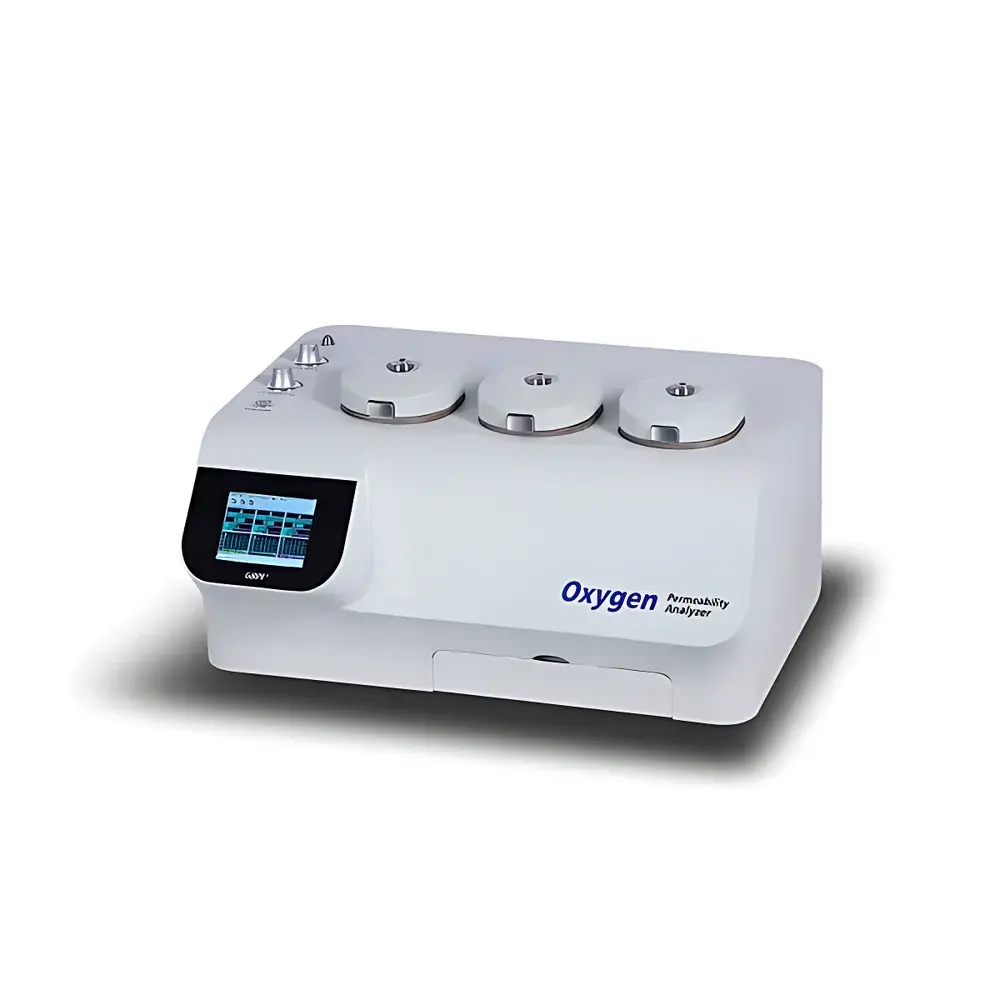
GBPI Y310M Isostatic Oxygen Transmission Rate (OTR) Analyzer
| Brand | GBPI |
|---|---|
| Origin | Guangdong, China |
| Manufacturer Type | OEM/ODM Producer |
| Country of Origin | China |
| Model | Y310M |
| Price Range | USD 14,000 – 70,000 |
| Test Range | 0.02–16,500 cm³/(m²·24h) (film) |
| O₂ Detection Resolution | 0.001 cm³/(m²·24h) |
| Temperature Control | 15–45°C (5–50°C optional) |
| Humidity Control | 30–90% RH (100% RH optional) |
| Test Area | 50.24 cm² |
| Specimen Size | Ø100 mm |
| Max Thickness | ≤3 mm |
| Sample Capacity | 1–3 specimens per test cycle |
| Carrier Gas Pressure | 0.1–0.2 MPa |
| Gas Inlet | 1/8″ stainless steel tubing |
| Dimensions (W×D×H) | 700×560×370 mm |
| Weight | 100 kg |
| Power | 750 W, AC 220 V, 50 Hz |
Overview
The GBPI Y310M Isostatic Oxygen Transmission Rate (OTR) Analyzer is a precision-engineered instrument designed for quantitative measurement of oxygen permeation through planar and three-dimensional packaging materials under controlled temperature and humidity conditions. It operates on the principle of coulometric detection—utilizing a high-stability electrochemical oxygen sensor to quantify trace-level oxygen flux diffusing across a sealed test specimen mounted in a diffusion cell. The system maintains strict isostatic pressure equilibrium between upstream (O₂-rich) and downstream (N₂-purged) chambers, ensuring compliance with the fundamental assumptions of standardized isostatic OTR testing methods. This architecture enables accurate, reproducible determination of oxygen transmission rates for barrier films, laminates, foils, rigid containers, and functional medical or electronic substrates—critical for shelf-life prediction, regulatory submission, and quality assurance in regulated industries.
Key Features
- Triple independent test chambers support concurrent analysis of up to three dissimilar specimens, each generating a fully traceable, standalone OTR report without cross-contamination or thermal/hygrometric interference.
- ARM-based embedded control system allows autonomous operation—no host PC required for routine testing—while retaining full remote monitoring and method synchronization via RS232 interface.
- Dual-stream humidity generation (dry N₂ + saturated humidified N₂) delivers precise, stable RH control from 30% to 100% RH with ±1% RH accuracy, validated per ISO 15105-2 Annex B calibration protocols.
- Electromagnetic programmable temperature control achieves ±0.1°C stability across 15–45°C (optionally extended to 5–50°C), enabling accelerated aging studies and comparative barrier performance mapping across climate zones.
- Coulometric oxygen sensor (imported, long-life design) provides sub-ppm O₂ detection sensitivity and automatic over-range protection to prevent sensor saturation damage during high-permeability testing.
- GMP-compliant software architecture implements role-based access control (Administrator, Operator, Reviewer), full audit trail (system, method, and run-level), electronic signatures, and 21 CFR Part 11–ready data integrity safeguards.
Sample Compatibility & Compliance
The Y310M accommodates flat specimens up to Ø100 mm and 3 mm thickness—including monolayer polymers, metallized PET, Al foil laminates, PVDC-coated films, silicone elastomers, ceramic substrates, and hydrogel-based medical patches. With optional container adapters and the high-capacity OTR mask accessory, it extends to rigid and semi-rigid formats: HDPE bottles, blister cavities, pouches, trays, and LCD cover films. All hardware and calibration workflows align with internationally recognized standards: ASTM D3985 (coulometric sensor), ASTM F1927 (moisture-sensitive barrier), ASTM F1307 (container testing), ASTM F2622 (high-resolution OTR), ISO 15105-2 (isostatic method), GB/T 19789-2005 (Chinese national standard), YBB00082003-2015 (Chinese pharmaceutical packaging), DIN 53380-3, and JIS K-7126-B. Certified reference materials (GBW(E)130497/8) are supplied for on-site verification per ISO/IEC 17025 metrological traceability requirements.
Software & Data Management
GBPI OTR Studio v4.x is a Windows-native application built for GLP/GMP environments. It features real-time dual-axis plotting of OTR, O₂ concentration, temperature, and RH—each curve independently scalable, draggable, and toggleable. All raw sensor outputs, environmental logs, and metadata are stored in an encrypted SQLite database with immutable timestamps. Reports auto-generate in PDF and Office-compatible formats, embedding instrument ID, operator credentials, calibration history, environmental setpoints, and uncertainty estimates per GUM (Guide to the Expression of Uncertainty in Measurement). Audit trails record every user action—including parameter edits, result deletions, and calibration events—with IP address, timestamp, and session ID. Data export supports CSV and XML for LIMS integration; no proprietary binary formats are used.
Applications
- Pharmaceutical packaging validation per USP , FDA guidance on container closure integrity (CCI), and EMA reflection paper on OTR-driven drug oxidation.
- Food packaging shelf-life modeling—correlating OTR values at 23°C/0% RH and 40°C/90% RH with accelerated stability data per ICH Q1A(R2).
- Medical device packaging qualification per ISO 11607-1, including Tyvek® pouches, peelable lids, and sterilization barrier systems.
- Flexible electronics encapsulation assessment—solar backsheet OTR screening, OLED moisture barrier layer R&D, and touch sensor film lifetime prediction.
- Regulatory dossier preparation for NDA/ANDA submissions requiring ASTM/ISO-aligned OTR data with full metrological traceability and instrument qualification records (IQ/OQ/PQ templates included).
FAQ
What calibration standards are supported?
Both certified reference films (e.g., 125 µm polyethylene standard) and certified gas mixtures (e.g., 100 ppm O₂ in N₂) are supported for dual-mode verification per ISO 17025 Clause 6.6.
Is the system compliant with 21 CFR Part 11?
Yes—audit trail, electronic signature, role-based permissions, and data immutability are implemented in accordance with Part 11 Subpart B requirements for closed systems.
Can the instrument test aluminum foil directly?
Yes—the 0.001 cm³/(m²·24h) resolution and low-noise sensor enable reliable measurement of ultra-high-barrier materials, including uncoated and laminated Al foils.
What gas supply specifications are mandatory?
Two high-purity gas sources are required: O₂ ≥99.999% and N₂ ≥99.999%, each equipped with a precision pressure regulator (0–0.4 MPa output) and particulate filter.
Does the system require annual recalibration by the manufacturer?
No—users perform routine verification using supplied reference materials; factory recalibration is recommended biennially or after major component replacement, with full NIST-traceable certificates provided.




