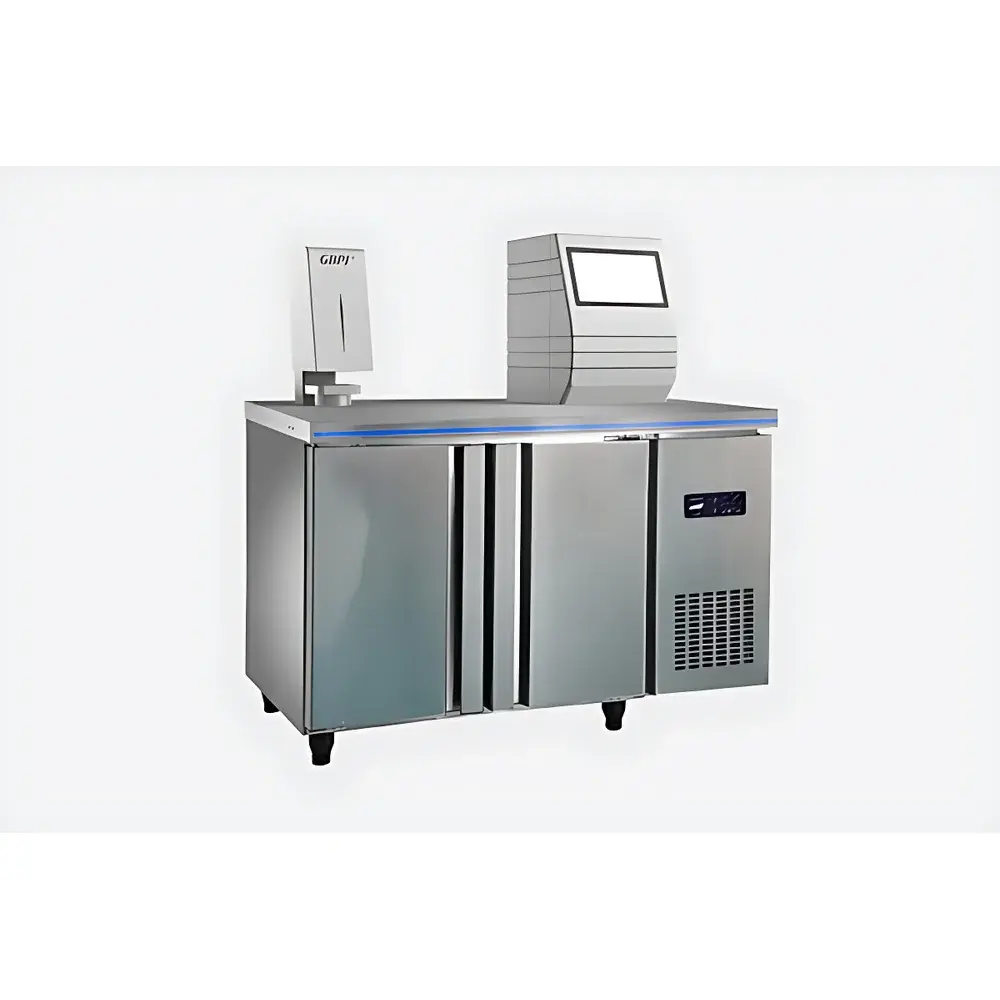
GBPI YQ-300W Aerosol Filtration Efficiency Tester for Respiratory Protective Devices
| Brand | GBPI |
|---|---|
| Origin | Guangdong, China |
| Manufacturer Type | Direct Manufacturer |
| Region Classification | Domestic (China) |
| Model | YQ-300W |
| Quotation | Upon Request |
| Filtration Efficiency Range | 0–99.999% |
| Flow Rate Range | 10–100 L/min (Accuracy Class 2.5) |
| Sampling Frequency | 1–9999 times/min (Adjustable) |
| Test Aerosol Concentration | 20–30 mg/m³ |
| Count Median Diameter (CMD) | NaCl aerosol (0.075 ± 0.02) µm |
| Geometric Standard Deviation (GSD) | NaCl ≤ 1.86 |
| Dynamic Concentration Detection Range | 0.001–100 mg/m³ (Accuracy: ±1%) |
| Instrument Accuracy Class | Class 4 |
| Dimensions | 460 mm × 525 mm × 1430 mm |
| Differential Pressure Sensor Range | 0–500 Pa |
| Power Supply | AC 220 V, 50 Hz |
Overview
The GBPI YQ-300W Aerosol Filtration Efficiency Tester is a fully integrated, computer-controlled instrumentation platform engineered for precise quantitative assessment of particulate filtration efficiency (PFE) in respiratory protective devices—including surgical masks, medical face masks, N95/N99 respirators, and industrial filtering facepieces—as well as in nonwoven fabrics and barrier materials used in healthcare and occupational safety applications. The system operates on the principle of upstream-downstream aerosol concentration differential measurement under controlled, constant-flow conditions, compliant with internationally recognized test methodologies rooted in gravimetric and optical particle counting principles. It employs dual aerosol generation pathways—salt (NaCl) and oil (DEHS or equivalent)—to simulate both hydrophilic and hydrophobic challenge agents, enabling evaluation across regulatory-defined test conditions per ISO 16900-1, ASTM F2299, EN 14683, and key Chinese national standards including GB/T 32610–2016, GB 2626–2006, GB 19082–2009, GB 19083–2010, GB 24539–2009, and YY 0469–2011.
Key Features
- Cold-generation dual-aerosol system: Independent NaCl and oil aerosol generators produce stable, monodisperse challenge particles without thermal degradation—ensuring reproducible CMD and GSD performance.
- High-fidelity real-time monitoring: Integrated PM2.5 sensors and laser particle counters (0.3–10 µm detection range) provide synchronized upstream/downstream concentration data at user-defined sampling frequencies (1–9999 Hz).
- Leak-tight, full-enclosure design: All aerosol-handling pathways are sealed with O-ring gaskets and negative-pressure containment, minimizing operator exposure and meeting OSHA-compliant laboratory safety requirements.
- Electrostatic neutralization module: Built-in 85Kr or soft X-ray neutralizer ensures charge equilibration of test aerosols prior to filter challenge—critical for eliminating electrostatic enhancement artifacts in PFE reporting.
- Pneumatic clamping fixture with mechanical interlock: Ensures consistent sample mounting pressure (±2 kPa repeatability) and automatic power cutoff upon door opening—certified to IEC 61000-6-2/6-4 EMC and IP20 operational safety class.
- Environmental monitoring suite: Onboard temperature and humidity sensors (±0.5 °C, ±3 %RH accuracy) continuously log ambient conditions, with automated pass/fail flagging if test chamber deviates beyond 25 °C ± 5 °C and 30 %RH ± 10 %RH.
- Modular flow control architecture: Precision glass rotor flowmeters and vacuum-regulated mass flow controllers maintain setpoint stability within ±1.5 % of full scale across the 10–100 L/min operating range.
Sample Compatibility & Compliance
The YQ-300W accommodates flat-sheet specimens up to 100 mm diameter or standard 3-layer surgical mask panels (with optional custom fixtures). It supports standardized conditioning protocols per ISO 13485 and ASTM D737 for textile breathability correlation. All test procedures align with regulatory audit expectations for GLP-compliant laboratories: raw data integrity is preserved via timestamped binary logging, electronic signatures meet FDA 21 CFR Part 11 requirements, and software audit trails record all parameter changes, calibration events, and user actions. System validation documentation—including IQ/OQ/PQ templates, uncertainty budgets per GUM (JCGM 100:2008), and metrological traceability to NIM (National Institute of Metrology, China)—is supplied with each unit.
Software & Data Management
The proprietary GBPI FilterTest v4.2 software runs on Windows 10/11 (64-bit) and provides role-based access control (administrator, technician, reviewer). It automates test sequence execution—including aerosol stabilization, baseline acquisition, challenge phase, and post-test purge—and computes filtration efficiency using the standard equation: FE (%) = [1 − (Cdown/Cup)] × 100. All intermediate values (ΔP, flow rate, CMD, GSD, aerosol concentration decay curves) are stored in encrypted SQLite databases with SHA-256 checksum verification. Export options include CSV, PDF test reports (with embedded digital signatures), and XML files compatible with LIMS platforms such as Thermo Fisher SampleManager and LabVantage. Automated backup to network drives or cloud storage (AWS S3, Azure Blob) is configurable.
Applications
- Regulatory submission testing for NMPA Class II/III medical mask registrations
- QC release testing of melt-blown polypropylene filter media in ISO 13485-certified production lines
- Comparative evaluation of electret decay under humidity/temperature stress per ISO 18562-2 biocompatibility guidance
- R&D screening of novel nanofiber or graphene-enhanced filtration layers
- Third-party certification per CE marking requirements under EU PPE Regulation (EU) 2016/425 Annex II
- Annual proficiency testing for CNAS-accredited laboratories (CNAS-CL01:2018)
FAQ
Does the YQ-300W support both salt and oil aerosol testing in a single test run?
No—dual-aerosol testing requires sequential operation with dedicated generator priming and system purging between modes to prevent cross-contamination and ensure CMD fidelity.
What calibration standards are required for routine maintenance?
Primary calibration uses NIST-traceable flow meters (e.g., DryCal DC-Lite) and ISO 21501-4 certified particle counters; secondary verification employs polystyrene latex (PSL) microspheres at 0.075 µm and 0.185 µm.
Is remote diagnostics supported?
Yes—the system includes Ethernet-connected embedded controller with TLS 1.2-secured remote desktop access (TeamViewer IoT module), enabling firmware updates and troubleshooting without on-site service visits.
Can test data be integrated into an existing ERP system?
Via RESTful API endpoints documented in the Software Development Kit (SDK), allowing bidirectional exchange of test IDs, pass/fail status, and metadata with SAP QM or Oracle Quality modules.
What is the recommended preventive maintenance interval?
Every 500 operational hours or semiannually—whichever occurs first—with scheduled replacement of aerosol nebulizer tips, HEPA exhaust filters, and differential pressure sensor diaphragms.