
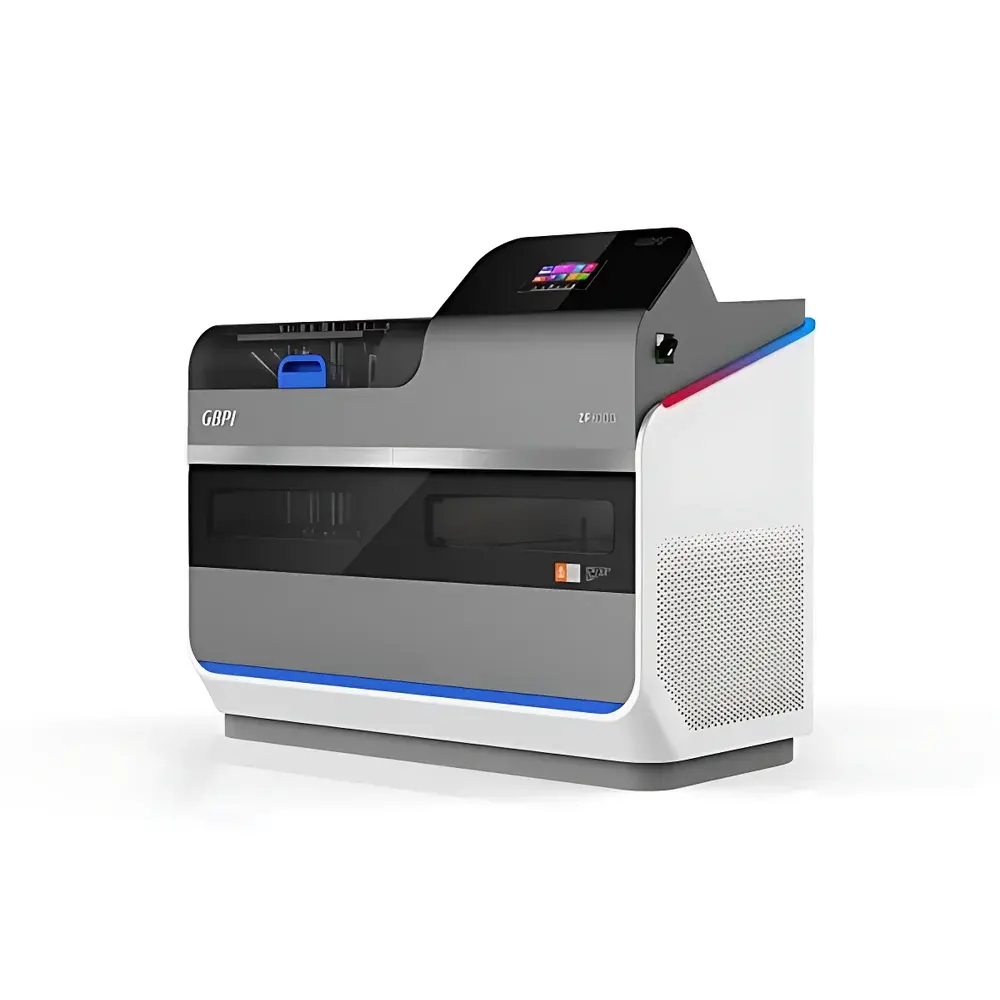
GBPI ZF-1800A Total Migration and Non-Volatile Residue Analyzer
| Brand | GBPI |
|---|---|
| Model | ZF-1800A |
| Origin | Guangdong, China |
| Manufacturer Type | Direct Manufacturer |
| Application Domain | Food Contact Material (FCM) Compliance Testing |
| Standards Compliance | GB 31604.8–2016, GB 31604.1–2015, GB/T 5009.156–2016, GB/T 9740–2008, GB/T 23949–2009, YBB00342002–2015, YBB00102005–2015, YBB00082002–2015 |
| Measurement Range | 0.167–167,000 mg/dm² |
| Resolution | 0.0001 mg/dm² |
| Balance Capacity | 0–200 g |
| Balance Readability | 0.1 mg |
| Water Bath Temp Control | 68.3–100 °C |
| Heating Chamber Temp Control | 68.3–117.9 °C |
| Cooling Chamber Temp Control | <27.5 °C |
| Temperature Accuracy | ±3 °C |
| Sample Throughput | 1–18 independent test positions |
| Gravimetric恒重 Cycle Time | 2.5 h (typical) |
| Evaporating Dish Volume | 0–200 mL |
| Dimensions (L×W×H) | 180 × 90 × 120 cm |
| Power Supply | 220 V, 50 Hz |
| Rated Power | 1500 W |
Overview
The GBPI ZF-1800A Total Migration and Non-Volatile Residue Analyzer is a fully automated, gravimetric system engineered for precise determination of total migration and non-volatile residue (NVR) in food contact materials (FCMs) under standardized regulatory conditions. It operates on the principle of solvent evaporation followed by high-precision mass measurement: test specimens are immersed in prescribed simulant solutions (e.g., 3% acetic acid, 10% ethanol, or olive oil), and the resulting extract is evaporated to dryness under controlled thermal and environmental conditions. The residual mass—calculated as the difference between the dried residue from the test extract and that from a blank simulant—is normalized to the specimen’s surface area to yield total migration in mg/dm². This methodology aligns with the fundamental requirements of ISO 10993-12, EU Regulation (EC) No. 10/2011 Annex I, and the Chinese national standard series GB 31604.x, ensuring traceable, auditable, and internationally comparable results.
Key Features
- Dual-Independent Thermal Chambers: Separate heating and cooling zones enable simultaneous temperature ramping and stabilization—reducing inter-cycle thermal inertia and improving throughput consistency. Each chamber maintains environment-controlled weighing conditions (±3 °C, <27.5 °C cooling zone), minimizing hygroscopic drift during gravimetric analysis.
- Integrated Water Bath Evaporation System: Fully automated water bath with self-regulating fill level detection, PID-controlled temperature stability (68.3–100 °C), and programmable evaporation-drying cycles. Includes dual safety interlocks: overtemperature cutoff and low-water-level alarm.
- Sealed Solvent Recovery Architecture: All evaporation occurs within a fully enclosed, negative-pressure cavity. Volatile solvents—including ethanol, isooctane, and chloroform—are continuously captured via integrated condensation and adsorption modules, preventing operator exposure and ambient contamination.
- Inert Atmosphere Capability: Optional nitrogen purge integration enables accelerated, oxidation-sensitive residue recovery—critical for testing epoxy-phenolic coatings or thermally labile polymer systems.
- True 18-Position Parallel Processing: Each test position features independent dish handling, thermal profiling, and gravimetric monitoring. Data streams remain isolated, eliminating cross-sample interference and supporting heterogeneous batch validation (e.g., multi-material packaging lines).
- ARM-Based Embedded Control: Touchscreen interface runs a real-time operating system with deterministic scheduling—ensuring synchronization of temperature ramps, balance acquisition, vacuum actuation, and data logging without host PC dependency.
Sample Compatibility & Compliance
The ZF-1800A supports regulatory testing across diverse FCM categories, including polyolefin films (PE, PP), polystyrene containers, rubber gaskets (natural and synthetic), epoxy-phenolic coated tinplate, PVC-based internal lacquers, and plant-fiber molded trays. Its design conforms to extraction protocols specified in GB/T 23949–2009 (for canned food linings), YBB00342002–2015 (pharmaceutical packaging), and GB 31604.8–2016 (total migration in aqueous and alcoholic simulants). The system meets GLP and GMP requirements per Chinese GMP Annex on Computerized Systems: all user actions, method changes, and weight acquisitions are immutably timestamped and attributed via role-based access control (administrator, operator, reviewer).
Software & Data Management
The embedded software complies with FDA 21 CFR Part 11 and EU Annex 11 for electronic records and signatures. Audit trails capture system-level events (login/logout, parameter edits), method execution logs (start/stop time, chamber temp profiles), and raw gravimetric data points at configurable intervals (1–60 s). Reports include full metadata: sample ID, simulant type, immersion time/temperature, surface area, replicate counts, and calculated migration values with uncertainty propagation. Export formats include PDF (print-ready), XLSX (for statistical process control), and CSV (for LIMS integration). Curve visualization supports overlay of multiple runs, residual mass vs. time, and convergence diagnostics for gravimetric endpoint validation.
Applications
- Migration testing of plastic food packaging (films, bottles, trays) per EU 10/2011 and GB 9685–2016
- Residue evaluation of rubber sealing components used in beverage and condiment closures
- Evaporation residue quantification in epoxy-phenolic coatings applied to food-grade metal cans
- Compliance verification of cellulose-based disposable containers under GB/T 27590–2011
- Stability assessment of volatile solvent-based adhesives in laminated flexible packaging
- Method development and validation for novel biopolymer substrates requiring low-temperature residue recovery
FAQ
What regulatory standards does the ZF-1800A directly support?
It is validated for GB 31604.1–2015 (general principles), GB 31604.8–2016 (total migration), GB/T 9740–2008 (evaporation residue), and pharmaceutical packaging standards YBB00342002–2015 and YBB00102005–2015.
Can the system operate unattended for overnight testing?
Yes—fully automated sequences include pre-weighing, simulant dosing, evaporation, drying, cooling, re-weighing, and endpoint confirmation. The 2.5-hour typical constant-weight cycle supports overnight batch processing with alarm-triggered notifications.
Is external balance calibration required during operation?
No—the internal 0.1 mg readability balance includes automatic internal calibration triggered by temperature drift thresholds and scheduled intervals, traceable to NIST-certified reference masses.
How is data integrity ensured for audit purposes?
All data modifications are logged with user ID, timestamp, pre-change value, and post-change value. The audit trail file is digitally signed and write-protected; export requires administrator privilege and generates a cryptographic hash for verification.
What optional accessories enhance compliance with specific test methods?
Vacuum pump (for accelerated drying under reduced pressure) and nitrogen generator (for oxygen-sensitive residue preservation) are factory-integrated options—both documented in IQ/OQ protocols and included in the system’s URS-aligned validation package.






