
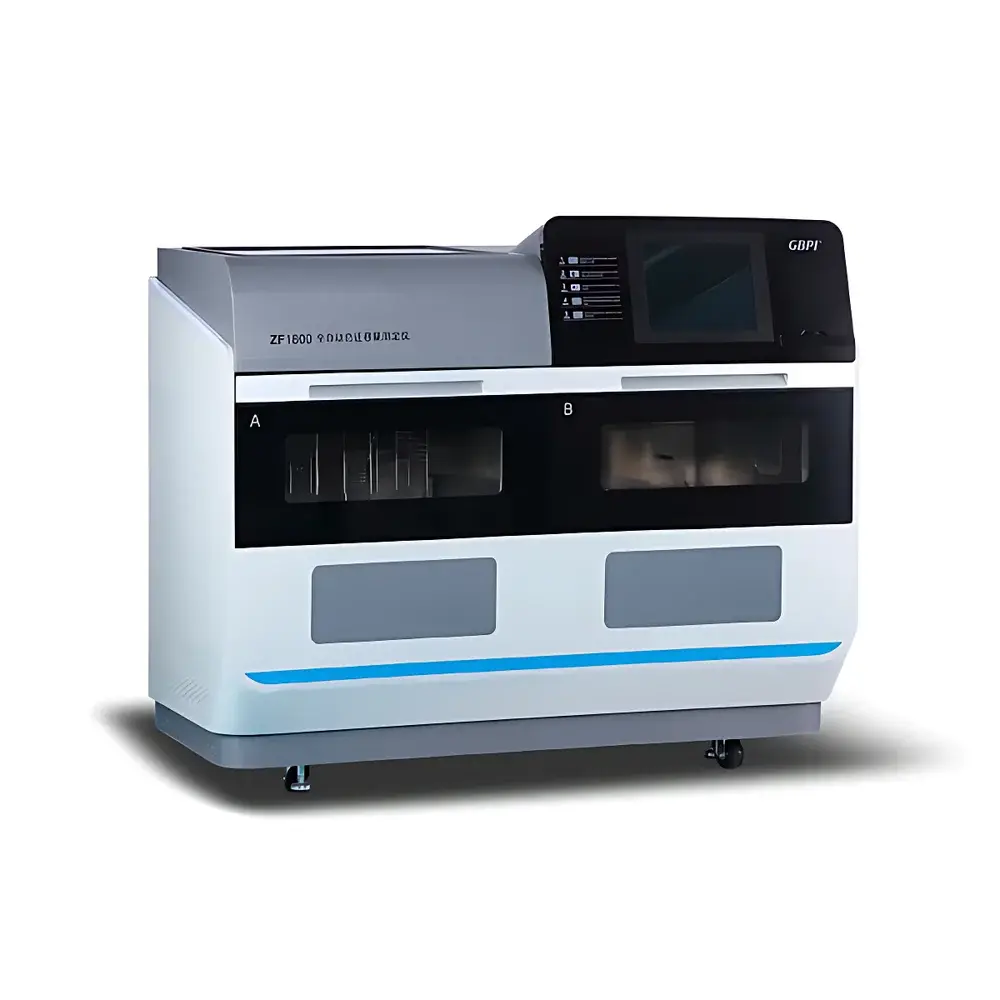
GBPI ZF-1800B Total Migration Tester
| Brand | GBPI |
|---|---|
| Origin | Guangdong, China |
| Manufacturer Type | Manufacturer |
| Country of Origin | Domestic (China) |
| Model | ZF-1800B |
| Pricing | Upon Request |
| Measurement Range | 0.2–167,000 mg/dm² |
| Resolution | 0.0001 g/dm² |
| Balance Capacity | 0–200 g |
| Balance Resolution | 0.1 mg |
| Water Bath Temp Control | Ambient to 100 °C |
| Heating Chamber Temp Control | Ambient to 120 °C |
| Cooling Chamber Temp Control | Ambient |
| Temp Accuracy | ±0.5 °C |
| Chamber Temp Uniformity | ±5 °C |
| Sample Capacity | 1–18 independent test positions |
| Constant-Weight Duration | 2.5 h (standard) |
| Evaporating Dish Volume | 0–200 mL |
| Dimensions (L×W×H) | 180 × 90 × 120 cm |
| Power Supply | 220 V, 50 Hz |
| Rated Power | 5000 W |
Overview
The GBPI ZF-1800B Total Migration Tester is an automated, integrated analytical system engineered for precise quantification of total migration—defined as the sum of all non-volatile substances released from food contact materials (FCMs) into food simulants under standardized conditions. It operates in strict accordance with internationally harmonized regulatory frameworks, including EU Regulation (EC) No. 10/2011, ISO 17349:2014 (Plastics — Determination of total migration into food simulants), and Chinese national standard GB 31604.8–2021 (National Food Safety Standard – Determination of Total Migration from Food Contact Materials). The instrument employs gravimetric analysis: after controlled extraction in specified food simulants (e.g., 3% acetic acid, 10% ethanol, olive oil, or isooctane), the extract is evaporated under regulated thermal conditions, and the residual mass is measured using a high-resolution analytical balance. This method yields results expressed in mg/dm²—the standard unit for migration compliance assessment across global food packaging regulations.
Key Features
- Independent dual-chamber architecture: Separated heating and cooling zones enable simultaneous evaporation and conditioning—eliminating thermal cross-interference and reducing cycle time by up to 40% compared to single-chamber systems.
- Integrated water bath subsystem: Fully automated water level detection, temperature-controlled evaporation, timed drainage, and dry-run protection; equipped with overtemperature and low-water alarms for fail-safe operation.
- Sealed solvent recovery loop: All evaporation occurs within a fully enclosed chamber; volatile organic solvents are condensed and recovered via an internal condensation path, preventing atmospheric release and ensuring operator safety per OSHA 29 CFR 1910.1200 and EU Directive 2004/37/EC (Carcinogens and Mutagens).
- Nitrogen purge capability: Optional inert gas inlet supports accelerated solvent removal under oxygen-sensitive conditions, minimizing oxidative degradation of labile migrants during evaporation.
- Negative-pressure test chamber: Maintains consistent sub-atmospheric pressure throughout extraction and evaporation phases, preventing simulant leakage and ensuring containment integrity during high-temperature protocols.
- ARM-based embedded control system: Touchscreen HMI integrates hardware control, real-time data acquisition, and method sequencing—no external PC required. Supports customizable test profiles, automatic dish taring, scheduled pre-weighing, and unattended overnight operation.
- Eighteen independent test stations: Each position features isolated thermal management, individual weight tracking, and autonomous endpoint detection—enabling parallel analysis of heterogeneous samples (e.g., PET trays, PP lids, PVC films) without cross-contamination risk.
Sample Compatibility & Compliance
The ZF-1800B accommodates a broad spectrum of food contact materials compliant with EU Plastics Implementation Measures and FDA 21 CFR Part 170–199. Validated substrates include polyolefins (PP, PE), polystyrene (PS), polyvinyl chloride (PVC), polyethylene terephthalate (PET), and coated metal cans. It supports all four standard food simulants defined in Regulation (EU) No. 10/2011: aqueous (3% acetic acid), alcoholic (10% ethanol), fatty (olive oil), and dry (isooctane). System validation documentation includes IQ/OQ protocols aligned with ISO/IEC 17025:2017 requirements. All operational parameters—including temperature ramp rates, dwell times, humidity setpoints, and balance stabilization criteria—are traceable to NIST-traceable reference standards.
Software & Data Management
The embedded software complies with Annex 11 (Computerised Systems) of the EU GMP Guidelines and FDA 21 CFR Part 11 for electronic records and signatures. Access control enforces role-based permissions (Administrator, Operator, Reviewer, Auditor) with granular configuration rights. Comprehensive audit trails capture user login/logout events, parameter modifications, method edits, result overrides, and report generation—all timestamped and immutable. Real-time dashboards display live weight trends, migration kinetics per station, chamber temperature profiles, and alarm logs. Export functions support CSV, PDF, and Office Open XML formats; reports include full metadata (simulant type, exposure time/temp, dish ID, blank correction, uncertainty estimation per GUM Guide). Data backups are encrypted and stored on removable SSD media compliant with GDPR Article 32 security obligations.
Applications
- Regulatory testing laboratories performing routine compliance verification for packaging suppliers targeting EU, UK, ASEAN, or Chinese markets.
- QC/QA departments in flexible packaging converters validating shelf-life stability of laminated structures under accelerated migration conditions.
- R&D teams evaluating new barrier coatings, nanocomposite additives, or bio-based polymers for extractables profiling prior to regulatory submission.
- Third-party certification bodies conducting GLP-compliant studies for ISO/IEC 17025 accreditation scope expansion.
- Government food safety agencies executing market surveillance programs for non-compliant FCMs in retail supply chains.
FAQ
What regulatory standards does the ZF-1800B directly support?
It implements test conditions specified in EU Regulation (EC) No. 10/2011, ISO 17349:2014, GB 31604.8–2021, and ASTM D5965–18 (Standard Test Method for Total Migration from Plastic Packaging into Simulants).
Can the system handle high-boiling-point simulants like olive oil?
Yes—the heating chamber reaches 120 °C with ±0.5 °C stability, and the sealed nitrogen-purge option mitigates thermal oxidation during prolonged olive oil evaporation.
How is data integrity ensured during long-duration tests?
All weight measurements are logged at 1-second intervals with checksum validation; system clocks are synchronized via NTP; audit trails record every data point modification with user ID and justification field.
Is remote monitoring supported?
The system provides Ethernet connectivity and optional Modbus TCP interface for integration into centralized LIMS environments; however, direct cloud access or remote desktop functionality is disabled by default to maintain 21 CFR Part 11 compliance.
What maintenance is required for the solvent recovery module?
Condenser coils require quarterly inspection; activated carbon filters must be replaced every 200 test cycles or when breakthrough is detected via FTIR verification of exhaust stream purity.






