
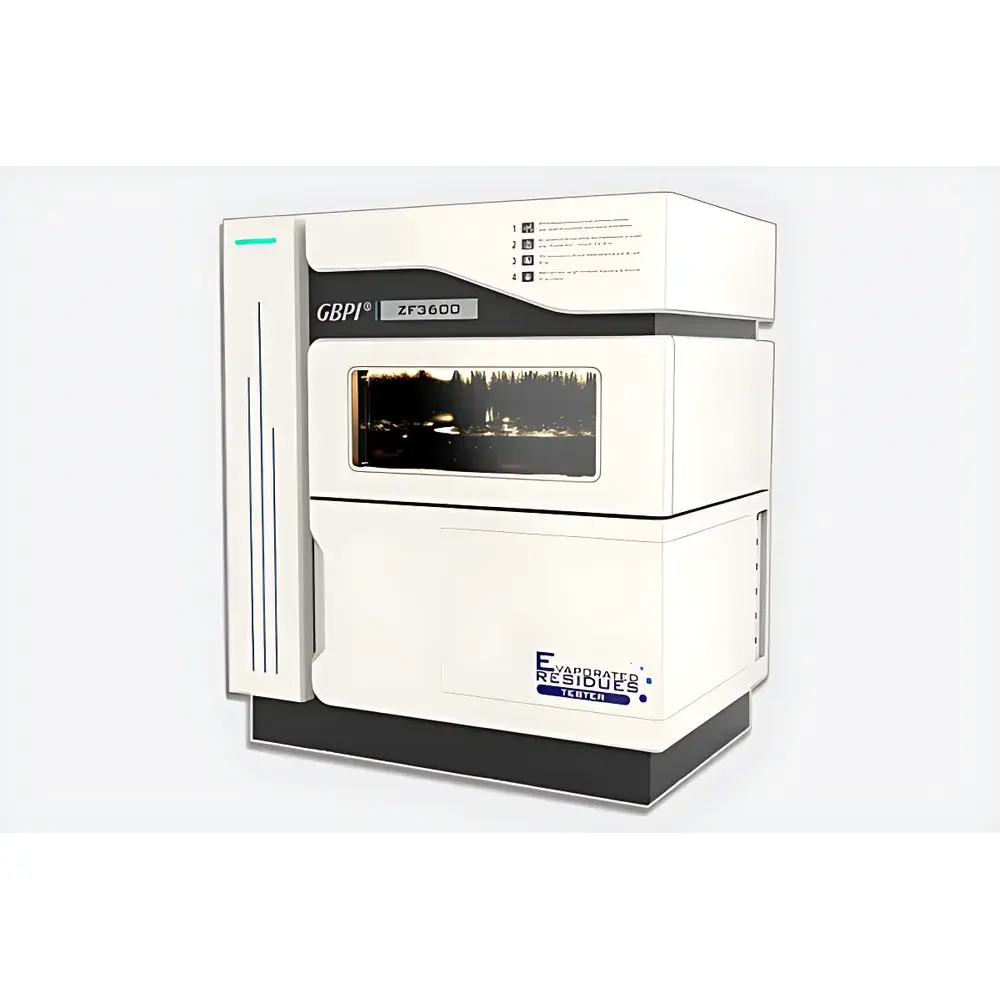
GBPI ZF3600M Total Residue Gravimetric Analyzer with Integrated Evaporation, Drying, Cooling & Constant-Weight Automation
| Brand | GBPI |
|---|---|
| Origin | Guangdong, China |
| Manufacturer Type | Direct Manufacturer |
| Country of Origin | China |
| Model | ZF3600M |
| Pricing | Upon Request |
| Measurement Range | 0–80 g |
| Balance Resolution | 0.01 mg |
| Balance Capacity | 0–220 g |
| Constant-Weight Tolerance | 0.3 mg (user-configurable) |
| Water Bath Temp Control Range | Ambient to 100 °C |
| Drying Chamber Temp Control Range | Ambient to 125 °C |
| Temperature Control Accuracy | ±0.5 °C |
| Sample Positions | 36 |
| Evaporating Dish Volume | 50 mL or 100 mL (selectable) |
| Pneumatic Interface | Φ8 mm |
| Dimensions (L×W×H) | 1200 × 850 × 1335 mm |
| Power Supply | 220 V, 50 Hz |
| Rated Power | 7000 W |
| OS | Windows 10 Pro 64-bit |
Overview
The GBPI ZF3600M Total Residue Gravimetric Analyzer is an integrated, fully automated laboratory instrument engineered for precise determination of non-volatile residue (total migration, evaporable residue), total dissolved solids (TDS), loss on drying (LOD), and moisture content in regulatory-compliant testing environments. It operates on the gravimetric principle: sequential solvent evaporation under controlled water bath conditions (below solvent boiling point), followed by thermal drying at defined temperatures (e.g., 105 °C per pharmacopoeial standards), desiccation-cooling in a stabilized environment, and high-precision weighing until constant mass is achieved. The system eliminates manual intervention across all critical stages—sample dispensing, evaporation, drying, cooling, and iterative weighing—ensuring reproducibility, traceability, and compliance with stringent quality assurance frameworks.
Key Features
- Dual-Chamber Integrated Architecture: Separated water bath and drying chamber modules operate under independent temperature control, minimizing cross-contamination and thermal interference; built-in liquid level sensors enable automatic water replenishment, drainage, and overflow protection.
- Automated Liquid Handling: Pneumatically actuated dispensing system delivers sample solutions with ≤0.1 mL residual volume; compatible with aqueous matrices (purified water), organic solvents (n-hexane, ethanol, acetic acid, chloroform), and suspensions.
- High-Stability Weighing System: Three imported analytical balances (0.01 mg resolution, 220 g capacity) housed in thermally isolated enclosures with active water-circulation shielding; balances engage only during dedicated weighing cycles, ensuring environmental stability (±0.2 °C, <40% RH).
- Efficient Solvent Recovery: Integrated recirculating chiller (30-minute cooldown to ambient) and high-capacity condensate collection system achieve >90% solvent recovery efficiency—critical for volatile organic method compliance and lab safety.
- Ergonomic & Secure Design: 1.2 m working height, front-access transparent viewing window, and splash-resistant chamber sealing meet ISO 15190:2020 laboratory safety requirements; emergency thermal cutoff and leak detection circuits are embedded in hardware logic.
Sample Compatibility & Compliance
The ZF3600M supports diverse sample types including purified water, pharmaceutical packaging materials (plastic films, laminates, closures), food contact articles (plastics, paperboard), cigarette tipping paper, chemical reagents, and solid dosage forms (tablets, granules, herbal extracts). It conforms to globally recognized regulatory methodologies: USP (Water Determination), Ph. Eur. 9.0 WATER, PURIFIED, ChP 2020 Vol. II (Purified Water) and Vol. IV (Extractables & LOD), GB 31604.8–2016 (Food Contact Materials), EN 1186-3:2002 Method A, Korean MOHW Chapter IV Section 2-8, GB/T 9740–2008, GB 8538–2016 (Mineral Water TDS), DZ/T 0064.9–2021 (Groundwater Analysis), and GB/T 5750.4–2006 (Drinking Water Standards). All operational sequences—including ramp rates, dwell times, humidity thresholds, and weight convergence criteria—are programmable to match specific monograph requirements.
Software & Data Management
Running on Windows 10 Pro 64-bit, the proprietary GBPI SmartLab OS implements ALCOA+ data integrity principles. Its modular GUI supports role-based access control (administrator, analyst, reviewer), electronic signatures compliant with FDA 21 CFR Part 11, and full audit trail logging (user actions, parameter changes, instrument events, calibration records). Test methods are stored as validated templates; raw data—including real-time mass readings, chamber temperature/humidity profiles, and balance stabilization timestamps—are saved in encrypted .csv and .pdf formats. Reports are customizable per client SOPs and include metadata for GLP/GMP audits. Remote connectivity enables secure cloud-based data export, firmware updates, and diagnostic telemetry via TLS 1.2–secured API endpoints.
Applications
- Regulatory testing of extractables from pharmaceutical primary packaging per ICH Q5C and Q3D guidelines
- Migration testing of food-contact plastics per EU Regulation 10/2011 and FDA 21 CFR §170–199
- Quality control of purified water and water-for-injection (WFI) in sterile manufacturing suites
- Determination of total dissolved solids in natural mineral waters and wastewater effluents
- Loss-on-drying assessment of hygroscopic APIs and excipients under ChP/USP compendial conditions
- Residue quantification in cleaning validation swab samples following ASTM E3051–16 protocols
FAQ
Does the ZF3600M support method validation per ICH Q2(R2)?
Yes—the instrument’s programmable parameters, full data traceability, and configurable acceptance criteria (e.g., max Δmass per weighing cycle, max deviation between replicates) align with ICH Q2(R2) analytical procedure validation requirements for accuracy, precision, and robustness.
Can the system be qualified under GMP Annex 11?
Yes—its electronic signature capability, user access tiers, change control logs, and 21 CFR Part 11–compliant audit trail satisfy Annex 11 computerized system validation prerequisites.
Is calibration of the internal balances traceable to NIST or BIPM standards?
All three balances are factory-calibrated using certified weights traceable to national metrology institutes (NMI); users may perform in-house verification using Class E2 or better reference masses.
What maintenance intervals are recommended for long-term operational reliability?
Daily: chamber wipe-down and drain inspection; quarterly: water bath descaling, pneumatic valve lubrication, and balance sensitivity verification; annually: full thermocouple calibration and chiller coolant replacement.
How does the system handle multi-solvent testing without cross-contamination?
Each test position uses disposable or autoclavable evaporating dishes; the pneumatic delivery lines feature solvent-specific purge cycles and are flushed with inert gas between runs; chamber exhaust passes through activated carbon filtration before venting.




