
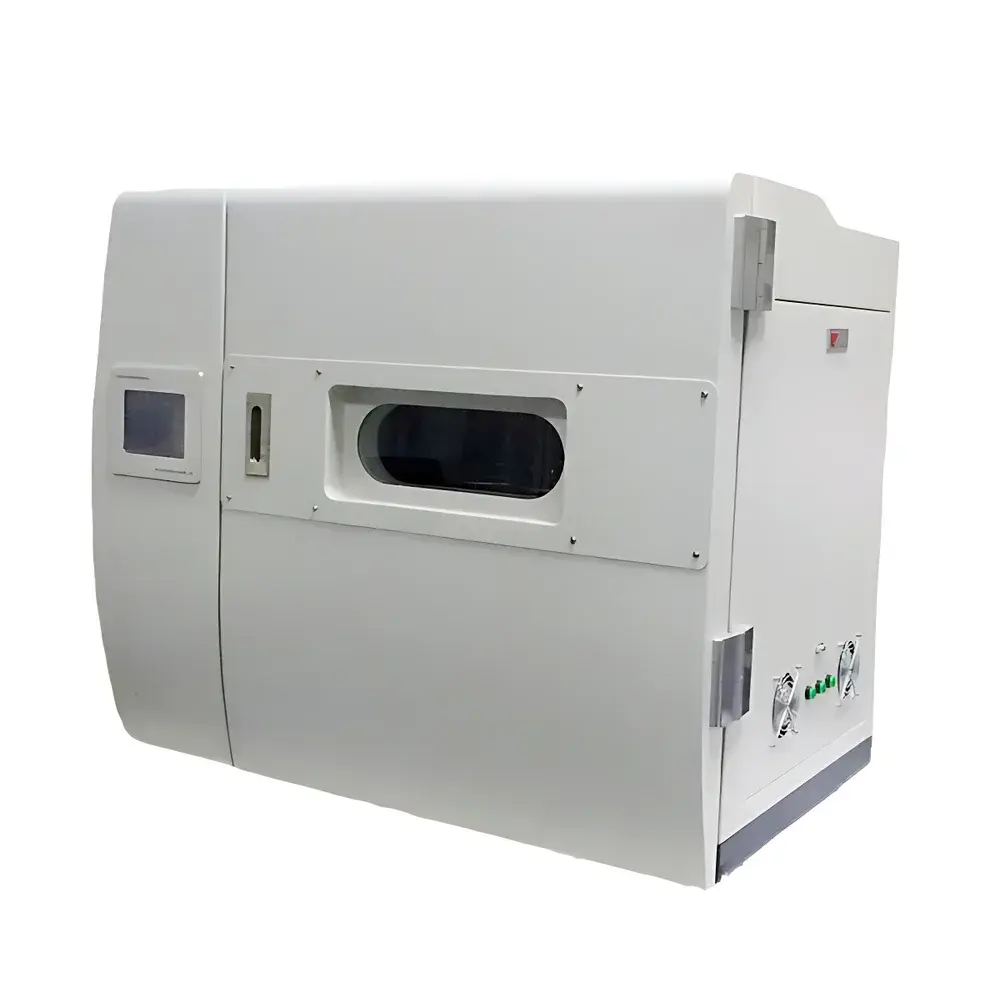
GBPI ZF800A Evaporative Residue Tester
| Brand | GBPI |
|---|---|
| Origin | Guangdong, China |
| Manufacturer Type | Manufacturer |
| Model | ZF800A |
| Measurement Range | 0–80 g (residue mass) |
| Accuracy | 0.1 mg |
| Resolution | 0.01 mg |
| Temperature Control Range | 80–150 °C (typical operating range: 100–130 °C) |
| Temperature Stability | ±0.1 °C (typical: ±0.2 °C) |
| Hot Air Circulation Velocity | 0.2 m/s |
| Sample Volume Capacity | 0–500 mL |
| Chamber Volume | 86 L |
| Independent Test Stations | 1–8 (expandable to 36) |
| Gas Supply | Compressed air |
| Pressure Requirement | 0.6 MPa |
| Tubing Interface | Φ6 mm polyurethane |
| Power Supply | AC 220 V, 50 Hz |
Overview
The GBPI ZF800A Evaporative Residue Tester is a precision laboratory instrument engineered for the quantitative determination of non-volatile residue following solvent extraction and evaporation—critical for regulatory compliance in food contact material (FCM) safety assessment. It operates on the gravimetric principle defined in multiple Chinese national standards (e.g., GB/T 5009.60–2003, GB/T 5009.64–2003, GB/T 5009.68–2003, GB/T 5009.69–2008, GB/T 5009.203–2003, and GB/T 9740–2008), which align with internationally recognized methodologies for extractable residue evaluation. The instrument automates the classical two-stage thermal process: first, controlled water- or glycerol-bath evaporation of extracted solution under standardized conditions; second, high-precision drying and repeated weighing in a thermally stabilized chamber until constant mass is achieved. This eliminates operator-induced variability in timing, temperature exposure, and handling—ensuring reproducibility essential for GLP-compliant laboratories and quality control environments.
Key Features
- Integrated dual-mode thermal control system: independent regulation of water/glycerol bath (for solvent evaporation up to 100 °C or 150 °C, respectively) and forced-air drying chamber (80–150 °C), both with ±0.1 °C stability
- High-resolution microbalance subsystem with 0.01 mg resolution and automatic tare/zero compensation, featuring overload protection and intermittent auto-weighing cycles synchronized with drying intervals
- Modular test station architecture supporting 1–8 independently monitored samples per run (scalable to 36 stations via optional expansion modules), each with dedicated sample volume tracking (0–500 mL)
- Self-contained embedded computing platform with 9-inch true-color touchscreen interface; fully functional without external PC connection—enables local parameter configuration, real-time curve visualization (temperature vs. time, mass vs. time), and on-device data storage
- Automated solvent recovery system minimizing environmental exposure and reducing laboratory ventilation load during routine operation
- USB connectivity for data export and remote firmware updates; supports password-protected parameter locking to prevent accidental modification during assay execution
- Thermally isolated chamber design with uniform hot-air circulation (0.2 m/s), ensuring spatial temperature homogeneity across all sample positions
Sample Compatibility & Compliance
The ZF800A is validated for use with polymeric and composite food contact materials including polyethylene (PE), polystyrene (PS), polypropylene (PP), chlorinated polyvinyl chloride (CPVC), and coated metal substrates (e.g., lacquered tinplate). It accommodates diverse specimen geometries—rigid containers, flexible films, gaskets, liners, and fiber-based packaging—as well as chemical reagents requiring volatile solvent removal under controlled thermal conditions. All operational protocols adhere to GB/T-series standards referenced above, which are harmonized with ISO 10993-12 (biological evaluation of medical devices) and serve as technical foundations for conformity assessments under China’s Food Safety Law and the State Administration for Market Regulation (SAMR) FCM registration framework. While not certified to ISO/IEC 17025 by default, the system supports full audit trail generation—including timestamped weight logs, temperature profiles, user authentication records, and version-controlled method files—facilitating internal validation and third-party accreditation preparation.
Software & Data Management
The embedded operating system provides a compliant data acquisition environment meeting core requirements of analytical traceability. Each test session generates a structured report containing: test standard reference, operator ID, material batch number, sample identification, bath/dry temperatures, total drying duration, intermediate and final mass readings, calculated residue mass (g), and residual mass per unit surface area or volume (as configured). All raw sensor data—including time-stamped temperature and mass values at each weighing interval—are stored in CSV-compatible binary format with cryptographic checksums. Reports are exportable via USB or network interface in PDF/A-1b format for long-term archival. Optional software modules support integration with LIMS platforms via HL7 or ASTM E1384-compliant interfaces. Audit trails comply with principles of ALCOA+ (Attributable, Legible, Contemporaneous, Original, Accurate, Complete, Consistent, Enduring, Available) and may be configured to meet FDA 21 CFR Part 11 requirements when deployed with validated electronic signature and access control policies.
Applications
- Regulatory testing of food packaging films and laminates for total extractables in aqueous, acidic, alcoholic, and oily simulants (e.g., 4% acetic acid, 10% ethanol, olive oil, isooctane)
- Quality assurance of sealing components (gaskets, liners, closures) used in canned foods and beverage containers
- Evaluation of coating integrity on tinplate and aluminum cans under accelerated migration conditions
- Validation of cleaning efficacy in reusable food processing equipment by quantifying residual process aids or sanitizers
- Research-grade residue profiling of novel biopolymer formulations intended for direct food contact
- Supporting toxicological risk assessment by providing quantitative input for migration modeling (e.g., based on EU Commission Regulation (EC) No 10/2011 Annex I compliance checks)
FAQ
What standards does the ZF800A directly support?
The instrument is pre-configured to execute test protocols specified in GB/T 5009.60–2003, GB/T 5009.64–2003, GB/T 5009.68–2003, GB/T 5009.69–2008, GB/T 5009.203–2003, and GB/T 9740–2008.
Can the ZF800A operate without a connected computer?
Yes—the integrated 9-inch touchscreen interface and onboard OS allow full method setup, real-time monitoring, automated endpoint detection, and report generation without external computing hardware.
How is temperature uniformity ensured across multiple sample positions?
A calibrated hot-air circulation system maintains velocity-controlled airflow (0.2 m/s) within the 86 L chamber, verified via NIST-traceable multi-point mapping during factory calibration.
Is solvent recovery mandatory during operation?
While not mandatory, the built-in condensation and collection system is recommended for routine use to minimize lab fume hood demand and improve operator safety when handling organic solvents.
What is the maximum allowable sample volume per test station?
Each station accepts up to 500 mL of extract solution, compatible with standard evaporation dish dimensions (e.g., 100 mm diameter porcelain or platinum dishes).
Related Products




