
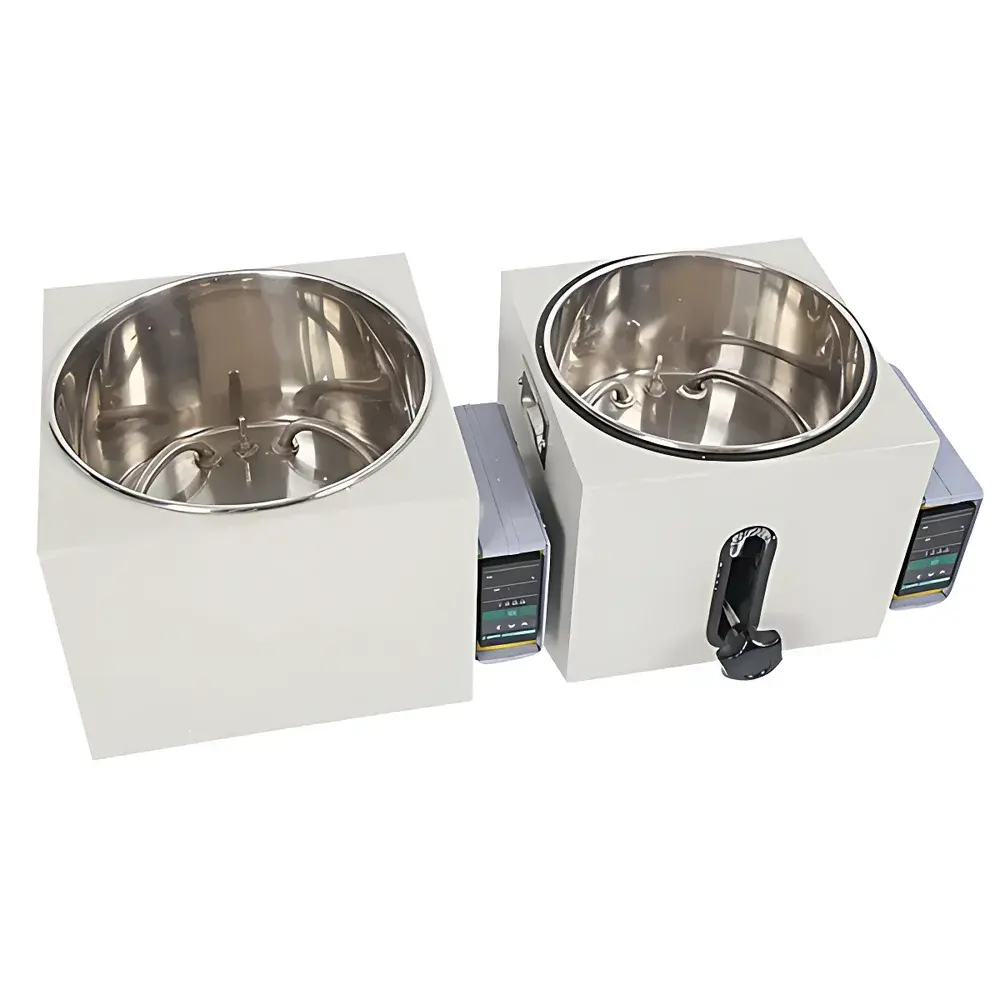
AS ONE GC02LS Compact Water & Oil Bath Circulator
| Brand | AS ONE |
|---|---|
| Origin | Japan |
| Manufacturer | AS ONE Corporation |
| Model | CC-5559-02 |
| Bath Volume | 2 L |
| Temperature Control Mode | Manual Lift, Digital PID Controller |
| Construction | Cold-Rolled Steel Housing with Epoxy Coating |
| Inner Bath | 304 Stainless Steel |
| Application | Lab-Scale Water/Oil Bath Heating & Temperature Maintenance |
| Category | Constant-Temperature Circulating Bath |
Overview
The AS ONE GC02LS is a compact, benchtop water and oil bath circulator engineered for precise temperature maintenance in small-scale laboratory applications. Unlike open-beaker heating methods, this unit employs a fully enclosed stainless steel bath reservoir coupled with a built-in circulation pump and PID-controlled heating system to deliver stable thermal environments across a wide operating range (typically ambient +5 °C to 150 °C when used with silicone oil; up to 100 °C with deionized water). Its design follows classical convection-based thermal equilibrium principles—heat is uniformly distributed via forced liquid circulation, minimizing axial and radial temperature gradients within the bath medium. This ensures high reproducibility for procedures requiring strict thermal consistency, including sample incubation, enzymatic reactions, solvent evaporation control, and calibration of temperature-sensitive sensors. The GC02LS is not a refrigerated circulator; it is strictly a heating-only system optimized for stability, safety, and space efficiency in QC labs, academic teaching labs, and R&D workstations where footprint and operational simplicity are critical.
Key Features
- Compact 2-liter bath capacity—ideal for low-volume sample processing without compromising thermal uniformity.
- Digital PID temperature controller with ±0.3 °C typical stability (at setpoint) and intuitive LED display showing real-time bath temperature.
- Manually adjustable vertical lift mechanism enables precise positioning of reaction vessels or probes relative to the bath surface—no motorized actuation required, reducing mechanical failure points.
- Corrosion-resistant construction: exterior housing fabricated from cold-rolled steel with durable epoxy powder coating; interior bath chamber made of electropolished AISI 304 stainless steel for long-term resistance to water, weak acids, alkalis, and common organic solvents.
- Over-temperature protection circuit automatically cuts power if internal sensor detects deviation beyond safe thresholds—compliant with IEC 61010-1 safety requirements for laboratory electrical equipment.
- No external chiller or cooling module required—designed exclusively for heating applications, simplifying installation and maintenance protocols.
Sample Compatibility & Compliance
The GC02LS accommodates standard laboratory glassware—including test tubes (up to 25 mm diameter), small flasks (Erlenmeyer, round-bottom), and vials—when placed directly into the bath or supported by optional accessories such as rack inserts or clamp holders. It is compatible with both aqueous and non-aqueous heat-transfer media, including distilled/deionized water, glycerol, and silicone oils (e.g., Dow Corning 200 Fluid series). While the unit itself does not carry CE marking for EU medical device use, its electrical architecture conforms to IEC 61010-1:2010 for measurement, control, and laboratory equipment. For GLP/GMP-regulated environments, users may integrate the GC02LS into validated workflows where temperature logging is performed externally using calibrated data loggers traceable to NIST standards. Note: The optional filter plate (Part No. 1-4596-11) is recommended when particulate-laden media are used to prevent pump clogging.
Software & Data Management
The GC02LS operates as a standalone analog-digital hybrid instrument with no embedded software, USB interface, or network connectivity. Temperature setpoint and real-time reading are managed exclusively via front-panel controls and the integrated LED display. This architecture eliminates cybersecurity risks associated with connected lab devices and aligns with FDA 21 CFR Part 11 guidance for instruments used in non-critical process steps where electronic records are not mandated. For laboratories requiring audit-ready temperature documentation, third-party USB data loggers (e.g., Omega OM-DAQPRO-5300 series) can be deployed alongside the unit using an external PT100 probe immersed in the bath—enabling timestamped, exportable CSV logs compliant with ISO/IEC 17025 traceability requirements.
Applications
- Controlled-temperature sample preparation prior to HPLC, GC, or spectroscopic analysis.
- Enzyme activity assays requiring incubation at 37 °C, 45 °C, or other defined setpoints.
- Viscosity standardization of calibration oils per ASTM D445 or ISO 3104 protocols.
- Thermal equilibration of reference standards before metrological comparison.
- Low-power solvent removal in rotary evaporation pre-concentration steps.
- Calibration of thermocouples, RTDs, and digital thermometers against NIST-traceable references.
FAQ
What is the maximum operating temperature with silicone oil?
The GC02LS supports silicone oil operation up to 150 °C, provided the selected fluid has appropriate flash point and thermal stability characteristics (e.g., Dow Corning 200 Fluid, 50 cSt).
Is the bath volume adjustable?
No—the reservoir is fixed at 2 liters. Partial filling is permissible but may affect thermal response time and uniformity; optimal performance is achieved at 70–90% fill level.
Can this unit be used for cooling applications?
No. The GC02LS lacks refrigeration capability and is designed solely for heating and temperature maintenance.
Does it support external temperature probe input for cascade control?
No. The unit uses only its internal Pt100 sensor; no auxiliary input terminals are provided.
What maintenance is required?
Routine cleaning of the stainless steel bath with mild detergent and deionized water; periodic inspection of the circulation impeller for debris; replacement of the filter plate (if installed) per usage frequency.



