
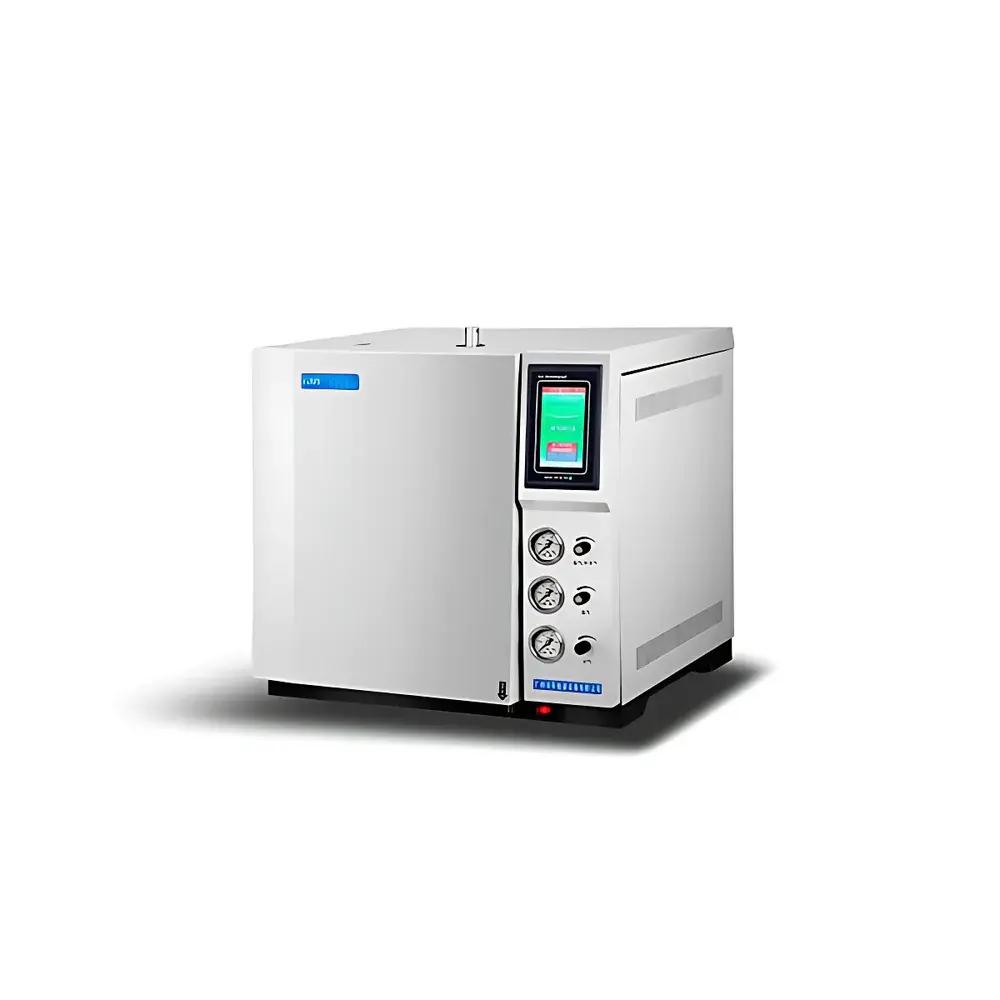
GC9802-Y Ethylene Oxide Residual Analysis System for Medical Masks (Gas Chromatograph with FID and Headspace Sampler)
| Brand | GBPI |
|---|---|
| Origin | Guangdong, China |
| Manufacturer Type | Direct Manufacturer |
| Instrument Type | Laboratory Gas Chromatograph |
| Model | GC9802-Y |
| Application Scope | General-purpose EO residue testing in medical devices and packaging |
| Detector | Flame Ionization Detector (FID), optional alternative detectors available |
| Detection Limit | ≤3×10⁻¹² g/s (n-hexadecane) |
| Baseline Noise | ≤2×10⁻¹⁴ A |
| Baseline Drift | ≤1×10⁻¹³ A/30 min |
| Column | 30 m × 0.32 mm × 0.5 µm EO-specific capillary column (optional columns available) |
| Headspace Autosampler | 20-position |
| Oven Dimensions | 240 × 210 × 240 mm |
| Temperature Range | 4 °C above ambient to 450 °C (1 °C increments) |
| Temperature Control Accuracy | ±0.1 °C |
| Temperature Gradient Uniformity | ±1% |
| Independent Temperature Zones | 6-channel oven, inlet, detector, and auxiliary zones |
| Programmed Temperature Ramp | Up to 16 steps, ramp rate 0.1–60 °C/min |
| Maximum Runtime Setting | 6000 min |
| Carrier Gas | High-purity nitrogen (99.999%, supplied externally) |
| Hydrogen Generator (optional) | 300 mL/min, purity ≥99.999% |
| Air Generator (optional) | Oil-free, dehydrated & deoiled, 3 L/min |
| Injection System | Split/splitless capillary injector with septum purge |
| Software | Dual-channel Chinese-language chromatography workstation with instrument control, real-time plotting, peak integration, calibration curve generation, PDF report export, and audit-ready data logging |
Overview
The GC9802-Y Ethylene Oxide (EO) Residual Analysis System is a dedicated laboratory gas chromatograph engineered for precise, reproducible quantification of residual ethylene oxide in sterilized medical masks and other single-use medical devices. Designed in strict alignment with international regulatory requirements—including ISO 10993-7, USP , and FDA guidance on EO sterilization validation—the system implements flame ionization detection (FID) coupled with automated headspace sampling to isolate and measure trace-level EO (typically 0.1–10 µg/g) without matrix interference. Its core analytical principle relies on thermal desorption of EO from solid samples into the headspace vial, followed by quantitative separation on a dedicated polar capillary column optimized for volatile epoxides. The instrument’s six-zone independent temperature control, sub-0.1 °C oven stability, and programmable multi-step ramping ensure retention time reproducibility and resolution of EO from co-eluting solvents such as ethanol or chloroform—critical for compliance with YY/T 0681.13–2014 and GB 19083–2010.
Key Features
- Integrated 20-position headspace autosampler enabling unattended batch analysis of mask samples per ISO 10993-7 Annex B protocols.
- FID detector with documented sensitivity ≤3×10⁻¹² g/s (n-hexadecane), baseline noise <2×10⁻¹⁴ A, and drift <1×10⁻¹³ A/30 min—meeting ASTM D3612 Class I performance criteria.
- Dedicated EO analysis column (30 m × 0.32 mm × 0.5 µm polyethylene glycol phase) pre-characterized for retention time consistency and peak symmetry across 100+ injections.
- Six independently controlled temperature zones (oven, inlet, detector, auxiliary ports) with ±0.1 °C stability and ±1% axial gradient uniformity—essential for method transfer and inter-laboratory comparability.
- Real-time dual-channel chromatographic workstation supporting GLP-compliant data acquisition, automatic peak identification, linear/non-linear calibration (1–5 point), and electronic signature-enabled PDF report generation.
- Hardware-level safety architecture: dual overtemperature protection (programmable setpoint + hardware cutoff), pressure-sensing gas flow regulation, and automatic shutdown on detector flame failure or carrier gas interruption.
- Modular gas supply interface compatible with external high-purity N₂ (99.999%), H₂ (≥99.999%), and zero-air—enabling full traceability per ISO/IEC 17025 gas certification requirements.
Sample Compatibility & Compliance
The GC9802-Y accommodates standard 20 mL headspace vials containing cut sections of surgical masks, N95 respirators, gowns, or EO-sterilized packaging films. Sample preparation follows YY/T 0681.13–2014: equilibration at 60 °C for 60 min, followed by 1 mL gas-phase injection. The system complies with all referenced national standards—including GB/T 10004–2008 (plastic packaging), YBB 00132002 (pharmaceutical packaging), and GB 2626–2006 (respiratory protective equipment)—and supports method validation per ICH Q2(R2) for specificity, linearity (r² ≥0.999), LOD/LOQ, precision (RSD ≤5% for n=6), and robustness. Data integrity meets FDA 21 CFR Part 11 requirements via audit trail-enabled software, user access controls, and immutable raw data storage.
Software & Data Management
The dual-channel chromatography workstation provides full instrument control, real-time signal visualization, and post-run processing without third-party dependencies. It supports sequence-based batch acquisition, automatic integration with customizable peak width and threshold settings, and multi-level calibration (external standard, internal standard, standard addition). All raw data (.dat), method files (.mth), and audit logs are stored in a relational database with timestamped operator IDs, electronic signatures, and change history. Reports conform to ISO/IEC 17025 documentation requirements and export directly to PDF, CSV, or XML for LIMS integration. Optional 21 CFR Part 11 module adds role-based permissions, biometric login support, and electronic record archiving.
Applications
- Quantitative EO residue testing in ASTM F2338-compliant medical device packaging validation.
- Residual solvent analysis in pharmaceutical primary packaging per USP .
- Quality control of EO-sterilized PPE during routine manufacturing release testing.
- Method development and transfer for EO, chloroform, and dichloromethane in polymer matrices.
- Environmental monitoring of EO emissions from sterilization facilities (per OSHA PEL and EPA Method TO-17).
- Academic research on EO degradation kinetics and diffusion modeling in nonwoven fabrics.
FAQ
What regulatory standards does the GC9802-Y support for EO residue testing?
It fully supports YY/T 0681.13–2014, GB 19083–2010, ISO 10993-7:2019, and USP , including required calibration, system suitability, and reporting formats.
Can the system be validated for GMP environments?
Yes—when configured with 21 CFR Part 11 software, IQ/OQ documentation packages, and certified reference standards, it meets GMP Annex 11 and EU GMP Chapter 4 data integrity expectations.
Is column aging or reconditioning required between sample batches?
No—under standard EO analysis conditions (≤120 °C oven max, 1 µL injection), the dedicated EO column demonstrates >500 injections without significant retention shift or peak tailing.
Does the workstation support multi-user audit trails?
Yes—the built-in audit trail records all method edits, integration changes, report exports, and user logins with timestamps and operator IDs, compliant with ISO/IEC 17025 clause 7.11.
What maintenance intervals are recommended for FID operation?
FID jet cleaning every 200 injections; ceramic igniter inspection every 6 months; detector gas flow verification quarterly per ASTM E260-18 Annex A1 guidelines.






