
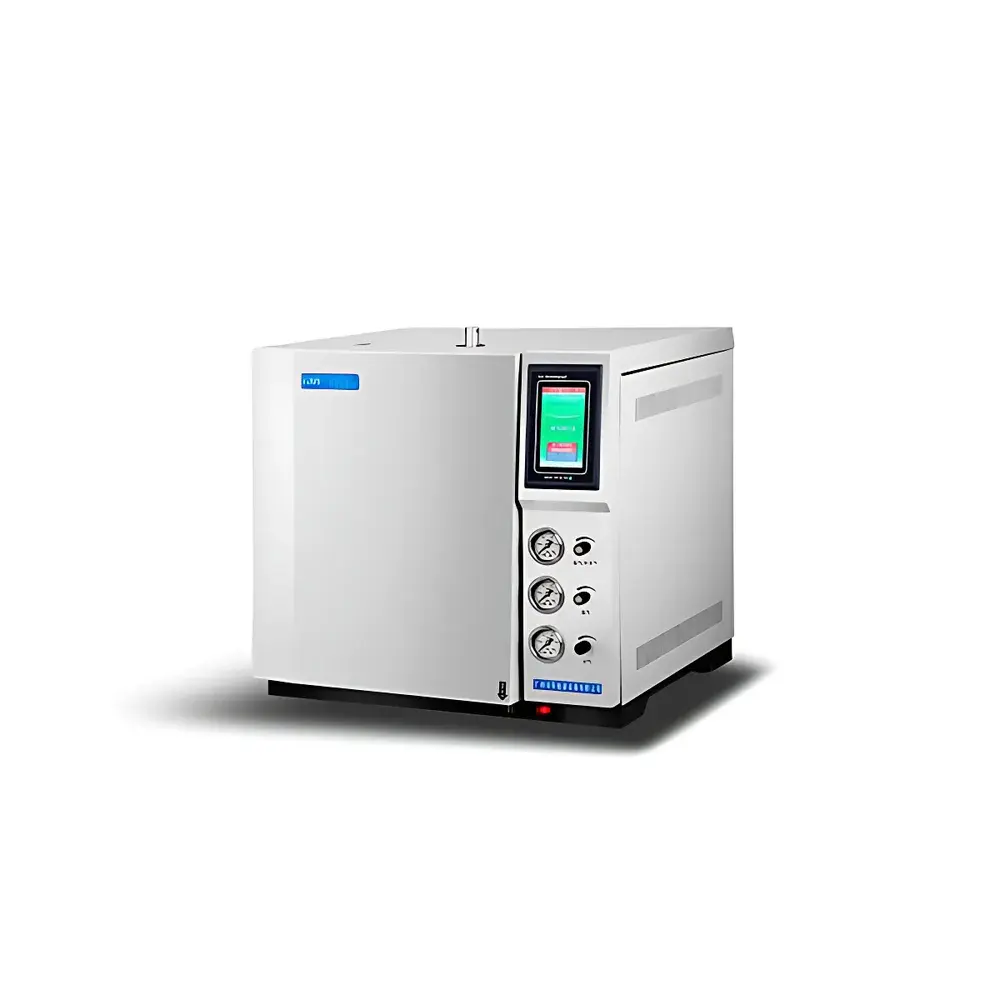
GC9802-T Gas Chromatograph for Solvent Residue Analysis in Packaging and Printing Materials
| Brand | GBPI |
|---|---|
| Origin | Guangdong, China |
| Manufacturer Type | Direct Manufacturer |
| Instrument Category | Domestic Lab-Scale GC |
| Model | GC9802-T |
| Instrument Type | Laboratory Gas Chromatograph |
| Application Field | Food Industry–Specific |
| Oven Temperature Range | Up to 400 °C |
| Oven Ramp Rate | 0–40 °C/min |
| Injector Maximum Operating Temperature | Up to 400 °C |
| Detector | FID (Hydrogen Flame Ionization Detector), optional alternative detectors available |
| FID Sensitivity | Mt ≤ 1 × 10⁻¹¹ g/s (n-hexadecane) |
| Baseline Drift | ≤ 0.02 mV/h |
| Noise | ≤ 0.02 mV |
| Column | OV-1701 capillary column (50 m × 0.32 mm × 0.5 µm), max. temp. 400 °C |
| Injector Type | Capillary inlet (packed column inlet optional) |
| Oven Dimensions | 240 × 210 × 240 mm (W × D × H) |
| Temperature Control Accuracy | ±0.1% |
| Temperature Resolution | 0.1 °C |
| Carrier Gas | High-purity N₂ (99.99%, 0.4 MPa, dried) |
| H₂ Supply | 99.99% purity, 0.4 MPa, dried |
| Air Supply | 0.4 MPa, dried and oil-free |
| Gas Line Connection | Φ3 mm tubing |
| External Dimensions | 500 × 550 × 500 mm (H × W × D) |
Overview
The GBPI GC9802-T is a dedicated laboratory gas chromatograph engineered for quantitative analysis of residual organic solvents in flexible packaging films, laminated pouches, printed labels, and other food-contact materials. It operates on the principle of separation by differential partitioning in a heated capillary column, followed by highly sensitive detection via hydrogen flame ionization (FID). Designed to meet stringent regulatory requirements for food safety, the system delivers reproducible retention time alignment and precise peak integration—critical for compliance with solvent residue limits defined in ISO 105-E03, ASTM D3960, and regional food contact material regulations. Its robust thermal management architecture ensures stable baseline performance across extended run sequences, supporting routine QC testing in high-throughput packaging laboratories.
Key Features
- Thermally optimized oven with programmable temperature ramping (0–40 °C/min) and precision control (±0.1% accuracy, 0.1 °C resolution) up to 400 °C—enabling full elution of high-boiling solvents including toluene, xylene, ethyl acetate, isopropanol, and n-butanol.
- Dual-stage gas flow regulation for N₂ (carrier), H₂ (detector fuel), and synthetic air (oxidant), each independently pressure-controlled and filtered to eliminate moisture and hydrocarbon contamination.
- Capillary-only inlet with split/splitless configuration and active septum purge—minimizing carryover and ensuring injection reproducibility for trace-level (<1 ppm) solvent quantification.
- Integrated noise-suppression circuitry and thermally isolated detector housing reduce electronic drift and mechanical vibration artifacts, contributing to long-term FID stability (baseline drift ≤ 0.02 mV/h).
- Over-temperature protection with dual-layer safeguards: software-based thermal shutdown and independent hardware cutoff circuitry—ensuring operational integrity during unattended runs.
- Modular unitized chassis design simplifies field maintenance, column replacement, and detector cleaning without requiring full system disassembly.
Sample Compatibility & Compliance
The GC9802-T supports headspace sampling (manual or autosampler-compatible), direct liquid injection, and thermal desorption interfaces for solid-phase extraction (SPE) eluates. It is validated for use with standard test protocols referenced in QB/T 2929–2008 (Chinese standard for solvent residue in plastic composite films), GB/T 10004–2008 (packaging for food and pharmaceutical products), and YBB 00132002–2015 (pharmaceutical packaging materials). When configured with appropriate calibration standards and internal standards (e.g., dichlorobenzene), the system meets GLP documentation requirements—including audit-trail-enabled data acquisition, user-access controls, and electronic signature support in compliant software mode per FDA 21 CFR Part 11 guidelines.
Software & Data Management
The instrument integrates with GBPI ChromaVision™ workstation software—a Windows-based platform supporting real-time chromatogram visualization, dynamic zoom/pan navigation, automated peak detection, and customizable report templates. All acquisition parameters, integration events, and calibration curves are timestamped and stored with immutable metadata. Raw data files (.cdf format) retain full spectral fidelity for retrospective reprocessing. Reports export to PDF, Excel, and CSV formats; include sample ID, analyst name, instrument serial number, calibration date, and uncertainty estimates per ISO/IEC 17025 Annex A.3. Audit logs record all user actions—including method edits, result overrides, and data deletions—for regulatory review.
Applications
- Quantitative determination of residual solvents (e.g., benzene, toluene, MEK, acetone, ethanol) in gravure- and flexo-printed polyethylene, PET, aluminum foil laminates, and paperboard packaging.
- Verification of solvent removal efficiency in drying ovens used in packaging manufacturing lines.
- Purity assessment of incoming solvent batches prior to ink formulation—supporting raw material release protocols.
- Stability-indicating analysis of migration potential under accelerated aging conditions (e.g., 40 °C/75% RH for 10 days).
- Method transfer support for laboratories implementing harmonized EU Plastics Regulation (EU No. 10/2011) or US FDA 21 CFR §177.1390 compliance programs.
FAQ
What regulatory standards does the GC9802-T support for solvent residue testing?
It is pre-configured for QB/T 2929, GB/T 10004, and YBB 00132002, and its performance characteristics align with ISO 105-E03 and ASTM D3960 methodologies.
Can the system be upgraded to support electron capture detection (ECD) or thermal conductivity detection (TCD)?
Yes—modular detector bays allow field installation of ECD, TCD, or NPD units; firmware and software modules must be licensed separately.
Is the chromatography data system compliant with 21 CFR Part 11?
Full Part 11 compliance—including role-based access, electronic signatures, and audit trail generation—is enabled when operated with validated ChromaVision™ software version 3.2 or later.
What is the recommended maintenance interval for the FID jet and collector?
Routine inspection every 200 injections; cleaning or replacement recommended after 500 injections or upon observed sensitivity loss (>15% reduction in response to 100 ng hexadecane).
Does GBPI provide application notes or SOPs for food packaging testing?
Yes—validated SOPs for residual solvent analysis in laminated films, printed pouches, and adhesive-coated substrates are included with instrument delivery and updated annually via GBPI Technical Library access.





