
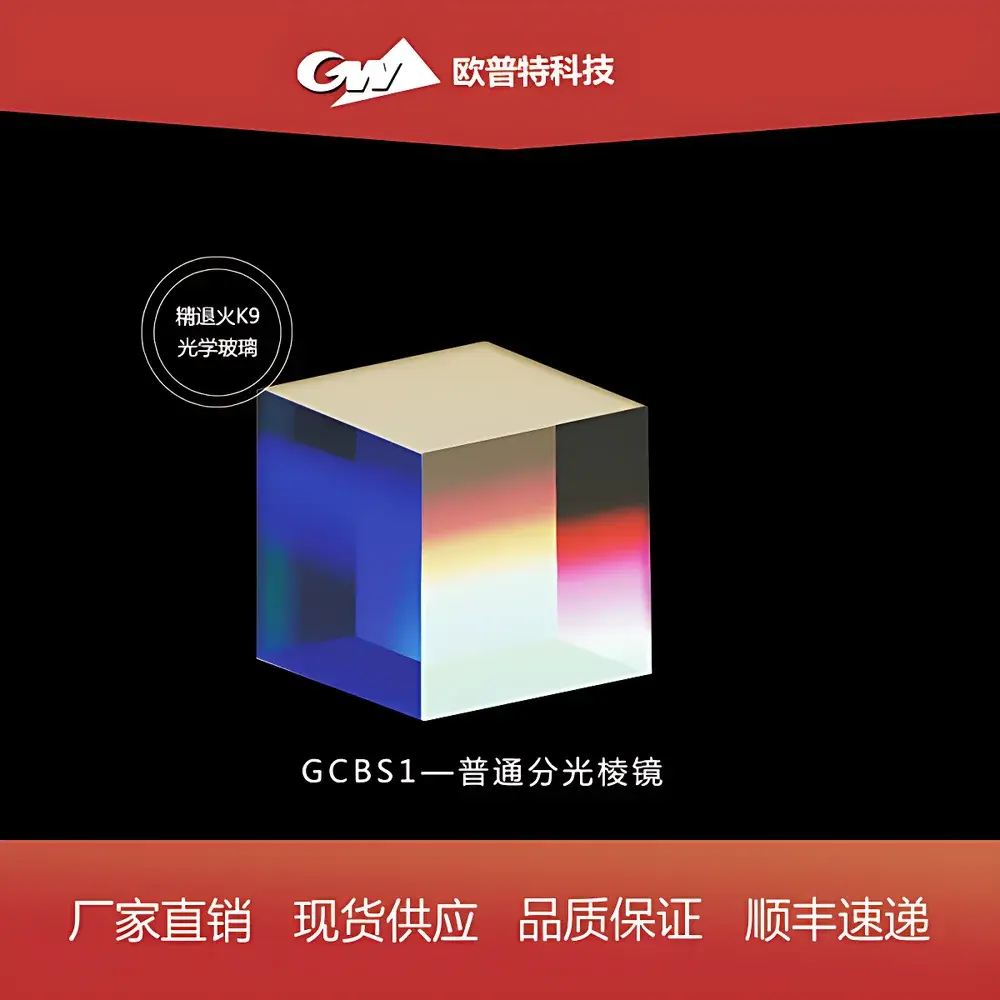
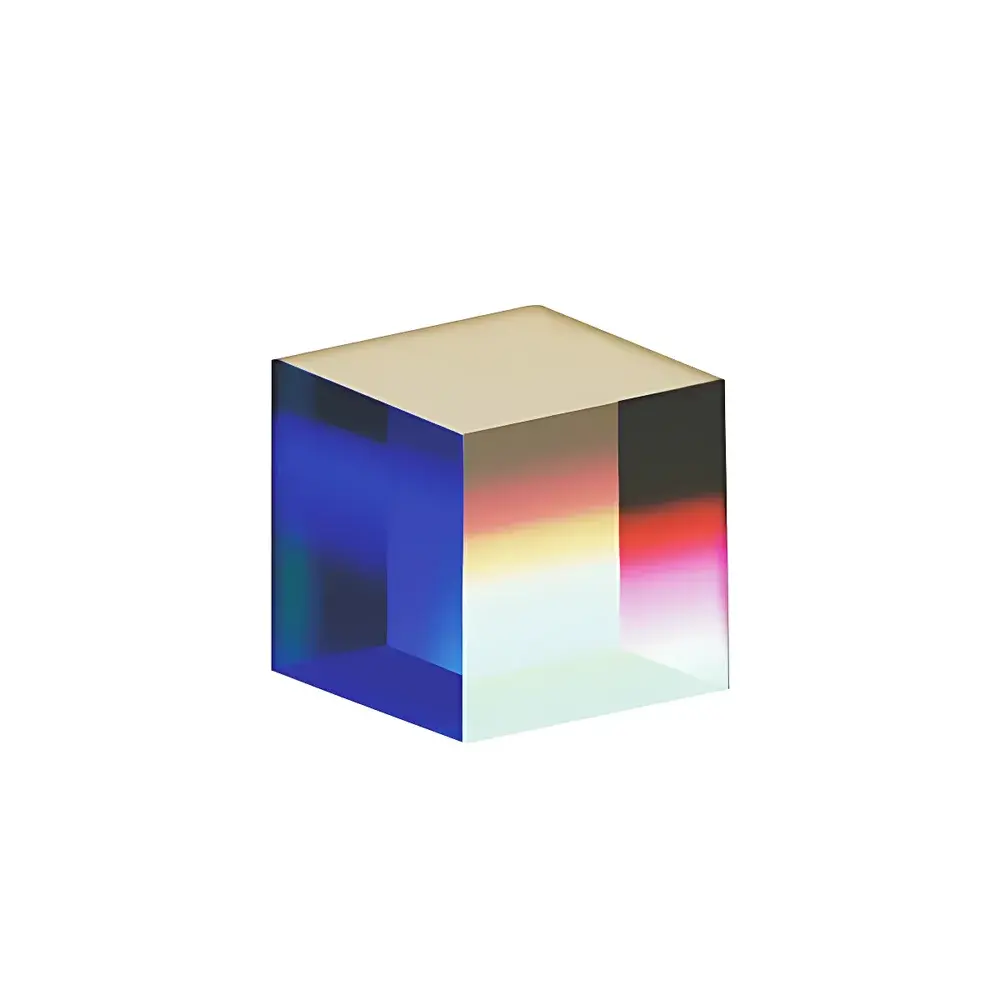
GCBS1 Standard Beam Splitter Cube
| Diameter | 5.0–50.0 mm |
|---|---|
| Split Ratio Options | 30R/70T, 50R/50T, 70R/30T |
| Wavelength Ranges | VIS (400–700 nm), NIR (700–1100 nm), SWIR (1100–2500 nm) |
| Material | BK7 glass with dielectric coating |
| Surface Flatness | λ/10 @ 633 nm |
| AR Coating | R < 0.25% per surface |
| Damage Threshold | >5 J/cm² @ 1064 nm, 10 ns pulse |
Overview
The GCBS1 Standard Beam Splitter Cube is a precision optical component engineered for reliable amplitude division in free-space optical systems. Constructed from high-homogeneity BK7 optical glass and bonded using optically matched epoxy, the cube maintains excellent wavefront fidelity and minimal beam deviation. Its dielectric thin-film coating is deposited via ion-assisted e-beam evaporation to achieve spectrally stable, angle-insensitive splitting performance across defined wavelength bands—VIS (400–700 nm), NIR (700–1100 nm), and SWIR (1100–2500 nm). Unlike plate-type splitters, the cubic geometry eliminates ghost reflections and beam walk-off, making it ideal for interferometry, laser cavity design, optical coherence tomography (OCT), and dual-channel imaging setups requiring spatially overlapped output beams.
Key Features
- Multiple aperture diameters: 5.0 mm, 10.0 mm, 12.5 mm, 15.0 mm, 20.0 mm, 25.0 mm, and 50.0 mm — enabling integration into compact OEM modules or large-aperture research benches.
- Precisely controlled split ratios: 30R/70T (30% reflected / 70% transmitted), 50R/50T (balanced), and 70R/30T — each calibrated at 0° angle of incidence for maximum polarization insensitivity in unpolarized light applications.
- High surface quality: λ/10 surface flatness (measured at 633 nm HeNe wavelength) and scratch-dig specification of 20–10 ensures minimal phase distortion in wavefront-critical applications such as holography and adaptive optics calibration.
- Ultra-low residual reflectance: Broadband anti-reflection (AR) coating applied to all four outer faces (R < 0.25% per surface across designated band) suppresses parasitic etalon effects and improves system throughput.
- Laser damage resistant: Optimized coating architecture sustains >5 J/cm² (1064 nm, 10 ns pulse, 20 Hz, Ø0.5 mm spot) — suitable for moderate-power Nd:YAG and fiber laser beam conditioning.
Sample Compatibility & Compliance
The GCBS1 series is compatible with standard kinematic mounts (e.g., SM1- or C-mount threaded housings), lens tubes, and cage systems (e.g., Thorlabs 30 mm or 60 mm systems). All cubes are manufactured under ISO 9001-certified processes and conform to ISO 10110-7 (optical element surface imperfections) and ISO 10110-8 (coating specifications). While not inherently compliant with FDA 21 CFR Part 11 or IEC 61000-4 electromagnetic immunity standards (as passive components), full traceable metrology data—including spectral transmission/reflection curves, interferometric surface maps, and coating durability test reports—is provided upon request for GLP/GMP-aligned validation protocols.
Software & Data Management
As a passive optical component, the GCBS1 requires no embedded firmware or driver software. However, spectral performance data (T(λ) and R(λ) curves) are delivered in standardized ASCII format (.csv) and compatible with common optical design platforms including Zemax OpticStudio, CODE V, and FRED. Each unit is serialized and accompanied by a certificate of conformance listing measured split ratio at center wavelength, peak transmission efficiency, and surface quality verification. For laboratory asset tracking, serial numbers integrate seamlessly with LIMS systems supporting GS1-compliant barcode labeling.
Applications
- Laser interferometry: Used in Michelson and Mach-Zehnder configurations where path-length matching and polarization stability are critical.
- Multiplexed sensing: Enables simultaneous reference and sample channel routing in absorption spectroscopy, ellipsometry, and photothermal deflection systems.
- Biomedical imaging: Integrated into OCT sample arms and fluorescence lifetime imaging (FLIM) excitation/detection paths to maintain temporal synchronization between pump and probe beams.
- Industrial machine vision: Provides robust beam routing in structured-light 3D scanning systems operating across visible and near-infrared bands.
- Quantum optics education kits: Serves as a pedagogical tool for demonstrating superposition, interference, and measurement-induced collapse in undergraduate physics labs.
FAQ
What does “R/T” notation mean in the model number (e.g., GCBS1-010-50-VIS)?
R/T denotes the nominal reflection/transmission ratio at the design wavelength center—for example, “50” indicates a 50R/50T split. Actual values vary ±2% across the specified band and are verified during final inspection.
Can the GCBS1 be used with polarized light?
Yes, but its dielectric coating is optimized for unpolarized or randomly polarized input. For high-extinction-ratio polarization-sensitive applications, consider a dedicated polarizing beam splitter (PBS) variant instead.
Is custom coating available beyond VIS/NIR/SWIR bands?
Yes—custom broadband (350–2000 nm) or narrowband (e.g., 785 ±5 nm) coatings can be quoted separately; lead time increases by 4–6 weeks.
What mounting options are recommended for vibration-sensitive setups?
We recommend kinematic mounts with elastomeric isolation (e.g., Thorlabs KM100 with Sorbothane pads) and torque-limited installation (<0.2 N·m for SM1-threaded versions) to prevent stress-induced birefringence.
How is spectral uniformity verified across the clear aperture?
Each cube undergoes point-scanning spectrophotometry at ≥9 locations (center + 8 radial positions); data is archived and available in the CoC package.




