
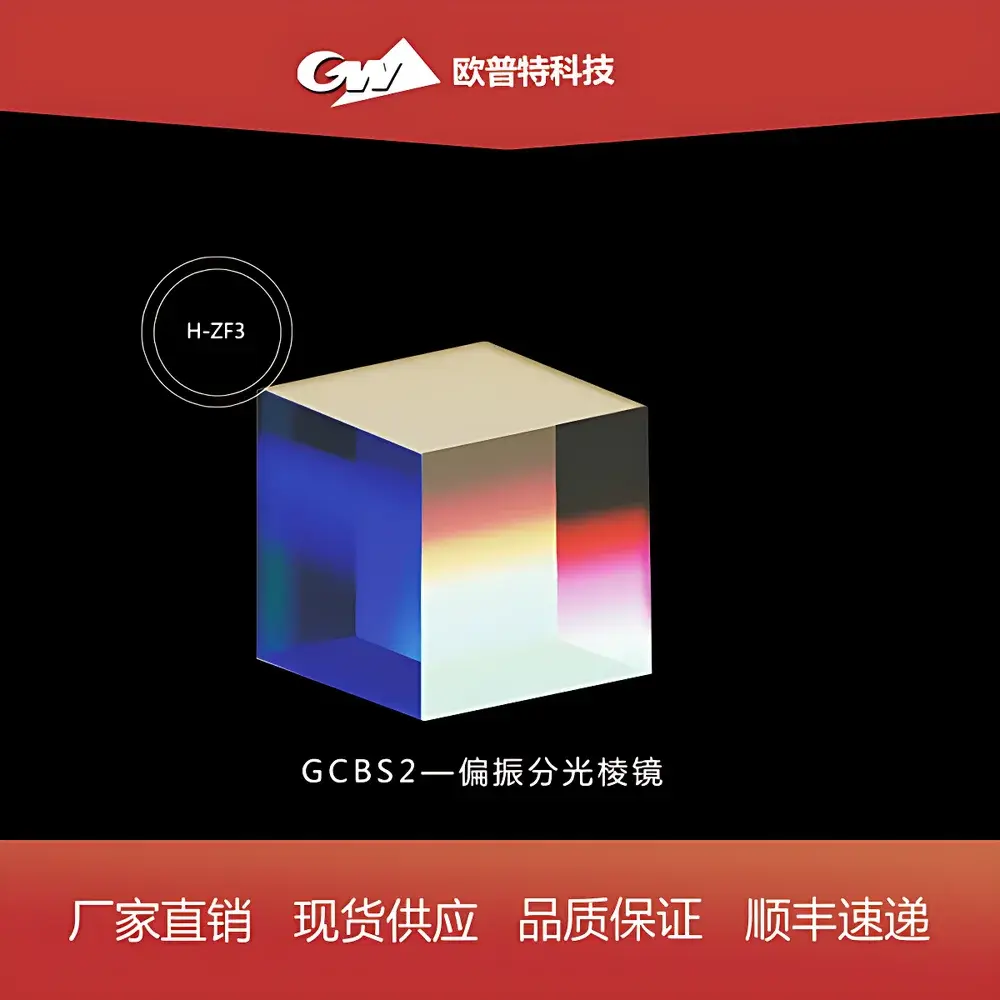
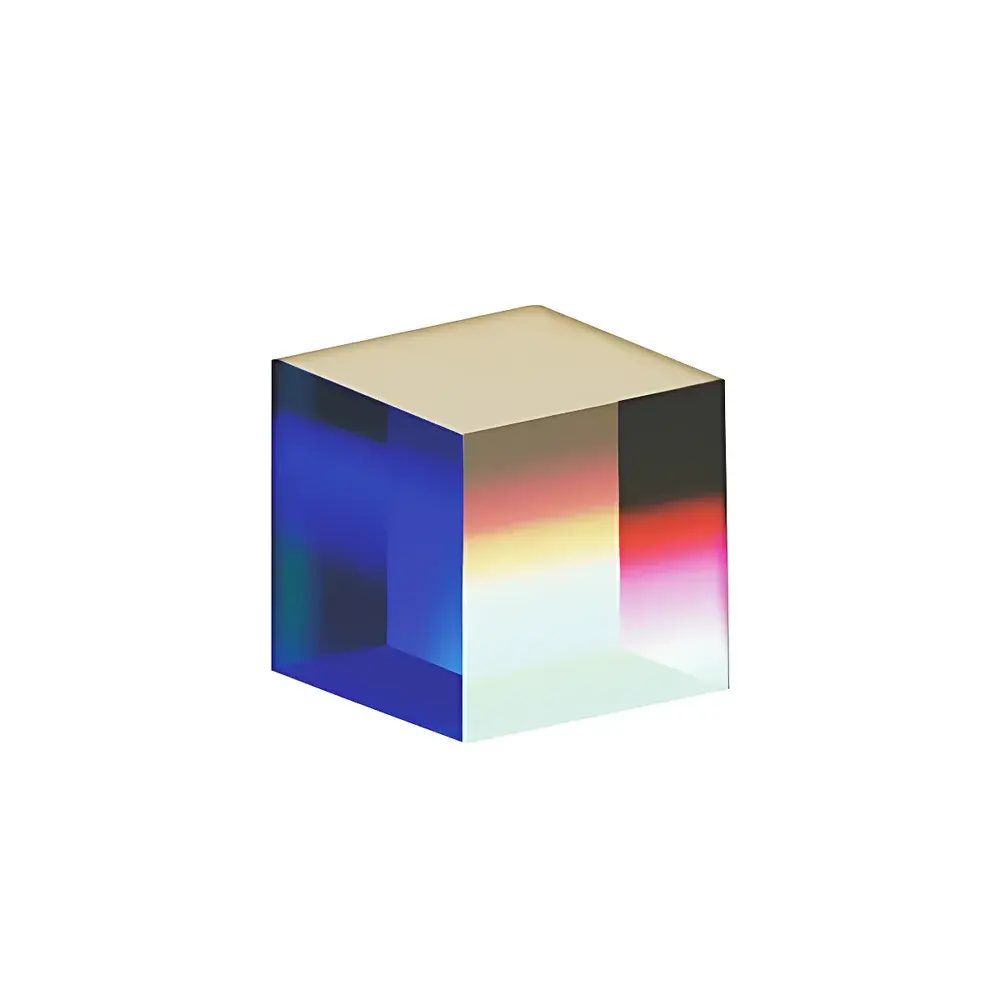
GCBS2 Polarizing Beam Splitter Cube
| Origin | Beijing, China |
|---|---|
| Manufacturer Type | Distributor |
| Origin Category | Domestic |
| Model | GCBS2 |
| Price Range | USD 140–420 (based on volume and configuration) |
| Component Category | Optical Element |
| Material | H-ZF3 Optical Glass |
| Surface Flatness | λ/10 @ 633 nm |
| Surface Quality | 3–4 Scratch-Dig |
| Clear Aperture | ≥90% of face dimension |
| Beam Deviation (Transmitted) | ≤3 arcmin |
| Beam Deviation (Reflected) | ≤3 arcmin |
| Dimensional Tolerance | ±0.2 mm |
| Edge Treatment | Protective Chamfer |
| Coating | Broadband Anti-Reflection (AR) on non-splitting faces |
| Transmission Efficiency (P-polarized) | TP >90% |
| Reflection Efficiency (S-polarized) | RS >99.5% |
| Extinction Ratio (TP/TS) | >1000:1 |
| Operating Angle | 45° ±5° incidence |
Overview
The GCBS2 Polarizing Beam Splitter Cube is a precision optical component engineered for high-fidelity polarization separation in demanding laboratory and industrial optical systems. Constructed from homogenous H-ZF3 borosilicate crown glass—a material selected for its low birefringence, excellent transmission across the visible to near-infrared spectrum (400–900 nm), and superior thermal and mechanical stability—the cube integrates a dielectric polarizing coating deposited on the hypotenuse interface via ion-assisted e-beam evaporation. Unlike plate-type polarizing beam splitters, the cubic architecture ensures equal optical path lengths for both transmitted and reflected beams, eliminating beam walk-off, spatial ghosting, and wavefront distortion due to differential path delay. This intrinsic symmetry makes the GCBS2 particularly suitable for interferometric setups, polarization-sensitive imaging, laser cavity design, and quantum optics experiments where phase coherence and spatial overlap are critical.
Key Features
- Monolithic cube construction with optically contacted or cemented interfaces—no air gaps to induce etalon effects or polarization-dependent phase shifts
- Hypotenuse-coated polarizing thin-film optimized for 45° incidence, delivering >90% transmission for P-polarized light and >99.5% reflection for S-polarized light across 488–650 nm
- Extinction ratio exceeding 1000:1 (TP/TS), enabling robust suppression of unwanted polarization states in metrology-grade applications
- Surface flatness of λ/10 @ 633 nm and surface quality rated 3–4 scratch-dig per MIL-PRF-13830B, ensuring minimal wavefront distortion and scatter
- Broadband anti-reflection coating (R <0.25% per surface) applied to all non-splitting faces, reducing Fresnel losses and back-reflections
- Dimensional tolerance of ±0.2 mm and protective 0.2–0.5 mm chamfer on all edges to prevent chipping during mounting and handling
Sample Compatibility & Compliance
The GCBS2 is compatible with standard kinematic mounts, lens tubes, and cage systems (e.g., Thorlabs 30 mm and 60 mm platforms). Its mechanical and optical specifications conform to ISO 10110-7 (surface imperfections), ISO 10110-3 (surface form), and ISO 9211-4 (coating performance). While not certified to specific regulatory frameworks (e.g., FDA or CE for medical devices), the component meets general requirements for use in ISO/IEC 17025-accredited laboratories conducting optical calibration, laser alignment, and polarization characterization per ASTM E1335 and ISO/IEC 17025 Annex A.2 guidelines. No hazardous substances are used in manufacturing; RoHS-compliant materials and processes are employed throughout production.
Software & Data Management
As a passive optical component, the GCBS2 requires no firmware, drivers, or software integration. However, it is routinely characterized using industry-standard metrology tools—including Zygo Verifire™ interferometers for wavefront analysis, Ocean Insight QE Pro spectrometers for spectral efficiency mapping, and Thorlabs PM100D power meters with calibrated polarizers for extinction ratio validation. Measurement data generated during qualification testing (e.g., transmission/reflection spectra, retardance maps, and angular sensitivity profiles) are archived in accordance with GLP-compliant documentation practices, including traceable calibration certificates and uncertainty budgets compliant with GUM (JCGM 100:2008).
Applications
- Laser cavity output coupling and intracavity polarization control in DPSS and Ti:sapphire systems
- Polarization-resolved microscopy (e.g., DIC, POL, and Mueller matrix imaging)
- Optical coherence tomography (OCT) reference arm beam routing
- Quantum key distribution (QKD) setups requiring deterministic polarization state separation
- Ellipsometry and spectroscopic reflectometry instrumentation
- Alignment and calibration of waveplate-based polarization controllers and modulators
FAQ
What is the maximum permissible incident power density for continuous-wave lasers?
The GCBS2 is rated for ≤5 W/cm² at 532 nm with TEM₀₀ beam profile and proper heat sinking. For pulsed operation (e.g., ns pulses), damage threshold is ≥0.5 J/cm² at 1064 nm, 10 ns, 10 Hz—subject to beam uniformity and coating batch verification.
Can the GCBS2 be used outside the specified 45° ±5° incidence range?
Performance degrades significantly beyond this range: extinction ratio falls below 500:1 at 40° or 50°, and angular sensitivity increases nonlinearly. Custom variants with re-optimized coatings are available upon request.
Is the cube vacuum-compatible?
Yes—when assembled with optical contact bonding (no epoxy), the GCBS2 maintains integrity under high vacuum (<10⁻⁶ Torr) and exhibits negligible outgassing per ASTM E595.
Do you provide spectral transmission/reflection data sheets?
Yes—each production lot includes a certificate of conformance with measured spectral curves (400–900 nm, 1 nm resolution) and angular performance plots, traceable to NIST-traceable reference standards.
Can the GCBS2 be AR-coated for extended NIR wavelengths (e.g., 1064 nm)?
Standard units cover 488–650 nm. NIR-optimized versions (e.g., 780–1064 nm) are available as GCBS2-NIR with modified coating design and corresponding extinction ratio and efficiency specifications.




