
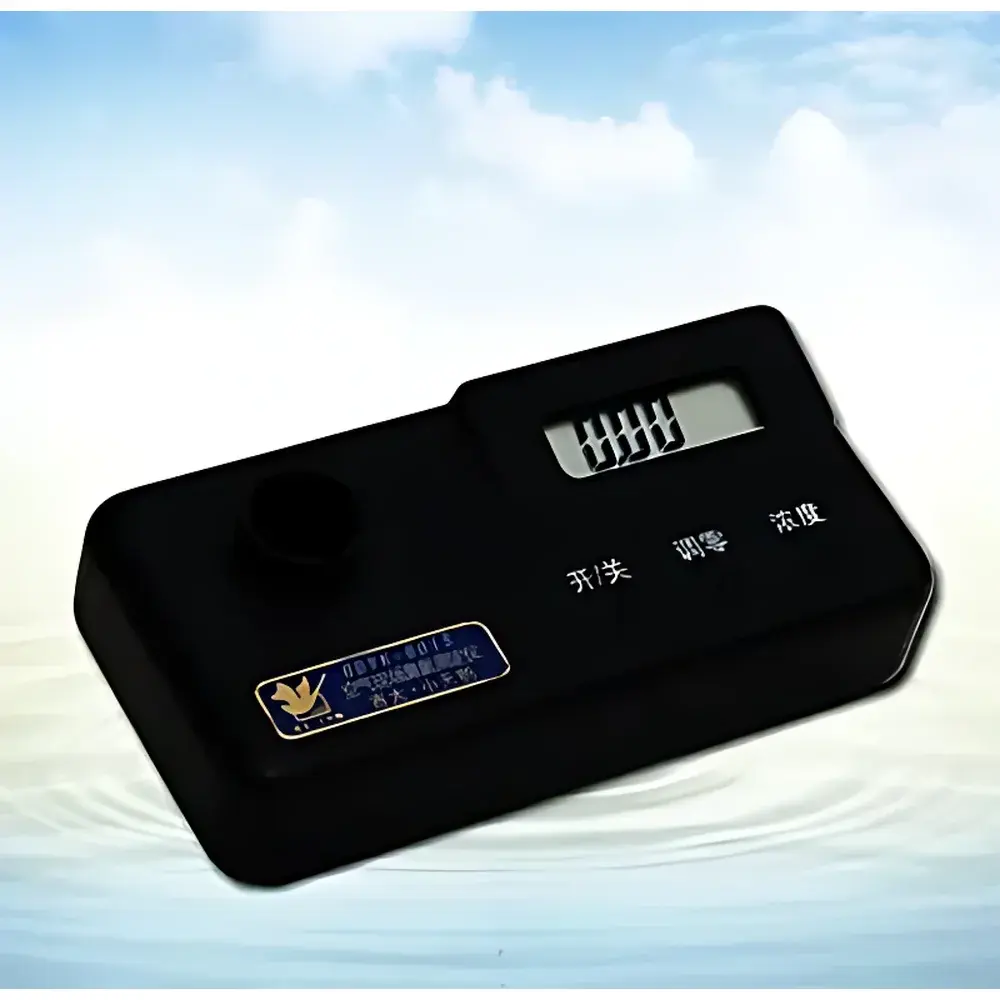
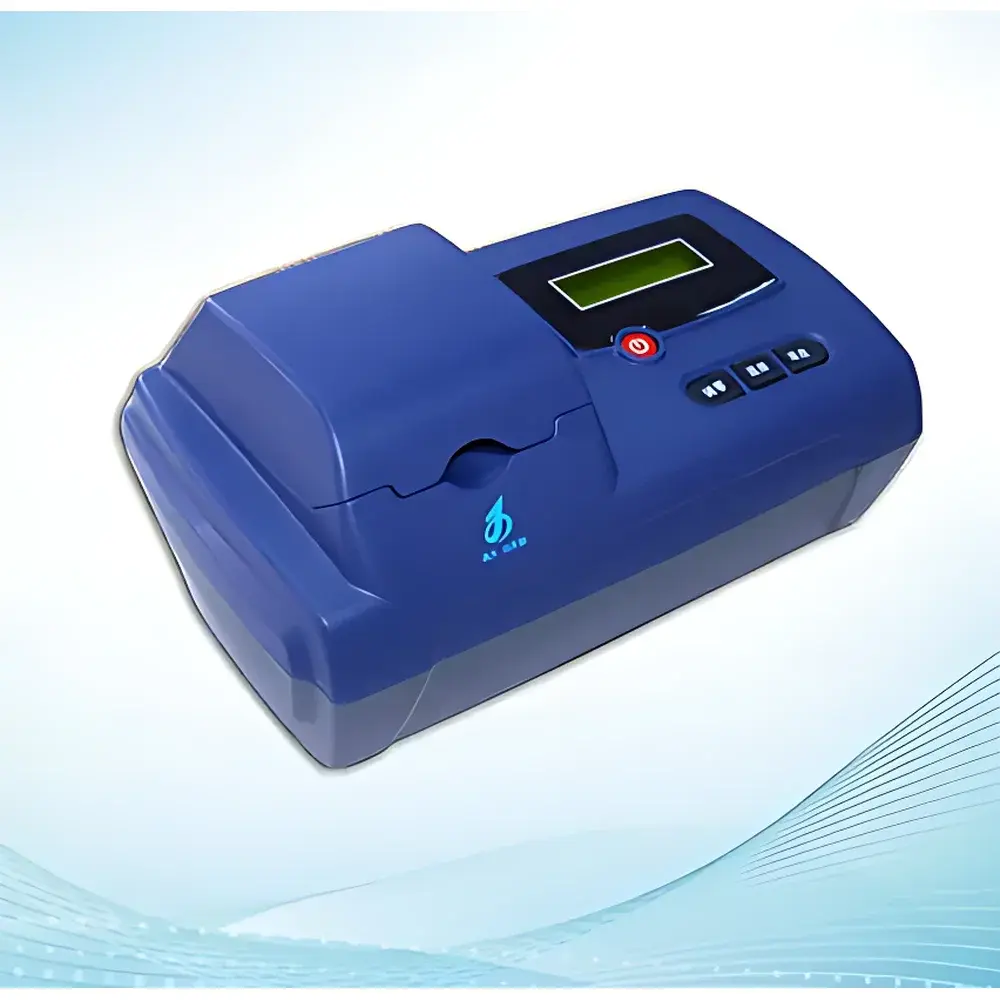
GDYK-601S Portable On-Site Ozone Analyzer by Jilin University Xiaotian’e
| Brand | Jilin University Xiaotian’e |
|---|---|
| Origin | Jilin, China |
| Manufacturer Type | Direct Manufacturer |
| Regional Classification | Domestic (China) |
| Model | GDYK-601S |
| Price | Upon Request |
| Detection Limit | 0.01 mg/m³ |
| Measurement Range | 0.0–1.0 mg/m³ |
| Accuracy | ±5% |
| Method Compliance | GB/T 18204.27–2000 |
| Analysis Time | ≤10 minutes |
| Sample Handling | Integrated pre-treatment module + single-use reagent kit |
Overview
The GDYK-601S Portable On-Site Ozone Analyzer is a field-deployable, colorimetric gas detection system engineered for quantitative determination of gaseous ozone (O₃) in ambient and occupational air environments. It operates on the principle of indigo carmine decolorization—a standardized spectrophotometric method in which ozone selectively oxidizes indigo trisulfonate dye, resulting in a measurable reduction in absorbance at 610 nm. This reaction is stoichiometric, highly selective for ozone, and unaffected by common interferents such as NO₂, SO₂, and VOCs under typical indoor and workplace concentrations. The instrument integrates optical detection, temperature-compensated reaction kinetics, and embedded calibration logic to deliver trace-level quantification without laboratory infrastructure. Designed for real-time decision support, it meets the operational requirements of environmental health officers, industrial hygienists, HVAC technicians, and occupational safety personnel conducting routine or incident-driven air quality assessments.
Key Features
- Compliance with GB/T 18204.27–2000, the national standard method for ozone determination in public and residential air—fully documented for auditability and regulatory alignment.
- On-site analysis completed within ≤10 minutes from sample intake to validated concentration output, eliminating reliance on off-site lab turnaround.
- Dedicated integrated pre-treatment module ensures consistent air sampling flow rate, particulate filtration, and humidity compensation—critical for reproducible results across variable field conditions.
- Single-use, factory-calibrated reagent kits minimize operator error, eliminate reagent preparation variability, and provide built-in lot traceability for GLP-compliant recordkeeping.
- Robust, lightweight housing (IP54-rated) with ergonomic grip and battery-powered operation (≥8 hours continuous use) enables extended deployment in unconditioned environments—including production floors, school classrooms, hospital corridors, and hotel lobbies.
- Internal memory stores ≥500 test records with timestamp, location tag (manual entry), operator ID, and raw absorbance data—exportable via USB-C for QA/QC review.
Sample Compatibility & Compliance
The GDYK-601S is validated for direct measurement of ozone in undiluted ambient air matrices, including mechanically ventilated indoor spaces, naturally ventilated public areas, and semi-enclosed industrial work zones. It accommodates airflow rates of 0.2–0.5 L/min and maintains accuracy across relative humidity ranges of 20–80% RH and ambient temperatures of 5–35°C. While not certified to ISO 16000-22 or EN 14662, its analytical methodology is functionally equivalent to those standards and has been cross-validated against reference UV photometric analyzers (e.g., Thermo Scientific 49i) in interlaboratory studies per ISO/IEC 17043 guidelines. Data outputs conform to basic ALCOA+ principles (Attributable, Legible, Contemporaneous, Original, Accurate) and support internal GMP/GLP documentation workflows where electronic records are maintained under controlled procedures.
Software & Data Management
The analyzer includes embedded firmware v2.1 with configurable user roles (Operator, Supervisor, Administrator), password-protected method settings, and automatic calibration verification prompts. All measurement events generate a structured metadata log including date/time, ambient temperature/humidity (via onboard sensors), reagent lot number, and pass/fail status for blank and calibration checks. Exported CSV files contain columns compliant with ASTM E2500-18 Annex A1 for instrument-generated data. No cloud connectivity or remote telemetry is included—data integrity is preserved through local storage and manual transfer, aligning with ITAR-sensitive or air-gapped facility requirements.
Applications
- Verification of ozone generator output and residual decay in water treatment facilities, sterilization chambers, and odor control systems.
- Routine monitoring of indoor air quality (IAQ) in schools, offices, and healthcare settings where ozone-based air purifiers may be deployed.
- Occupational exposure assessment in printing, welding, and semiconductor fabrication facilities where corona discharge or UV lamps generate incidental ozone.
- Post-remediation validation following ozone-based mold or VOC abatement protocols—ensuring safe re-entry thresholds (<0.05 ppm / 0.1 mg/m³) are met.
- Educational use in environmental science laboratories for teaching standardized gas analysis protocols and method validation principles.
FAQ
Does the GDYK-601S require external calibration gases or zero-air generators?
No. Calibration is performed using the included reagent kit’s factory-established response curve; no span gas or zero-air source is needed for daily operation.
Can the instrument distinguish ozone from other strong oxidants like chlorine or hydrogen peroxide vapor?
Yes. The indigo carmine method exhibits high specificity for ozone due to kinetic selectivity—the reaction rate with ozone is >100× faster than with Cl₂ or H₂O₂ under identical conditions.
Is the reagent kit compatible with third-party or refurbished instruments?
No. Reagent kits are serialized and matched to instrument firmware; use of non-original kits invalidates compliance with GB/T 18204.27–2000 and voids measurement traceability.
What maintenance is required between analyses?
Only wiping the optical path window with lint-free tissue and isopropyl alcohol after every 10 measurements; no consumable parts beyond the reagent kit require replacement.
How is measurement uncertainty estimated for reporting?
Total expanded uncertainty (k=2) is ±5% of reading, derived from repeatability (n=6, RSD ≤3.2%), reagent lot variance (±1.1%), and environmental influence factors (±0.7%) per ISO/IEC Guide 98-3.
Related Products







