
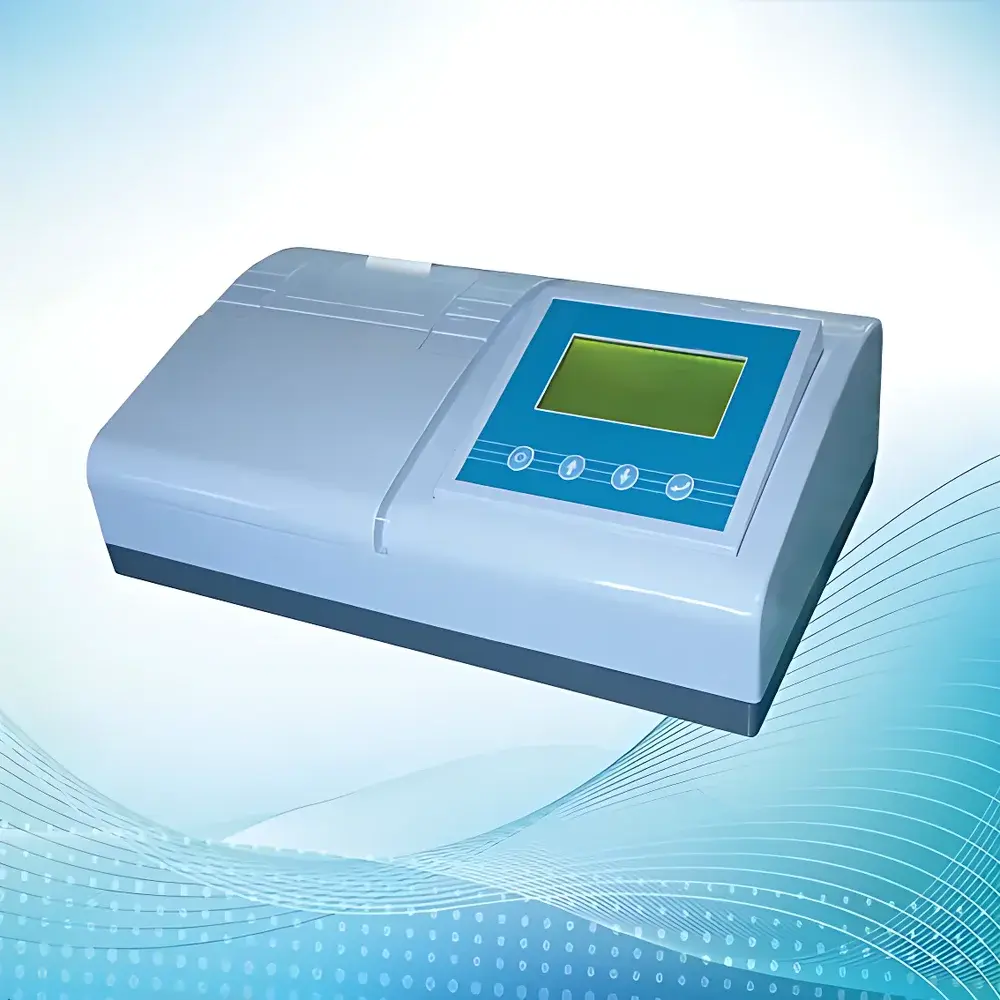
GDYN-106SD Pesticide Residue Rapid Tester by Jilin University–Xiaotian’e
| Brand | Jilin University–Xiaotian’e |
|---|---|
| Origin | Jilin, China |
| Manufacturer Type | Direct Manufacturer |
| Origin Category | Domestic (China) |
| Model | GDYN-106SD |
| Detection Limit | 0.1–3.0 mg/kg |
| Inhibition Rate Range | 0–100% |
| Measurement Accuracy | ±10% |
| Sample Throughput | 6 samples per run |
| Assay Time | ≤13 minutes per batch |
| Compliance Standard | GB/T 5009.199–2003 |
| Display | Backlit LCD with Chinese UI |
| Control System | Embedded MCU with data logging and statistical processing |
| Sample Prep | Integrated dedicated pretreatment kit and single-use reagent cartridges |
Overview
The GDYN-106SD Pesticide Residue Rapid Tester is a benchtop enzymatic inhibition-based analyzer engineered for field-deployable and laboratory-grade screening of organophosphorus (OP) and carbamate pesticides in fresh produce. It operates on the principle of acetylcholinesterase (AChE) inhibition assay: intact AChE hydrolyzes a chromogenic substrate (e.g., indoxyl acetate or acetylthiocholine), generating a measurable colorimetric or spectrophotometric signal; pesticide residues inhibit AChE activity proportionally, resulting in reduced signal intensity. The degree of inhibition—quantified as percentage inhibition—is correlated to residue concentration against reference standards calibrated per GB/T 5009.199–2003. Designed for high-throughput preliminary screening rather than confirmatory quantification, the GDYN-106SD delivers rapid, cost-effective triage for food safety monitoring programs where turnaround time and operational simplicity are critical.
Key Features
- Compliance with national standard GB/T 5009.199–2003 for pesticide residue detection in fruits and vegetables
- Complete assay cycle completed within ≤13 minutes per batch of six independent samples
- Integrated embedded microcontroller unit (MCU) enabling real-time data acquisition, internal storage, and basic statistical analysis (mean, SD, CV)
- Backlit monochrome LCD display with native Chinese interface for intuitive navigation, parameter configuration, and result visualization
- Dedicated sample preparation module including homogenization accessories and pre-calibrated, single-use reagent cartridges to minimize cross-contamination and operator variability
- Onboard communication interface supporting RS-232 or USB connectivity for data export to external PCs or LIMS systems
- Self-diagnostic routines and calibration verification prompts to ensure measurement consistency across operational shifts
Sample Compatibility & Compliance
The GDYN-106SD is validated for qualitative and semi-quantitative analysis of OP and carbamate residues in common horticultural commodities—including leafy greens (e.g., spinach, lettuce), solanaceous fruits (e.g., tomatoes, peppers), cucurbits (e.g., cucumber, zucchini), and pome/stone fruits (e.g., apples, peaches). Sample matrix effects are mitigated via standardized extraction protocols specified in GB/T 5009.199–2003, requiring homogenization in phosphate buffer followed by centrifugation and supernatant dilution. While not intended for regulatory enforcement-level quantification, the instrument meets performance criteria for rapid surveillance under China’s national food safety monitoring framework. It supports Good Laboratory Practice (GLP)-aligned workflows through audit-trail-capable data logging (time-stamped results, operator ID, batch ID), though full 21 CFR Part 11 compliance requires external validation and system configuration.
Software & Data Management
The device firmware includes built-in data management functions: automatic timestamping, sample ID tagging, inhibition rate calculation, and pass/fail classification based on user-defined thresholds (e.g., ≥50% inhibition = positive screening result). Up to 1,000 test records can be stored internally. Exported datasets are formatted as CSV files compatible with Microsoft Excel, LabWare LIMS, or custom QA/QC dashboards. No proprietary software installation is required for basic operation; however, optional PC-based utility software (supplied on USB drive) enables report generation, trend charting, and multi-instrument fleet management. All data entries are immutable post-acquisition—no edit or deletion function is implemented to preserve integrity of raw measurement logs.
Applications
This instrument serves as a frontline tool in decentralized food safety infrastructure: municipal market inspection stations perform daily vendor audits; agricultural cooperatives conduct pre-harvest field testing to guide harvest timing; supermarket QA labs screen incoming deliveries prior to shelf placement; and provincial CDC laboratories deploy units for emergency outbreak investigations involving suspected pesticide intoxication. Its portability (≤4.2 kg), battery-operable mode (optional), and minimal infrastructure requirements (no fume hood, HPLC, or certified analyst) make it suitable for mobile labs, rural extension centers, and border inspection checkpoints. It is not designed for detecting neonicotinoids, pyrethroids, or fungicides—only AChE-inhibiting compounds covered by the referenced national standard.
FAQ
What types of pesticides does the GDYN-106SD detect?
It detects organophosphorus and carbamate pesticides that inhibit acetylcholinesterase activity, per GB/T 5009.199–2003. It does not detect non-AChE-inhibiting compounds such as glyphosate, chlorpyrifos-methyl (without hydrolysis), or synthetic pyrethroids.
Is calibration required before each use?
A blank control and positive inhibition control must be run with each batch to verify enzyme activity and reagent integrity; full recalibration is recommended every 30 days or after reagent lot change.
Can results be exported to a laboratory information management system (LIMS)?
Yes—via USB or serial interface using standard CSV format; no middleware or driver installation is needed.
Does the instrument require trained chemists to operate?
No—operators require only basic training in sample homogenization, pipetting, and interpretation of inhibition rate thresholds; no analytical chemistry certification is mandated.
Is the GDYN-106SD compliant with ISO/IEC 17025 requirements?
As a screening device, it supports elements of ISO/IEC 17025 (e.g., traceable calibration, documented procedures, uncertainty estimation), but formal accreditation requires site-specific validation per CNAS-CL01 guidelines.





