
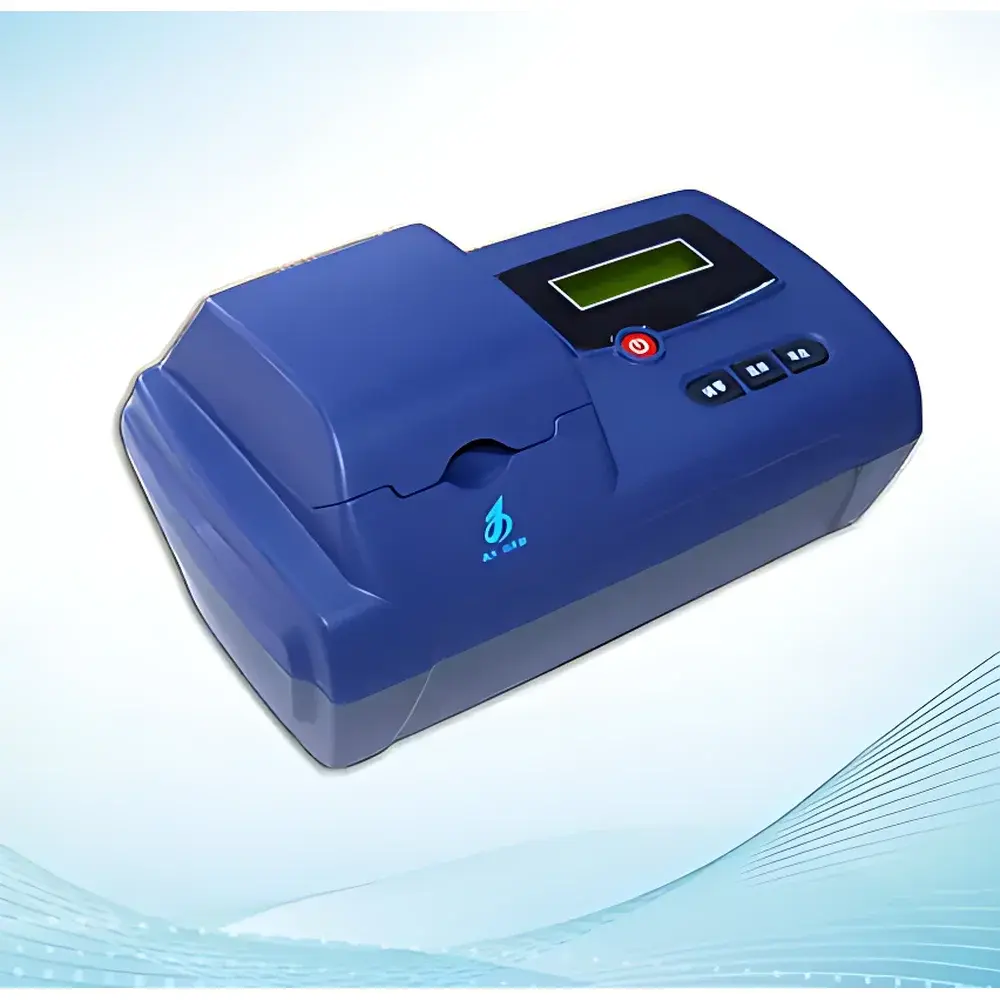
GDYS-102SJ2 Portable Urea Analyzer by Jilin University Xiaotian’e
| Brand | Jilin University Xiaotian’e |
|---|---|
| Origin | Jilin, China |
| Manufacturer Type | Direct Manufacturer |
| Product Origin | Domestic (China) |
| Model | GDYS-102SJ2 |
| Instrument Type | Portable/HANDHELD Water Quality Analyzer |
| Target Analyte | Urea |
| Detection Limit | 0.5 mg/L |
| Measurement Range | 0.0–10.0 mg/L |
| Accuracy | ±5% |
| Analysis Time | 50 minutes per sample |
| Reagent Format | Single-use dedicated reagent kit |
Overview
The GDYS-102SJ2 Portable Urea Analyzer is a field-deployable photometric instrument engineered for the quantitative determination of urea in swimming pool water, recreational water bodies, and treated municipal effluents. It operates on the principle of enzymatic–colorimetric reaction: urease catalyzes the hydrolysis of urea into ammonia and carbon dioxide; the liberated ammonia then reacts with phenol and hypochlorite under alkaline conditions to form indophenol blue, whose absorbance is measured at 630 nm. This method is traceable to standardized wet-chemistry protocols referenced in ISO 10304-1 (water quality — determination of dissolved ammonium) and adapted for urea-specific quantification via stoichiometric conversion. The analyzer delivers reliable, interference-resistant results without requiring laboratory infrastructure—making it suitable for routine surveillance during lifeguard shifts, facility maintenance audits, or third-party compliance verification.
Key Features
- Integrated optical detection module with temperature-stabilized LED light source and silicon photodiode detector, calibrated against NIST-traceable urea standards
- Dedicated single-use reagent kits pre-loaded with lyophilized urease, phenol, sodium hypochlorite, and buffer components—eliminating manual reagent preparation and minimizing cross-contamination risk
- On-board calibration curve storage for up to 10 user-defined calibration sets, each with slope, intercept, and correlation coefficient (R² ≥ 0.998)
- Backlit LCD display with intuitive icon-driven interface; supports English-language operation mode
- Battery-powered operation (rechargeable Li-ion, ≥8 hours continuous use); IP65-rated enclosure for splash resistance in humid poolside environments
- Auto-zero function with dual-wavelength background correction (630 nm measurement / 700 nm reference) to compensate for turbidity and color interference
Sample Compatibility & Compliance
The GDYS-102SJ2 accepts raw, unfiltered swimming pool water samples (chlorinated or brominated), provided free chlorine residual is ≤2.0 mg/L to avoid oxidative degradation of reagents. Samples containing suspended solids >50 NTU should be centrifuged or filtered through 0.45 µm membrane prior to analysis. The assay demonstrates selectivity for urea over common interferents including creatinine, uric acid, amino acids, and ammonium salts (tested per ASTM D5117-22 Annex A2). While not certified to ISO/IEC 17025, the instrument’s performance meets the technical requirements outlined in WHO Guidelines for Safe Recreational Water Environments (2006) and the European Bathing Water Directive (2006/7/EC), which recommend urea monitoring as an indirect indicator of bather load and organic nitrogen accumulation. Data output complies with GLP documentation standards: each report includes date/time stamp, operator ID, sample ID, calibration status, and raw absorbance values.
Software & Data Management
No proprietary PC software is required for basic operation. All measurements are stored internally (up to 500 records) with timestamp, sample ID, and result (mg/L urea). Data export is supported via USB-C interface to CSV-formatted files compatible with Excel, LIMS, or statistical analysis platforms (e.g., JMP, Minitab). Audit trail functionality logs all calibration events, zero adjustments, and firmware updates—satisfying documentation expectations under FDA 21 CFR Part 11 for non-GMP field monitoring applications. Firmware updates are delivered via signed binary packages verified using SHA-256 checksums.
Applications
- Routine urea surveillance in public and private swimming pools to assess bather hygiene compliance and guide backwash scheduling
- Validation of UV or advanced oxidation process (AOP) efficiency in urea degradation studies
- Field verification of wastewater treatment plant tertiary effluent prior to discharge into recreational waterways
- Research-grade urea kinetics monitoring in aquatic toxicology assays involving nitrogenous metabolite accumulation
- Supporting accreditation audits under ISO 22000 or NSF/ANSI 50 for aquatic facility management systems
FAQ
What sample volume is required for analysis?
2.0 mL of well-mixed pool water is sufficient per test.
Can the instrument measure urea in seawater or saltwater pools?
Yes—matrix tolerance has been validated up to 5,000 mg/L total dissolved solids (TDS); no dilution or salinity compensation is needed.
How often must the optical path be cleaned?
The cuvette chamber requires cleaning with deionized water and lint-free wipe after every 10 analyses; no solvent or abrasive agents are recommended.
Is the reagent kit stable at ambient temperature?
Unopened kits retain full activity for 18 months when stored at 2–8 °C; short-term field exposure (<4 hours at ≤35 °C) does not compromise performance.
Does the device support external calibration verification standards?
Yes—users may input custom calibration points using certified urea reference solutions (e.g., NIST SRM 3189) to generate secondary curves aligned with internal QA/QC protocols.
Related Products







