
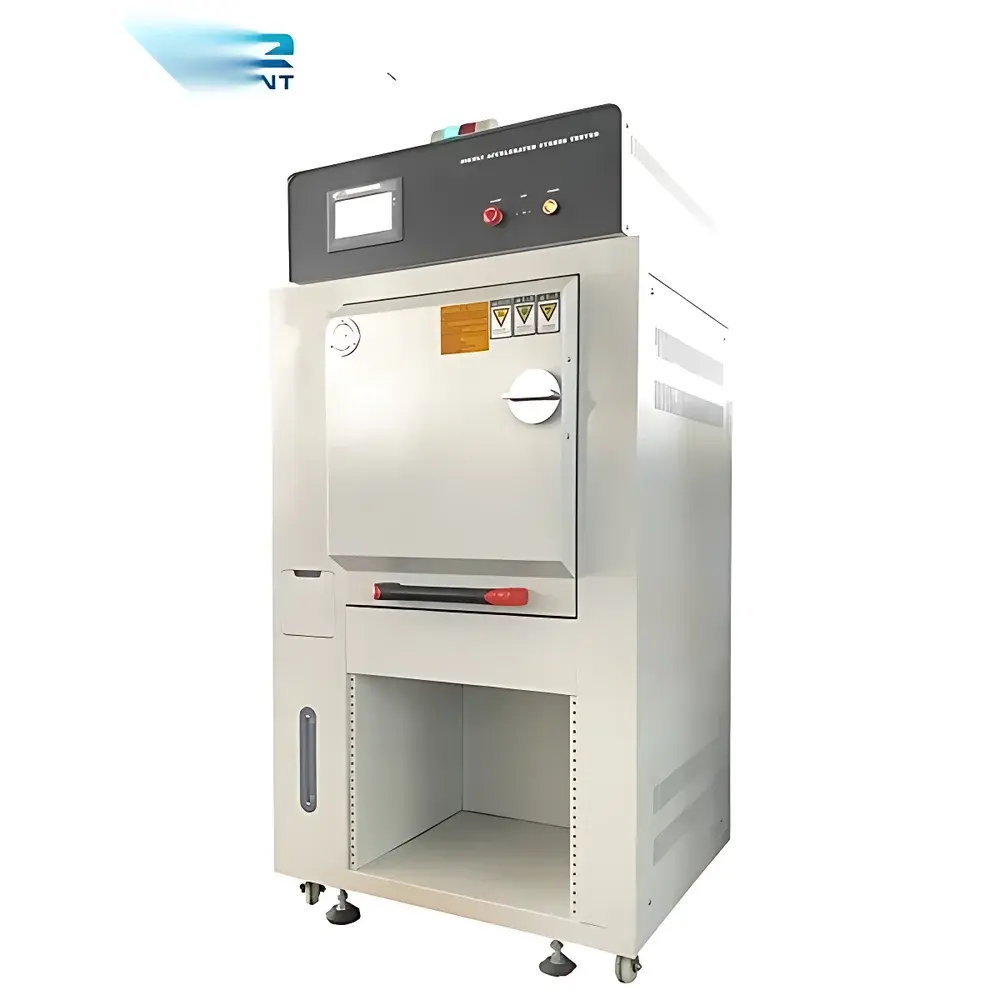
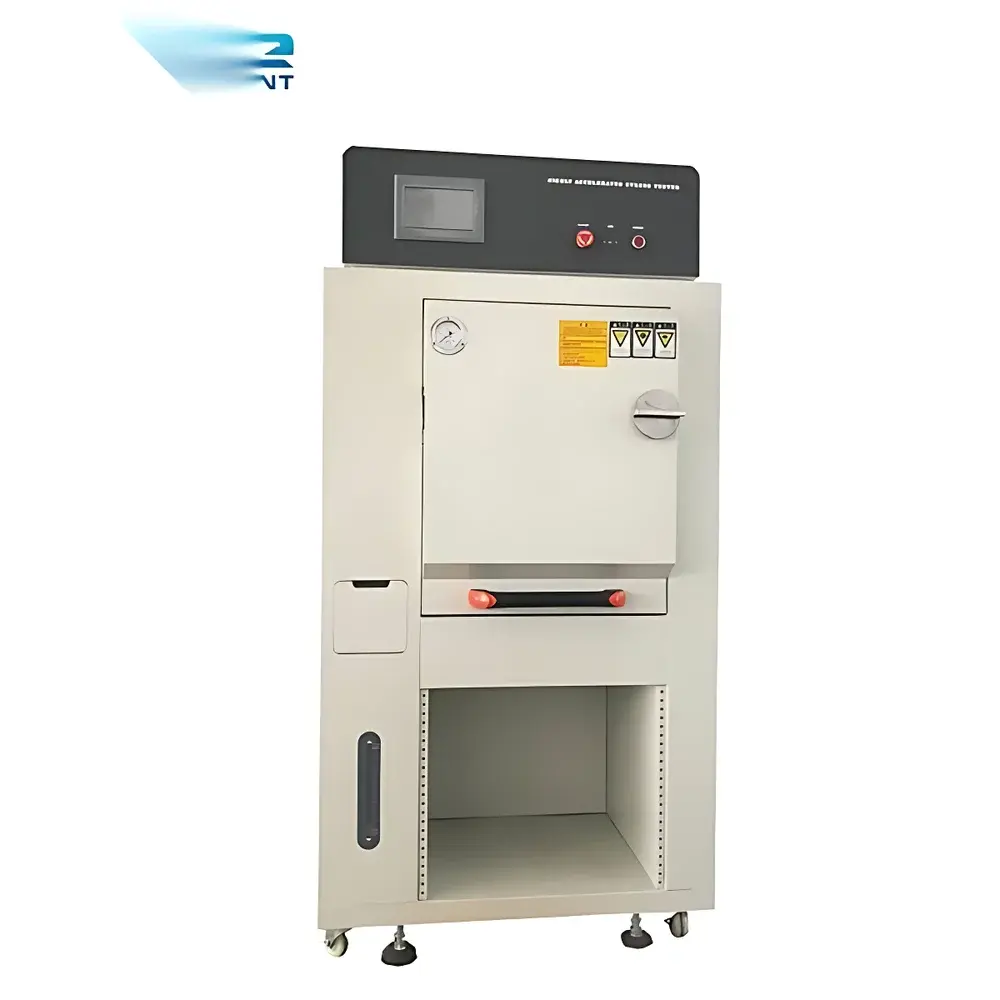
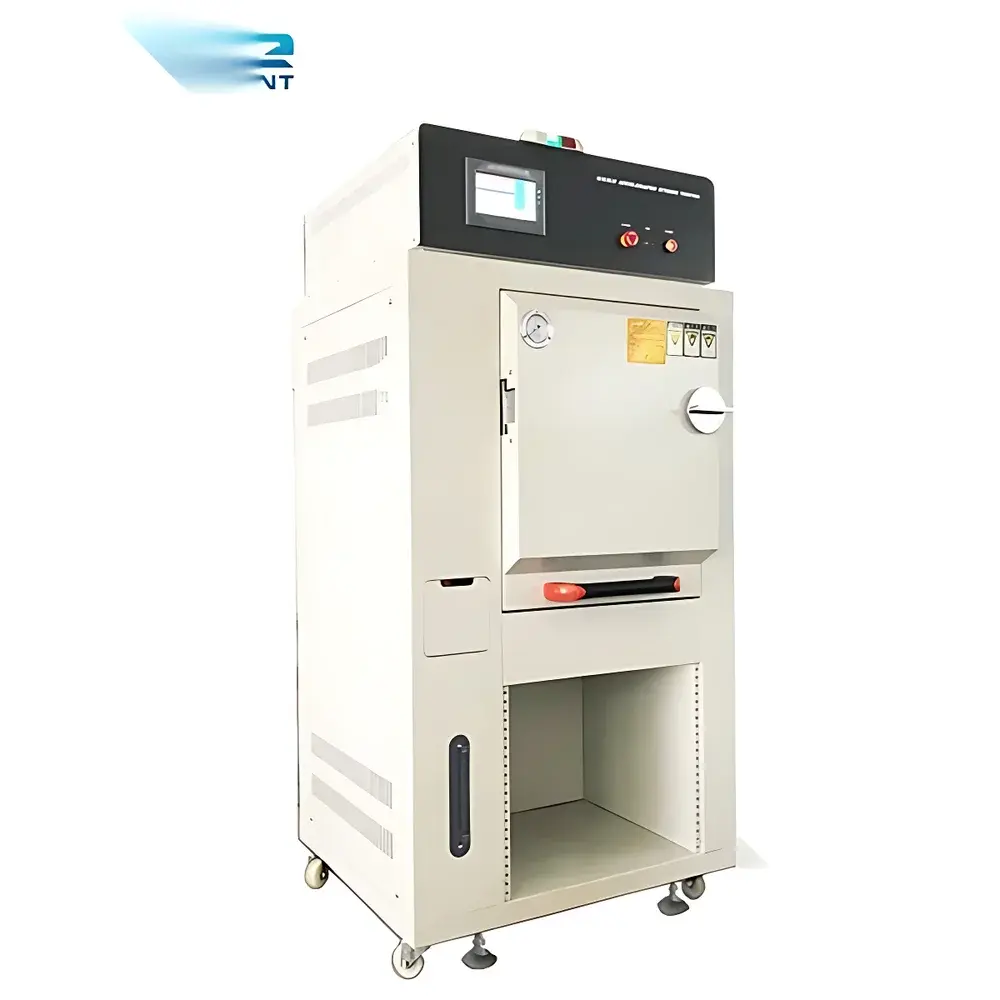
Generic HAST/PCT Accelerated Aging Test Chamber for Humidity, Temperature, and Pressure Stress Testing
| Brand | Other Brands |
|---|---|
| Origin | Imported |
| Manufacturer Type | Authorized Distributor |
| Price | USD 14,000 (FOB) |
| Chamber Dimensions | Ø400 mm × L600 mm (Cylindrical) |
| External Dimensions | 900 × 700 × 1600 mm (W×D×H) |
| Inner Vessel Material | SUS316 Stainless Steel (3 mm thickness) |
| Outer Vessel Material | Stainless Steel or Optional Powder-Coated Steel |
| Insulation | Rock Wool + Rigid Polyurethane Foam |
| Steam Generator | Titanium Heating Element |
| Control System | Delta Color Touchscreen PLC with PT-100 Sensors |
| Humidity & Saturation Control | Microprocessor-Based PID Algorithm |
| Pressure Indication | Analog Bourdon-Tube Pressure Gauge |
| Water Supply | Manual Fill Valve with Auto-Replenishment Capability |
| Compliance | GB/T 10586–1989, GB/T 2423.3–1993 (IEC 60068-2-3), MIL-STD-810D Method 502.2, GJB 150.9–1986, GB/T 2423.34–1986, MIL-STD-883C Method 1004.2 |
Overview
The Generic HAST/PCT Accelerated Aging Test Chamber is an engineered environmental stress test system designed to perform highly accelerated temperature and humidity (HAST) and pressure cooker test (PCT) protocols under saturated steam conditions. It operates on the principle of exposing electronic and microelectromechanical components to elevated temperature (typically 100–130 °C), high relative humidity (>85% RH), and elevated partial pressure of water vapor (up to 3 atm absolute), thereby accelerating moisture diffusion into encapsulated packages and interfaces. Unlike conventional damp heat testing, this chamber enables rapid identification of latent failure mechanisms—including wire bond corrosion, die attach delamination, mold compound blistering, and intermetallic growth—within hours rather than weeks or months. Its cylindrical pressure vessel architecture ensures uniform thermal distribution and structural integrity under sustained positive pressure, making it suitable for qualification-level reliability screening in accordance with JEDEC JESD22-A102 and A110 standards.
Key Features
- Cylindrical inner chamber constructed from 3 mm-thick SUS316 stainless steel, offering superior resistance to chloride-induced stress corrosion cracking during prolonged exposure to saturated steam environments.
- Titanium-sheathed heating elements integrated into the steam generation chamber prevent oxidation and scaling, ensuring long-term stability of thermal output and minimizing maintenance intervals.
- Delta-brand color touchscreen PLC controller with real-time data logging capability; supports programmable ramp/soak profiles, alarm thresholds, and event-triggered data capture.
- Redundant safety architecture including dual overtemperature cutoffs, mechanical pressure relief valve (set at 3.2 bar abs), and automatic shutdown upon door interlock breach.
- High-efficiency insulation combining mineral rock wool and rigid polyurethane foam (≥35 mm total thickness), achieving thermal loss <1.2 K/h at 121 °C under full saturation.
- Auto-replenishment water supply system allows uninterrupted operation over extended test cycles (e.g., 96 h PCT per JEDEC), eliminating manual intervention during qualification runs.
Sample Compatibility & Compliance
This chamber accommodates a broad range of hermetically sealed and surface-mount electronic components, including but not limited to IC packages (QFP, BGA, CSP), PCB assemblies, LCD modules, ferrite magnets, and MEMS sensors. Its internal volume (≈75 L) permits batch testing of up to 200 standard JEDEC trays (300 × 200 mm). The system meets the physical and procedural requirements of multiple international and military standards: GB/T 10586–1989 (Chinese national specification for humid chambers), IEC 60068-2-3 (constant damp heat), MIL-STD-810D Method 502.2 (humidity exposure), GJB 150.9–1986 (Chinese military environmental testing), and MIL-STD-883C Method 1004.2 (combined temperature-humidity-pressure cycling). While not certified to ISO/IEC 17025, its control traceability supports GLP-compliant documentation when paired with external calibration records for PT-100 sensors and pressure transducers.
Software & Data Management
The embedded Delta DOP series HMI provides intuitive navigation through test setup, real-time monitoring, and post-run analysis screens. All operational parameters—including chamber temperature, saturation humidity (calculated from PT-100 readings and steam table interpolation), absolute pressure, and elapsed time—are logged at user-selectable intervals (1 s to 10 min resolution). Export functionality supports CSV format via USB flash drive for integration into statistical process control (SPC) platforms or failure analysis databases. Audit trail features include operator ID entry, parameter change timestamps, and alarm history with cause codes—enabling alignment with FDA 21 CFR Part 11 requirements when deployed in regulated manufacturing environments under documented SOPs.
Applications
Primary use cases include qualification of packaging integrity for automotive-grade ICs, validation of conformal coating performance on flex-rigid PCBs, screening of solder mask adhesion under thermal-hygric stress, and reliability assessment of wafer-level chip-scale packages (WLCSP) prior to burn-in. Secondary applications span magnetic component aging studies (e.g., coercivity drift in NdFeB magnets under steam exposure) and evaluation of adhesive bond durability in optoelectronic assemblies. The chamber’s ability to sustain precise saturation conditions makes it particularly valuable for root-cause analysis of field failures linked to moisture ingress pathways.
FAQ
What is the maximum allowable operating pressure and temperature?
The chamber is rated for continuous operation up to 3.0 bar absolute pressure and 130 °C saturated steam temperature.
Does the system support automated test sequencing across multiple cycles?
Yes—the PLC controller supports up to 99 programmable steps per profile, including transitions between temperature/pressure setpoints and dwell durations.
Is third-party calibration documentation available for metrological traceability?
Calibration certificates for PT-100 sensors and analog pressure gauges can be provided upon request, traceable to NIST or CNAS-accredited laboratories.
Can the chamber be integrated into a central lab monitoring network?
While native Ethernet or Modbus TCP is not included, optional RS-485 communication modules enable integration with SCADA or MES systems using custom protocol mapping.
What maintenance schedule is recommended for titanium heating elements?
No scheduled replacement is required; however, visual inspection every 500 operational hours is advised to verify absence of scale accumulation or mechanical deformation.



