
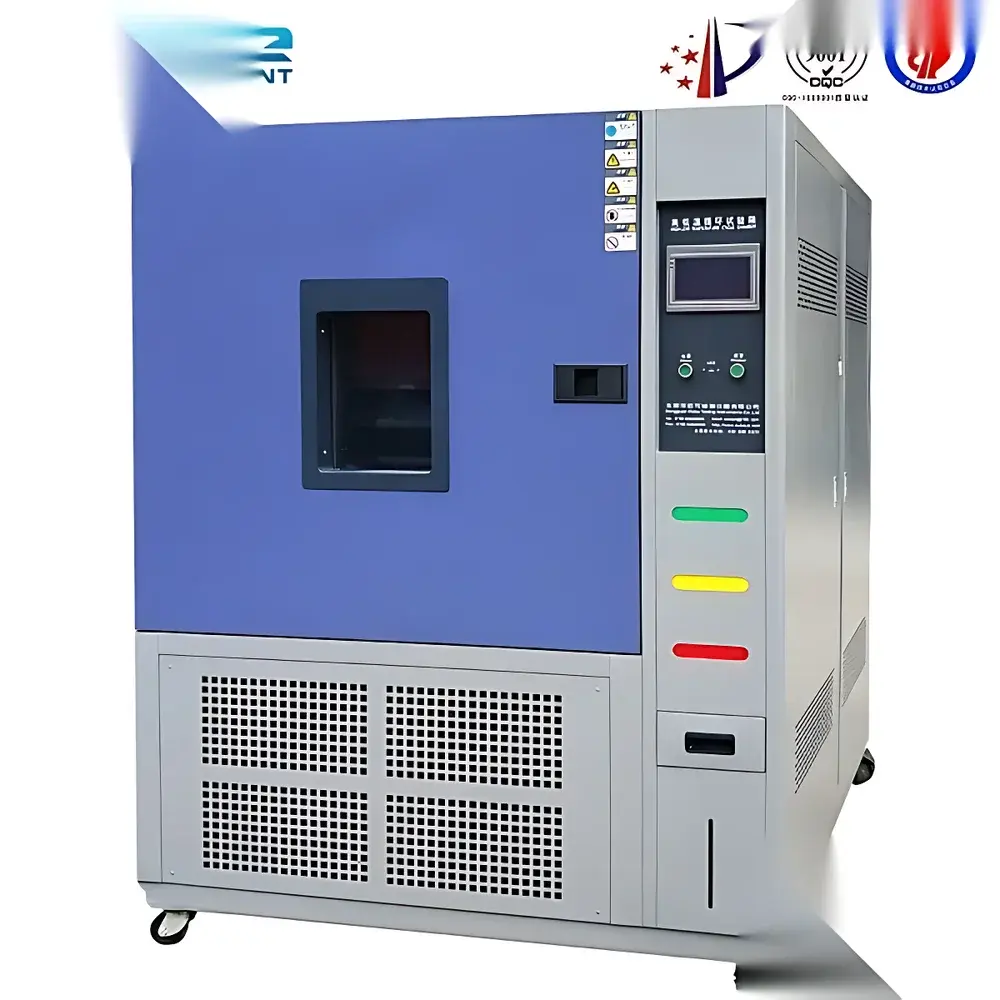
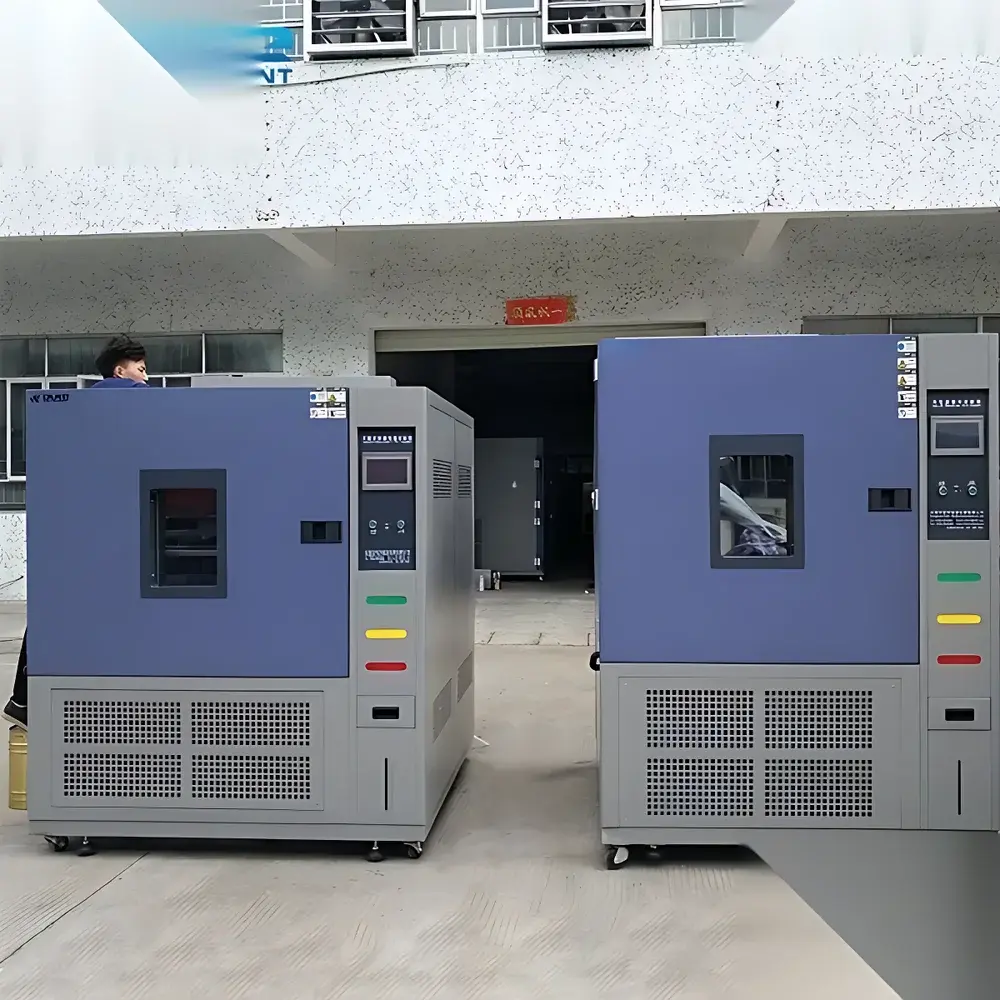
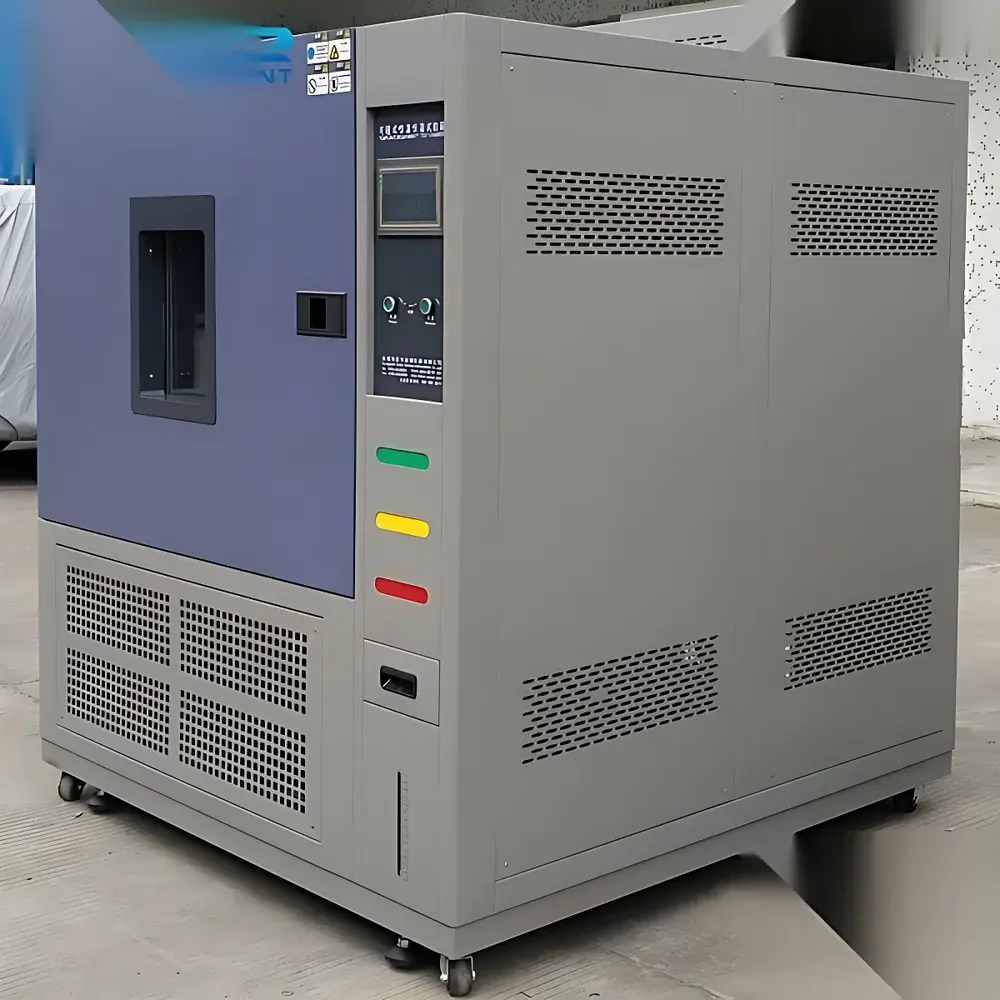
Generic Temperature and Humidity Controlled Environmental Test Chamber
| Brand | Other Brands |
|---|---|
| Origin | Imported |
| Manufacturer Type | Authorized Distributor |
| Price | USD 3,100 (approx. based on ¥22,000 at 1 USD = ¥7.1) |
| Temperature Range | −65 °C to +150 °C |
| Humidity Range | 20–95 % RH |
| Temp. Uniformity | ±2.0 °C |
| Temp. Stability | ±0.5 °C |
| Humidity Uniformity | ±3.0 % RH |
| Humidity Stability | ±1.5 % RH |
| Heating Rate | ≥2.5 °C/min (from +20 °C to +85 °C in ≤60 min, no load) |
| Cooling Rate | ≥1.0 °C/min (from +20 °C to −40 °C in ≤70 min, no load) |
| Refrigeration System | Dual-stage mechanical refrigeration |
| Compressor | Hermetic scroll compressor (e.g., Tecumseh or Embraco) |
| Refrigerant | R404A / R23 blend |
| Humidification | Stainless steel steam generator |
| Insulation | 100 mm high-density fiberglass + polyurethane foam |
| Interior Material | Mirror-finish SUS304 stainless steel |
| Exterior Material | Powder-coated cold-rolled steel or SUS304 brushed stainless steel |
| Control System | TEMI880 color touchscreen PID controller with data logging, curve display, alarm history, and multi-segment programmability |
Overview
The Generic Temperature and Humidity Controlled Environmental Test Chamber is an ISO/IEC 17025-aligned environmental simulation system engineered for precision stability, repeatability, and long-term operational reliability in laboratory and industrial quality assurance settings. It operates on the principle of forced-air convection combined with dual-stage vapor-compression refrigeration and resistive steam humidification—enabling tightly regulated simultaneous control of temperature (−65 °C to +150 °C) and relative humidity (20–95 % RH). Designed for compliance-driven testing environments—including electronics qualification, automotive component validation, and pharmaceutical packaging stability studies—the chamber meets core metrological requirements defined in GB/T 2423 series (equivalent to IEC 60068), ASTM D4332, and MIL-STD-810G Method 507.5. Its thermodynamic architecture ensures minimal thermal lag and low spatial gradient under steady-state and dynamic ramp conditions, supporting both static environmental exposure and complex cycling protocols (e.g., temperature-humidity bias, damp heat, and thermal shock with humidity hold).
Key Features
- Double-wall insulated construction with 100 mm thickness of high-density glass fiber and closed-cell polyurethane foam, achieving thermal resistance (R-value) >2.8 m²·K/W.
- Mirror-finish SUS304 stainless steel interior chamber and powder-coated or brushed stainless steel exterior—resistant to corrosion, cleaning agents, and repeated thermal cycling.
- Multi-layer tempered safety glass observation window with integrated conductive film heating and Philips LED lighting—ensuring fog-free visibility during low-temperature/high-humidity operation.
- Programmable TEMI880 color touchscreen controller featuring 17-level backlight adjustment, real-time setpoint/actual value curve overlay, multi-zone PID tuning, and event-triggered alarm logging.
- Hermetically sealed dual-stage refrigeration system using R404A/R23 refrigerant blend and scroll-type compressors (Tecumseh or Embraco), rated for continuous operation at −65 °C with wind-cooled or optional water-cooled condensation.
- Stainless steel steam humidifier with auto-drain function and overheat protection; nickel-chromium alloy tubular heaters for uniform thermal distribution.
- Integrated vibration-dampening PU casters and anti-vibration floor pads—reducing airborne noise to <62 dB(A) during full-load operation.
- Comprehensive safety suite: over-temperature cut-off, compressor high-pressure shutdown, humidity sensor failure detection, door interlock, and ground-fault circuit interrupter (GFCI) compliant power input (3-phase 380 V, 50 Hz).
Sample Compatibility & Compliance
This chamber accommodates a wide range of test specimens—from PCB assemblies and lithium-ion battery cells to polymer films and medical device packaging—without compromising environmental fidelity. The internal volume (standard configurations: 100–1000 L) supports standard test racks, load-powered monitoring ports (optional), and non-intrusive sensor feedthroughs. All models are designed and verified per GB/T 5170.2–6 (equivalent to IEC 60068-3-5, -3-6), ensuring traceable calibration against national metrology standards. For regulated industries, the TEMI880 controller supports audit-ready data export (CSV/Excel), user-access level management (admin/operator/guest), and optional 21 CFR Part 11-compliant electronic signature modules when deployed with validated software firmware.
Software & Data Management
The TEMI880 controller provides native USB and RS485 interfaces for local data download and remote supervision via Modbus RTU or optional Ethernet gateway. Real-time process variables—including chamber air temperature, relative humidity, compressor discharge pressure, and heater duty cycle—are logged at user-defined intervals (1 s to 60 min) with timestamping and checksum verification. Historical trends can be exported for statistical analysis (e.g., Cpk calculation per ISO 22514), while alarm logs retain timestamps, severity codes, and operator acknowledgments for GLP/GMP documentation. Optional PC-based software (e.g., TEMI-Link Pro) enables centralized fleet monitoring, automated report generation (PDF/HTML), and integration with LIMS or MES platforms via OPC UA.
Applications
- Accelerated aging of elastomers and adhesives per ASTM D573 and ISO 188.
- Environmental stress screening (ESS) of avionics and defense-grade electronics per MIL-STD-810G Method 507.5.
- Stability testing of pharmaceutical primary packaging per ICH Q1A(R2) and USP .
- Validation of automotive interior materials under cyclic hot/humid conditions (SAE J2412).
- Reliability assessment of photovoltaic modules per IEC 61215-2 MQT 10.1 (damp heat test).
- Calibration reference environment for hygrometers and thermistors per ISO/IEC 17025 Clause 6.4.3.
FAQ
What is the standard calibration interval recommended for this chamber?
Per ISO/IEC 17025 and manufacturer guidelines, initial calibration is performed pre-shipment; subsequent verification is recommended every 6 months under routine use or after any major maintenance event. NIST-traceable certificates are available upon request.
Can the chamber operate continuously at −65 °C and 95 % RH?
No. The specified humidity range (20–95 % RH) applies only within the temperature band of +10 °C to +85 °C. At sub-zero temperatures, condensation physics limits practical RH control; operation below 0 °C is dry-cold only unless equipped with specialized low-temperature humidification (not standard).
Is the TEMI880 controller compliant with FDA 21 CFR Part 11?
Out-of-the-box, it supports audit trails and password-protected access levels. Full Part 11 compliance requires optional validation package (including IQ/OQ documentation, electronic signature module, and change control log)—available through certified service partners.
What electrical infrastructure is required for installation?
A dedicated 3-phase, 5-wire 380 V ±10 %, 50 Hz supply with protective earth grounding (TN-S or TT system) and circuit breaker rated ≥32 A is mandatory. Voltage imbalance across phases must not exceed 2 %. Water-cooled variants require deionized water supply at 2–3 bar pressure.
Does the chamber support custom test profiles with conditional branching?
Yes. The TEMI880 supports up to 120 segments per program, including ramp/soak steps, loop nesting, and event-triggered actions (e.g., “hold until humidity reaches 85 % RH” or “initiate cooling upon external signal”).



